

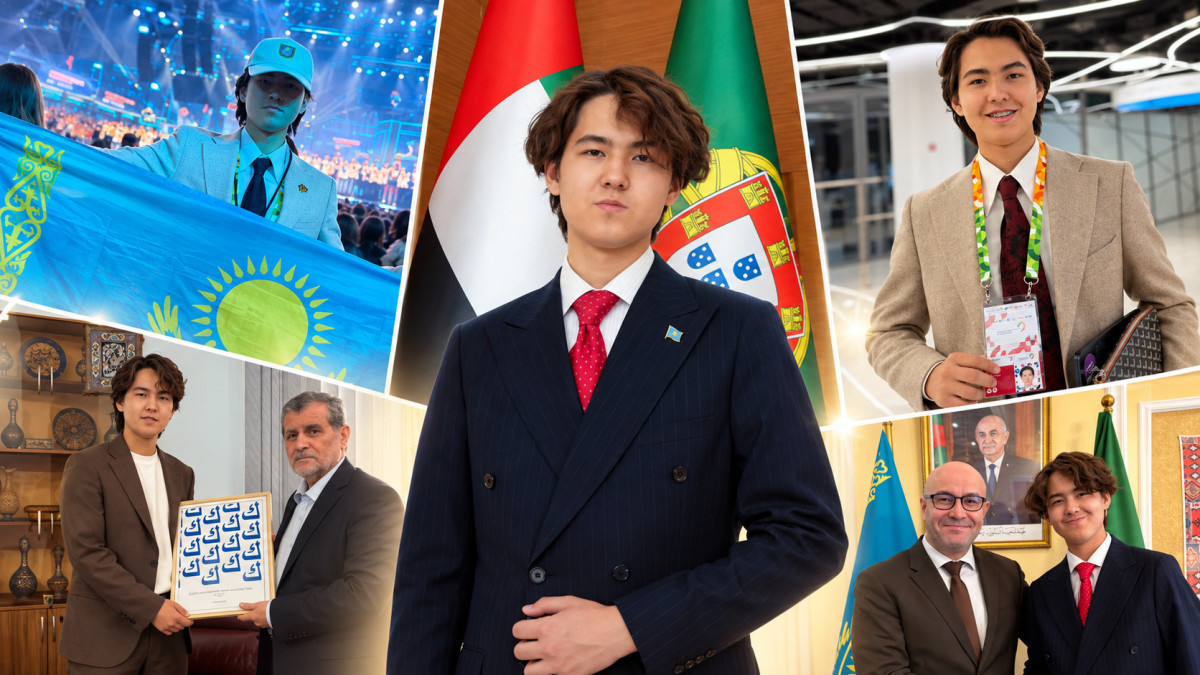
Bakhtiyar Akylbay speaks several foreign languages, participates in international programmes and is gaining experience in the diplomatic environment. The young polyglot spoke about how he was given this opportunity, how he learned languages and why he wants to pursue a career in diplomacy.
At a diplomatic reception marking the National Day of the Islamic Republic of Iran, he provided interpretation for the Ambassador of Oman.
“The school invited me to a diplomatic meeting attended by the Ambassador of Oman, and I was entrusted with interpretation because I speak Arabic. Before that, I had mainly studied Arabic in the classroom, but that day I was able to use it in a real diplomatic setting,” Bakhtiyar Akylbay says.
The event was held to mark the National Day of the Islamic Republic of Iran and the 47th anniversary of the Islamic Revolution. Bakhtiyar was tasked with interpreting from Arabic into Russian and from Russian into Arabic. According to him, the main challenge was to convey the participants’ remarks accurately and clearly to both sides.
“When the interpretation was over, I was praised and told that I am good at Arabic. I had studied the language for several years, used it in a professional diplomatic environment and received positive feedback from people who speak it. That greatly encouraged me,” he says.
Bakhtiyar’s age also attracted the attention of the reception’s guests. However, he does not consider age to be the main measure of success.
“For me, the most important thing was to approach the task entrusted to me responsibly. My age was irrelevant in that regard,” he says.
How He Learned Several Languages
Bakhtiyar says that, in addition to his native language, he is fluent in Russian, Arabic and English. He speaks Turkish at B2 level, Persian, German and Chinese at A2 level, and Indonesian at A1 level. According to the young polyglot, to use a new language fluently, it needs to become part of everyday life.
“I tried not only to memorise words, but also to use them in sentences, listen extensively and speak the language whenever possible. What helped me most was working with the language every day — even if only a little, but consistently,” says the polyglot.
His daily routine includes reviewing new vocabulary, reading texts, listening exercises and speaking practice. When learning Arabic, he paid particular attention to listening comprehension and speaking skills.
International Opportunities
Bakhtiyar says he did not wait for opportunities to participate in international programmes to come his way. He found his first programmes online and regularly followed projects organised by international organisations, as well as grant opportunities and internships.
“I did not rely on a single source of information. I used social media, official websites and various platforms. When looking for international opportunities, the most important thing is to take the initiative and actively search rather than simple wait,” he says.
In his applications, he sought to demonstrate his language proficiency, experience in international projects and civic engagement.
This year, Bakhtiyar was part of the Kazakhstan delegation participating in an international youth environmental programme in Uzbekistan. According to him, Kazakhstan was represented by 10 participants, while delegations from nine countries took part in the programme overall. The programme was supported by the Ministry of Culture and Information of the Republic of Kazakhstan.
He also participated in an international youth project in Russia as a representative of the Earth Ambassadors programme. According to Bakhtiyar, fewer than 5 % of applicants were selected for the programme.
“For me, such projects mean more than simply travelling abroad. The most important things are representing Kazakhstan, exchanging experience with young people from other countries and working responsibly in an international environment as a representative of my country,” says Bakhtiyar.
“There Were Also Projects That Did Not Work Out”
Social media tends to highlight people’s achievements, but Bakhtiyar does not hide the fact that not all of his endeavours were successful. According to him, he has had projects that did not materialise, as well as ventures that failed to generate the expected income and instead resulted in losses.
“I do not view this simply as failure. After each project, I tried to analyse where I had made a mistake and what I had overlooked in planning or allocating funds. I realised that a good idea alone is not enough. It is important to plan it properly, study the market, assess the risks and manage resources effectively,” he says.
At one point, Bakhtiyar launched an online language school to share his knowledge and experience with others. He found his first students through his social media posts, and the audience later grew through referrals. He is currently focused on his studies, international and diplomatic projects. At the same time, language teaching remains one of his important areas of activity.
“Sharing knowledge with other people rather than keeping it to myself is of great value to me,” he says.
Goal: A Career in Diplomacy
Bakhtiyar sees his future in diplomacy. He is particularly interested in Kazakhstan’s relations with other states, international negotiations and protecting the interests of Kazakhstani citizens abroad. He is currently studying Oriental Studies at Al-Farabi Kazakh National University, where he is learning Arabic. In addition, he continues to improve his Arabic and English, participates in international events and Model United Nations (MUN) conferences.
“To become a diplomat, knowing languages is not enough. You need a strong understanding of history, international relations, economics and your country’s foreign policy. That is why I am currently working to develop myself gradually in all these areas,” says Bakhtiyar.
His family has also played an important role in shaping his path. Bakhtiyar says that from an early age his parents instilled in him a commitment to learning, hard work and responsibility.
“I looked for international programmes myself, just as I found my own ways of learning languages. But the discipline, diligence and determination that I developed along the way are rooted in the upbringing I received from my family,” he says.
Three Steps He Recommends to Young People
Drawing on his own experience, Bakhtiyar advises young people who want to learn languages and participate in international programmes to focus on three key areas.
First, set a clear goal. A person should have a clear understanding of which language they are learning and why they need it.
Second, seek opportunities rather than waiting for them. This means regularly monitoring official websites, international organisation platforms and social media announcements for grants, internships and youth programmes.
Third, do not stop after the first setbacks.
“You may not be selected in your first application, but that is no reason to stop. I have also had projects that did not materialise and selection processes that I did not pass. Every attempt provides experience for the next opportunity. So set a goal, seek opportunities and take action. Sometimes the most important opportunity comes after you take the first step yourself,” says Bakhtiyar Akylbay.
