

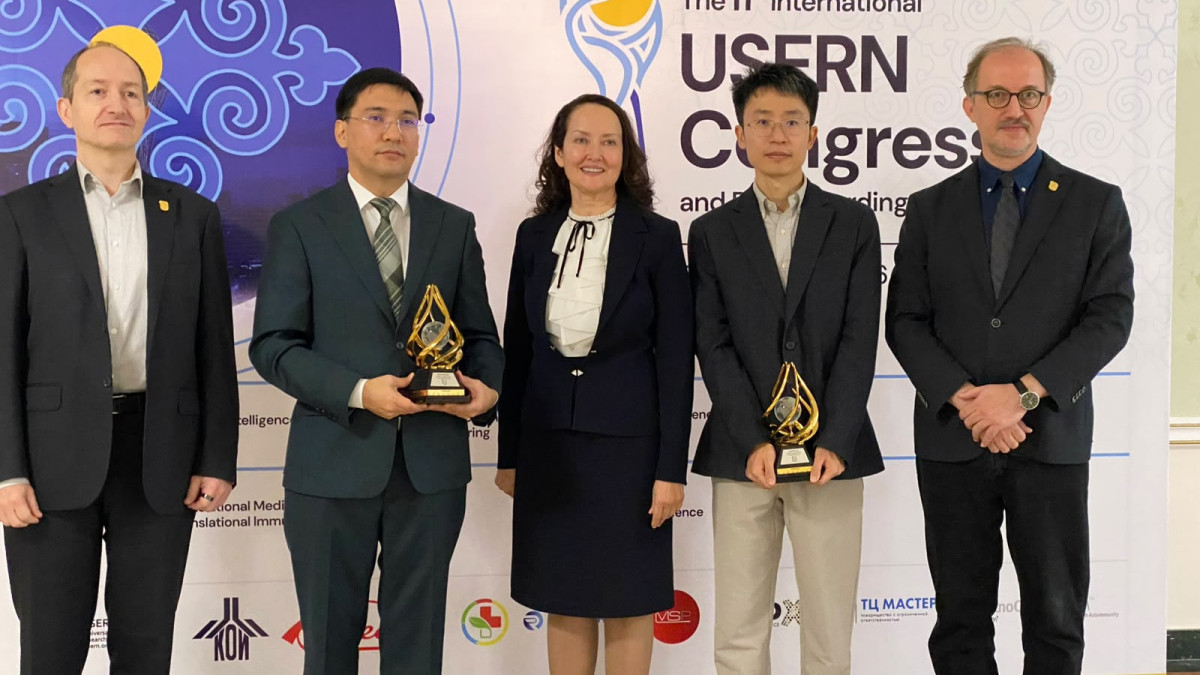
Geneticist Maksat Zhabagin has been named the recipient of the USERN Prize 2026 in the field of Biological Sciences, El.kz reports.
According to the organisers, Maksat Zhabagin is the first Kazakhstani scientist to receive this prestigious award.
He was one of five finalists in the Biological Sciences category. The other finalists were Luigi Rosati (Italy), Suihong Liu and Siyuan Ding (United States), and Roodabeh Bahramsoltani (Iran). The winner was selected by an international committee of scientists.
Selection Process
Approximately 1,000 researchers from around the world were nominated for the award. Following the initial screening conducted by the selection committee, 521 applications proceeded to the next stage.
The Advisory Board subsequently approved a shortlist of 96 nominees. The finalists were selected across the fields of Formal Sciences, Physical and Chemical Sciences, Biological Sciences, Medical Sciences, and Social Sciences.
About the Organisation Behind the Award
USERN, or the Universal Scientific Education and Research Network, brings together scientists from different countries. Its Advisory Board comprises more than 600 researchers, including Nobel Prize and Abel Prize laureates.
The award has been presented since 2016 in recognition of outstanding contributions to science and work in the service of humanity. The award ceremony is traditionally held around 10 November, which is observed as World Science Day for Peace and Development.
The congress lasted three days and was held under the theme “Youth Earn Vision”. Since its inception, the forum has been hosted in Tehran, Kharkiv, Reggio Calabria, Budapest, Istanbul, Muscat, Yerevan, Plovdiv, and São Paulo.
The Laureate’s Research
Maksat Zhabagin, PhD, Professor and Head of the Human Genetics Laboratory at the National Center for Biotechnology, focuses his research on the population history of Kazakhstan and Central Asia. His work involves analysing paternal lineages, transmitted from father to son, as well as ancient DNA.
Maksat Zhabagin compares the genetic data obtained with shezhire — traditional genealogical records maintained by Kazakh clans and passed down from generation to generation. This interdisciplinary approach brings together genetics, archaeology, and history, providing additional validation of findings concerning population migrations and genetic relationships between populations. He has also conducted research into the genomes of Central Asian populations.
“By studying ancient DNA, we reconstruct the history of our ancestors, while the analysis of modern genomes enables us to uncover the genetic diversity of populations and establish a foundation for future advances in personalised genomic medicine,” said Maksat Zhabagin.
