

Automotive giant BMW has started transforming its oldest production facility into a high-tech hub that will manufacture only fully electric vehicles by the end of the year, El.kz reports citing Interesting Engineering.
The 104-year-old assembly plant in Munich, in Bavaria, Germany, which is also the company’s oldest in the world, will become the first existing BMW site to produce exclusively all-electric vehicles by 2027.
The facility is currently undergoing a massive USD 750 million (EUR 650 million) overhaul to support the production and rollout of the BMW i3 all-electric sedan, the second model in the Neue Klasse range, from August 2026.
Munich plant goes electric
The upgrade will convert the site from an internal combustion engine production facility to an all-electric one. “We have paved the way for the upcoming start-ups in all our plants and have invested heavily in technologies, digitalization and AI,” Nedeljković continued.
BMW stated it has reengineered its entire production system under its iFACTORY strategy. Peter Weber, head of BMW Group Plant Munich, revealed that the firm has considerably cut production costs in recent years.
The iFACTORY focuses on efficiency, sustainability and digitalization. In the press shop, steel and aluminum are turned into tens of thousands of components every day using highly automated press lines.
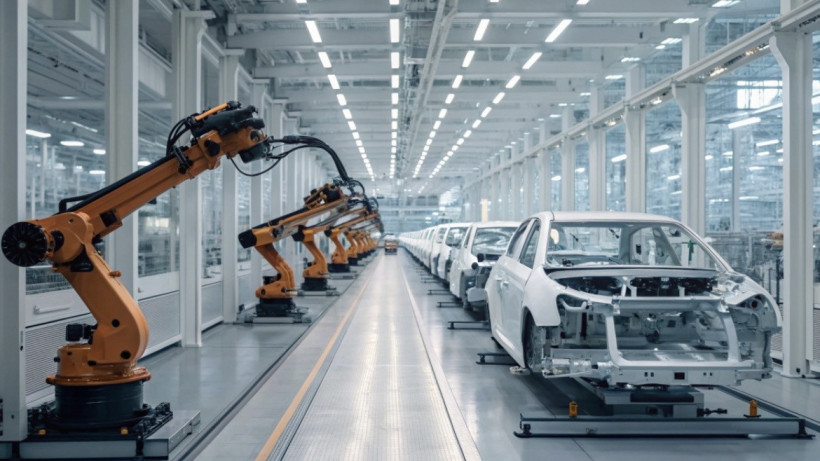
The new body shop for the Neue Klasse uses 800 industrial robots and runs at an automation rate of around 98 percent. In the paint shop, AI-based systems and cameras inspect surfaces and detect even the smallest production defects.
During assembly, each BMW i3 digitally transmits real-time data on up to 20,000 features to the production system. At the same time, the logistics department at the site can move around 2.5 million parts a day. In the future, about 70 percent will be delivered directly to assembly workstations.
Smarter production systems
As per BMW, the plant’s transformation will greatly increase automation levels in logistics. In the future, robots and driverless transport systems are set to handle around 60 percent of the supply tasks.
Meanwhile, despite the massive upgrade, the plant has continued producing up to 1,000 vehicles per day during construction, thus highlighting the complexity of the transition.
The automaker expects the changes to deliver significant efficiency gains. “With the start of production of the BMW i3, we will reduce overall production costs at the Munich plant by a further 10 per cent, bringing them below the level of the current vehicle generation,” Weber said in a press release.
Furthermore, the Neue Klasse architecture itself also contributes to these savings, as it is designed specifically to streamline EV production. The transition extends beyond Munich, as high-voltage batteries for the new vehicles will be supplied from a nearby Bavarian facility in Irlbach-Straßkirchen.
Electric drive units are produced at BMW’s plant in Steyr, Austria. “With seamless inline quality controls, digital twins and the systematic use of artificial intelligence, the BMW Group is setting new standards in battery production,” BMW concluded.
