

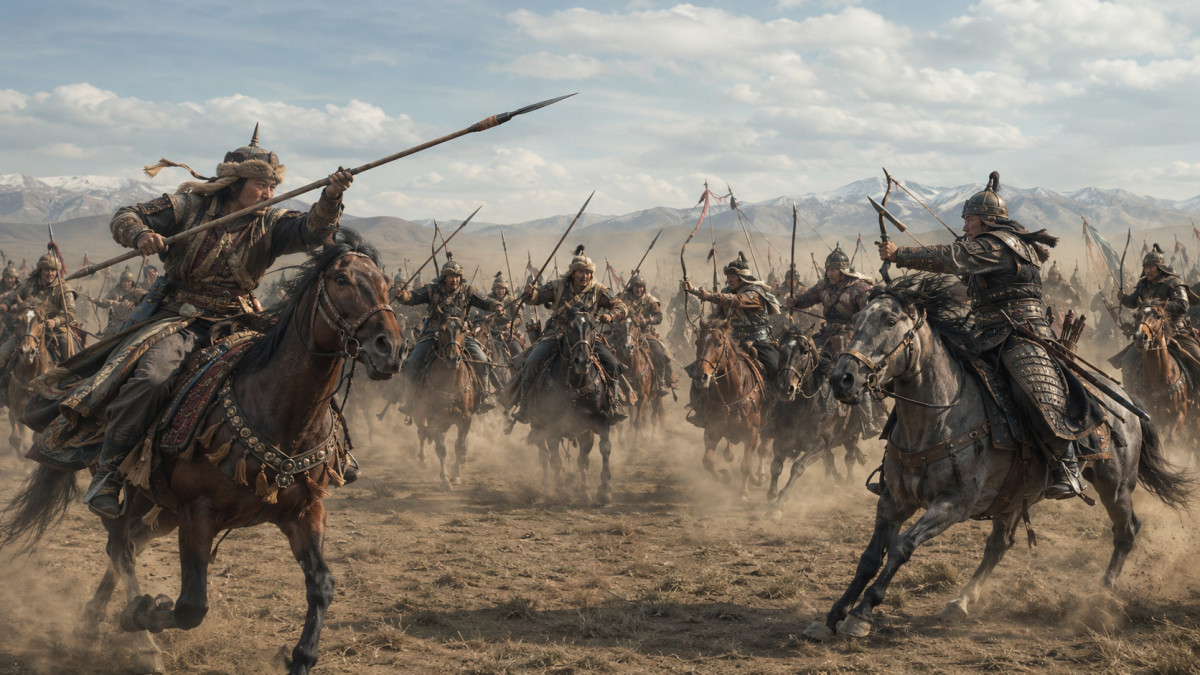
In the mid-18th century, the Dzungar Khanate remained one of the principal military powers in Central Asia. Within only a few years, however, the state disappeared from the political map, while a substantial share of its population died, El.kz reports.
The Last Nomadic Empire
The Dzungar Khanate emerged in the 17th century as a political union of the western Mongol tribes, collectively known as the Oirats. Its territory encompassed the Dzungarian Basin, present-day northern Xinjiang, parts of Eastern Kazakhstan, and areas surrounding the Altai Mountains.
The name “Dzungar” derives from the Mongolian expression züün gar, meaning “left hand” or “left wing.” Although the inhabitants of the khanate were commonly referred to as Dzungars, ethnically they belonged to the broader Oirat community.
The Dzungar Khanate maintained a standing army and developed agriculture, handicrafts, and mining. It produced firearms and gunpowder, while the authority of its rulers extended well beyond that of a traditional nomadic confederation. For this reason, historians frequently describe it as the last major nomadic empire of Eurasia.
Why the Dzungars fought the Kazakhs
The Kazakh Khanate and the Dzungar Khanate competed for control over pastures, trade routes, and the lands of Zhetysu. Their confrontation lasted for decades, periodically escalating from border clashes into large-scale military campaigns.
The most devastating episode began with the Dzungar invasion of 1723. The offensive triggered mass displacement, widespread destruction of nomadic settlements, and famine. In Kazakhstan’s historical memory, this period is remembered as Aktaban Shubyryndy, Alkakol Sulama (“The Great Disaster”).
Kazakh militias gradually regained the strategic initiative. Victories at the Battles of Bulanty and Anyrakai enabled them to recover part of the lost territories. Nevertheless, military confrontations with the Dzungars continued for many years thereafter. The khanate remained a regional power as long as its centralized authority endured.
Internal power struggles weakened the khanate
A turning point came after the death of Galdan Tseren in 1745. During his reign, the Dzungar Khanate maintained effective governance, a strong military, and considerable influence across Central Asia. Following his death, rival heirs and members of the ruling elite entered into a prolonged struggle for power.
Successive rulers replaced one another, regional factions launched rebellions, and some aligned themselves with neighbouring states. Lama Dorji seized the throne before being overthrown by Dawachi and Amursana. Soon afterward, the former allies themselves became adversaries.
After suffering defeat, Amursana sought assistance from the Qing Empire. Beijing viewed the internal conflict as an opportunity to eliminate a longstanding rival. The Qing leadership exploited the political fragmentation of the Dzungar Khanate by supporting one claimant against another.
How the Qing Empire conquered Dzungaria
In the spring of 1755, the Qianlong Emperor dispatched a large military force against Dawachi. By that time, the Dzungar Khanate had been so severely weakened by internal conflict that it was no longer capable of organizing coordinated resistance. Dawachi was captured, and the core territories of the khanate came under Qing control.
Amursana expected to become the sole ruler of all Dzungaria. Instead, Emperor Qianlong decided to divide the Oirat population into several dependent domains governed by separate rulers. Rejecting this arrangement, Amursana launched an uprising.
The conflict resumed with exceptional brutality. Qing forces suppressed resistance, destroyed settlements, and pursued groups supporting Amursana. At the same time, a smallpox epidemic spread rapidly among the population, which possessed little natural immunity to the disease.
By the late 1750s, organized resistance had been eliminated. The territory of the former khanate was incorporated into the Qing Empire and later became part of the administrative region known as Xinjiang, meaning “New Frontier.”
What happened to the Dzungars
The exact population of Dzungaria before the conquest and the total number of casualties remain uncertain. Historians rely on Qing archival records, contemporary accounts, and later scholarly estimates, which differ considerably.
Nineteenth-century Chinese historian Wei Yuan wrote that a significant proportion of the Dzungars died from smallpox, many were killed during the military campaigns, while others fled to the Kazakhs or sought refuge within the Russian Empire. Contemporary scholars generally agree that the demographic losses were extraordinarily severe, although precise figures remain the subject of ongoing academic debate.
A number of scholars characterize the mass destruction of the Dzungars as genocide. This assessment is based on imperial directives issued by Emperor Qianlong against participants in the resistance, as well as the scale of the subsequent killings, deportations, and enslavement. Other researchers emphasize that the demographic catastrophe also resulted from epidemic disease and the collapse of the economic system, arguing that no single factor alone accounts for the scale of population loss.
The surviving Dzungars dispersed across neighbouring territories. Some integrated into other Oirat communities, others joined the Kalmyks along the Volga River or entered Russian allegiance. Certain families sought refuge among the Kazakhs and were gradually assimilated into the local population.
Accordingly, the Dzungars did not disappear entirely as descendants of particular clans and tribes. Rather, it was their political entity that ceased to exist, while the name itself no longer denoted a distinct and numerous people.
Who settled the vacated lands
Following the defeat of the Dzungar Khanate, extensive territories were left sparsely populated. The Qing authorities initiated resettlement policies, relocating Manchus, Mongols, Uyghurs, Han Chinese, and representatives of other ethnic groups to the region. As a result, the former heartland of the Dzungar Khanate gradually acquired a new demographic composition.
Kazakh clans returned to the pastures of Tarbagatai, the Altai, and Zhetysu, areas that had previously been occupied by the Dzungars. This development gave rise to new disputes with the Qing Empire, which regarded the conquered territories as part of its sovereign domain. Ablai Khan therefore had to balance military pressure, diplomatic negotiations, and the formal recognition of relations with Beijing.
The name “Dzungaria” has survived on modern maps. It continues to designate both the Dzungarian Basin in Xinjiang and the Dzungarian Alatau mountain range along the Kazakhstan–China border. While the state itself disappeared, the geographical name endures as a reminder of a khanate brought to an end by internal divisions, Qing conquest, large-scale violence, and epidemic disease.
