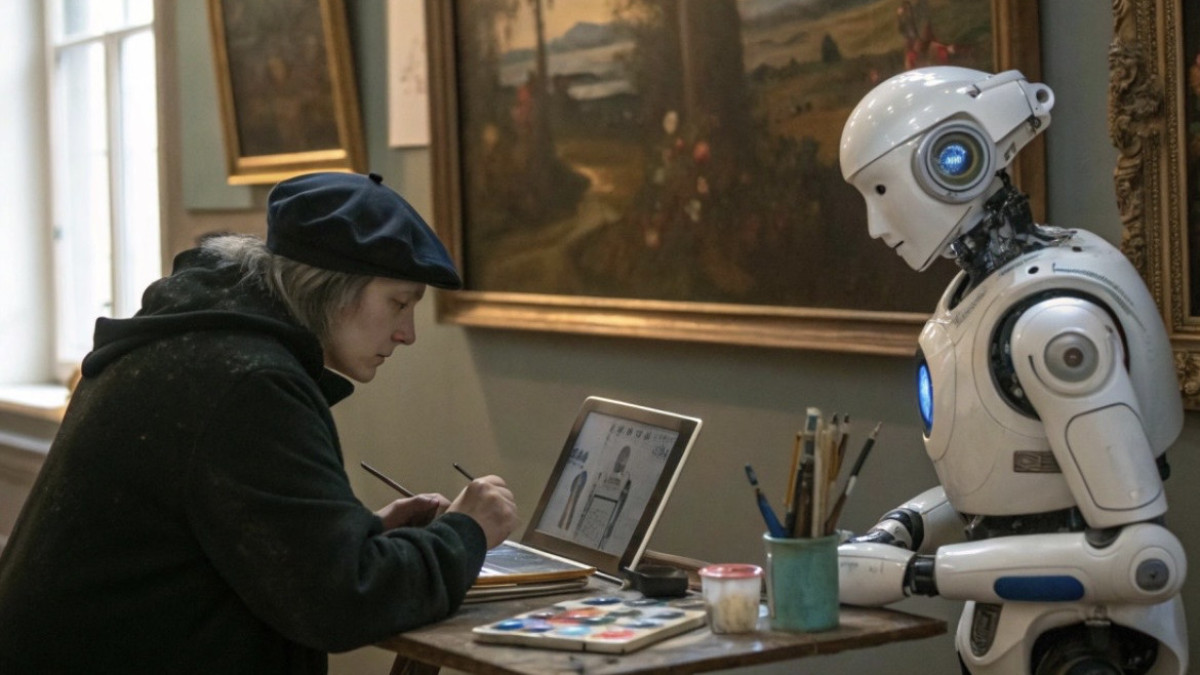
Why luxury brands shunning AI in favor of handcraft
Алима Муслиманова Журналист El.kz
By 2026, artificial intelligence has officially moved past the "wow-effect" phase to become a tool. It has become fast, cheap, and accessible to almost everyone. The world’s most expensive brands have begun to quietly but firmly turn away from it. What was considered cutting-edge technology yesterday is now at risk of becoming a primary marker of mass-market appeal and cheapness. El.kz explored why true luxury is now defined by what cannot be created by an algorithm in a few clicks.
We are entering a new era of the "scarcity in economics," where value is determined not by speed and scale, but by the rarity of the human touch. When anything can be generated in seconds, the ultimate sign of premium quality becomes that which cannot be scaled by a neural network.
“Human Made” as the New Luxury Currency
In a world where content, design, and even code are created instantly, the "errors" of a living person have suddenly become the most expensive asset. An uneven stitch on a bag, the trembling line of a brush in an illustration, text written by a real author with a unique style and mood - all of these are now perceived as rare artifacts.
Luxury consumers no longer want a perfect digital image. They want to feel a human presence - the time, talent, doubts, and even small imperfections. This is why "Human Made" is gradually becoming the new standard for authenticity and exclusivity.
Porsche hand drawn Christmas ad
In December 2025, Porsche released a holiday video titled "The Coded Love Letter." The video went viral almost instantly.
The project was developed by the Paris-based Parallel Studio. They officially confirmed that not a single AI-generated frame was used in the production. Every shot was created by hand using traditional frame-by-frame 2D animation with elements of stylized 3D.
The brand positioned its approach as an antithesis to the fast, faceless AI-generated videos of mass-market brands. Porsche showed the world that true luxury requires patience, taste, and months of meticulous manual labor.
A Hand-Drawn Website You Can Feel with Your Eyes
French artist Linda Merad completely redesigned the brand's official website by hand using pen and ink on paper. The paper, the textures, the uneven lines, and the visible traces of a human hand were intentionally preserved and highlighted.
The brand wanted every visitor to the site to physically feel that a human had made it.
Tactility vs. Digital Sterility
Another striking example was a video for Loewe created by the artist Ancho (Annie Choi). She utilized stop-motion technique: every frame was literally assembled by hand from paper, fabric, and leather. Real shadows, volume, and material textures are visible - qualities that neural networks are still unable to convey convincingly.
Why Luxury Is Shunning AI
There is a deep logic behind this trend. When a "perfect" image becomes free and accessible to almost any brand, imperfection becomes the true luxury. A visible pencil mark, a trembling brush line, or an accidental ink blot serves as proof that the brand paid an artist for their time, talent, and even for their right to make a mistake.
In a world of infinite digital content, a living human touch creates a much stronger emotional connection. It leaves room for the viewer's imagination, forcing the brain to "fill in" the gaps and evoking a sense of authenticity that perfectly generated content lacks.
Furthermore, an artist’s unique signature becomes a sort of watermark of authenticity. While neural networks are excellent at copying an average style, they struggle to replicate the individual pressure of a pen, the specific rhythm, and the "human noise" that makes a work unique.
The New Line of Demarcation
We are witnessing a clear market split. AI is taking over the routine, "middle-tier" content for the mass and mid-range segments. Meanwhile, in the luxury sector, "Human Made" is gradually becoming a new ecological and ethical standard - a sign that a brand is willing to spend months and vast resources on something that cannot be accelerated by an algorithm.
The Future Has Arrived
Artificial intelligence did not kill human labor in content production; it made it significantly more valuable.
While mass-market brands compete in the speed of content generation, the world’s most expensive fashion houses are doing the exact opposite. They are investing in human imperfection, in the living touch, and in emotions that cannot be algorithmized.

El recommends 
