

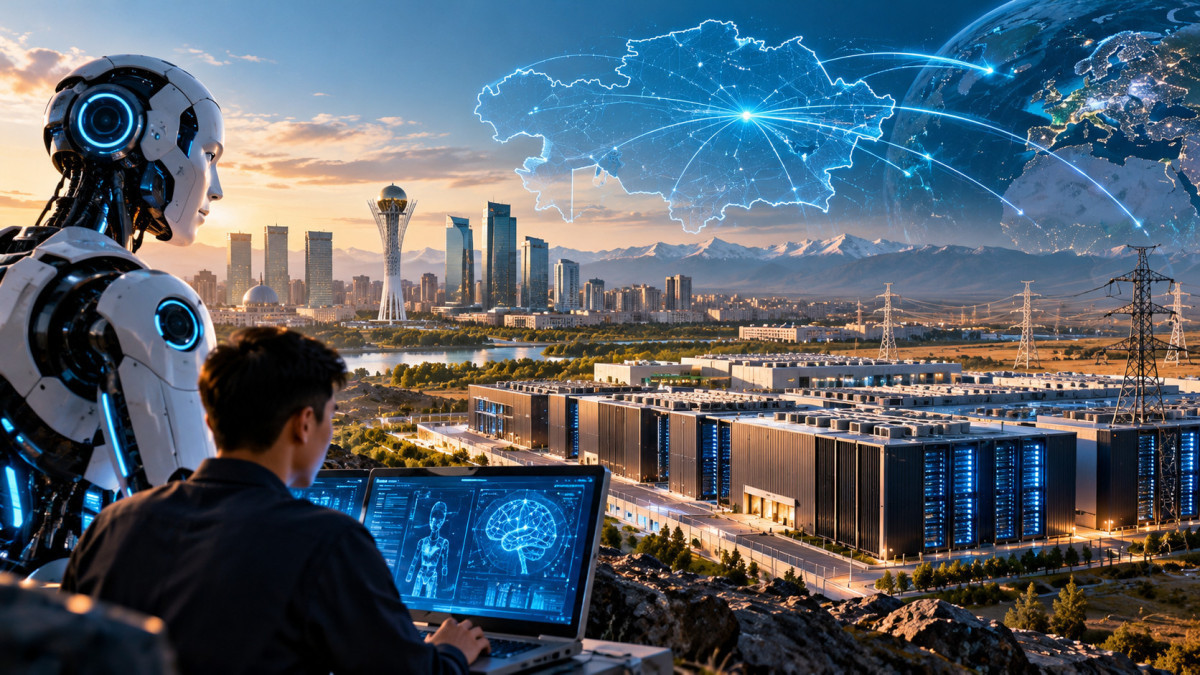
Kazakhstan is gradually transforming from a consumer of digital technologies into a country that actively participates in their development. International technology companies are taking an interest in the country’s energy resources, its potential for data centre construction, and the development of local engineering talent. But what lies behind the ambition to turn Kazakhstan into a global AI hub, and what benefits could this bring to the economy and ordinary citizens, El.kz reports .
The visit to Astana on October,23, 2026 by founder Chief Executive Officer of NVIDIA Jensen Huang was one of the most notable events for Kazakhstan’s technology sector. The head of the company whose graphics processing units (GPUs) are used to train and run modern neural networks was presented with domestic AI solutions, infrastructure projects, and plans for the development of robotics.
This is a planned data centre cluster designed to accommodate high-performance computing infrastructure. Such facilities can be used to train neural networks, process large volumes of data, and provide cloud services to international clients.
According to the Kazakh Ministry of Artificial Intelligence and Digital Development, the project is designed to increasea power capacity to 1 GW. Capacity of 215 MW for the first phase has already been reserved, and the figure is expected to reach 300 MW in 2027.
In June 2026, the Government of Kazakhstan announced the signing of a package of agreements involving US-based Firebird and NVIDIA, with a total value of USD 10 bln.
The project is designed to establish a computing cluster using advanced GPUs, including NVIDIA GB300 and Vera Rubin systems. In the longer term, the plan envisages deploying approximately 100,000 accelerators.
According to Minister Zhaslan Madiyev, implementation of the project could generate at least USD 3 bln in annual export revenue for Kazakhstan.
How Kazakhstan plans to generate revenue from AI
For decades, the extraction and export of raw materials have played a major role in Kazakhstan’s economy. The authorities are now proposing an additional economic model: using the country’s energy resources to produce digital services.
The model works as follows. Electricity powers high-performance servers; the servers perform computational tasks; and the results are sold to companies that require artificial intelligence capabilities.
For example, an international technology company could lease computing capacity in Kazakhstan to train a neural network or process requests from users in other countries.
The underlying data and software products do not necessarily have to be owned by a Kazakhstani entity. Instead, the exportable product is the computing service itself.
This approach is referred to as the development of the AI token economy—an economy based on the production and use of computing resources for artificial intelligence.
In this context, a token is not a cryptocurrency but a unit representing text or other information processed by a language model. Processing large volumes of tokens requires computational resources, for which customers pay AI infrastructure providers.
Chairman of the Management Board of Kazakhtelecom Bagdat Mussin previously described this model as a way of transforming electricity generated from Ekibastuz coal into a high-value technology export service.
Why Kazakhstan is investing in Physical AI
An important component of Kazakhstan’s strategy is Physical AI—a field of artificial intelligence focused on interacting with and controlling physical objects.
While a conventional chatbot answers questions and processes text, Physical AI systems can use data from cameras and sensors, interpret their surroundings, and enable robots to perform specific tasks.
This field is of particular interest to Kazakhstan given the country’s well-developed industrial base.
At mining operations, intelligent systems can be used to inspect hazardous areas, predict equipment failures, and operate autonomous machinery.
In the energy sector, these technologies can help monitor infrastructure conditions, detect equipment anomalies, and plan maintenance activities.
In logistics and warehousing, autonomous robots can move cargo, monitor inventory, and perform repetitive tasks.
During Jensen Huang’s visit to Astana, he was presented with Kazakhstani projects operating in these areas.
These included ARC Aero, which develops unmanned aerial vehicles and autonomous control systems, and QazTWIN, which creates digital twins of industrial facilities and infrastructure assets.
Why investors need more than electricity and servers
Building data centres alone will not be sufficient to attract major technology companies to Kazakhstan.
International investors need a predictable regulatory environment, intellectual property protection, clear tax rules, the ability to transfer data in compliance with applicable legislation, and access to a skilled workforce.
For this reason, the development of computing infrastructure is accompanied by the establishment of educational programmes, technology hubs, and mechanisms to support start-ups.
In an interview, Zhaslan Madiyev stated that more than 2,500 start-ups and IT companies were registered within the Astana Hub ecosystem. According to the minister, these companies export services to more than 100 countries.
One example of Kazakhstani technology companies entering international markets is Higgsfield, an AI-powered video generation platform.
According to the Ministry of Artificial Intelligence and Digital Development, Jensen Huang met with Higgsfield’s founders during his visit to Astana. The company collaborates with NVIDIA and uses its computing technologies to develop its own products.
What will ordinary Kazakhstanis gain?
At first glance, the construction of supercomputers and data centres may appear to be an industry with little connection to everyday life.
However, if successfully implemented, these projects could affect the labour market, education, the quality of digital services, and the development of domestic businesses.
First and foremost, they could create new jobs. Computing centres require engineers, power systems specialists, information security professionals, network infrastructure experts, and cooling systems technicians.
The growth of AI is also increasing demand for software developers, data analysts, robotics engineers, and specialists in the deployment of intelligent systems.
Universities and research institutions could gain additional access to advanced computing resources. This is particularly important for scientific research involving the processing of large datasets.
For businesses, access to domestic computing infrastructure could make it possible to develop their own AI products without having to rely entirely on foreign platforms.
Over time, these technologies could be used to improve public services, medical diagnostics, transport management, and industrial operations.
Today, Kazakhstan has several key building blocks for the development of an AI industry: operational supercomputers, an established industrial base, technology start-ups, and international partnerships.
