

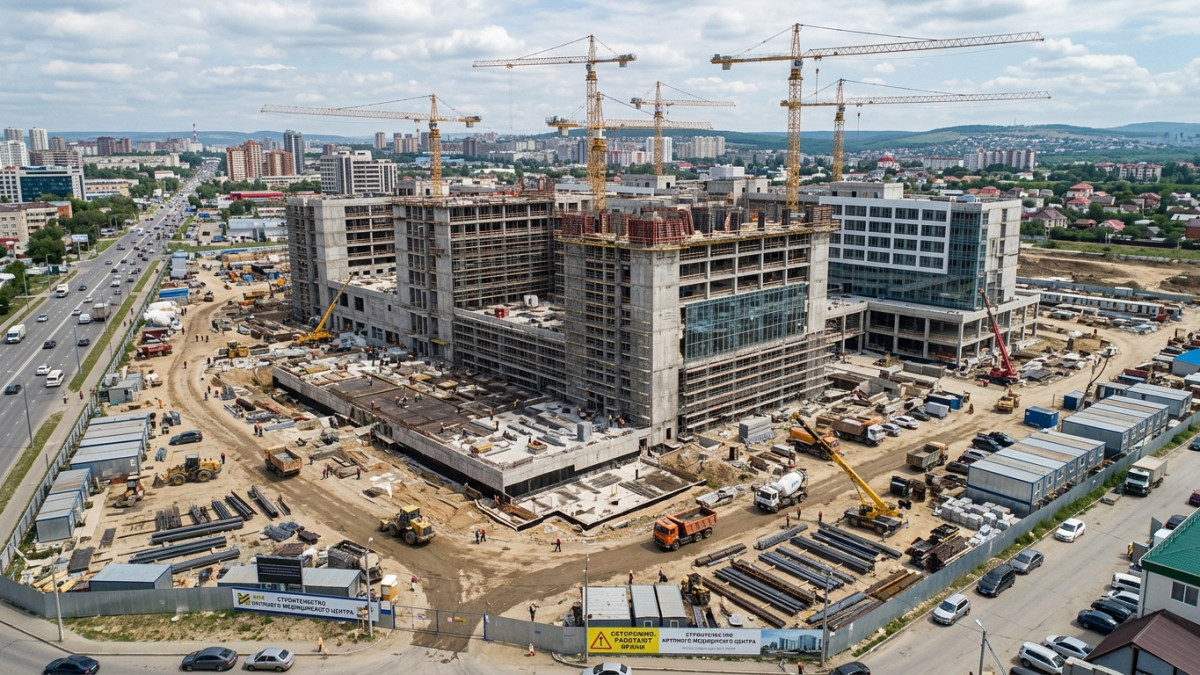
The Government has approved the first projects under the “Halyqtyq Qurylys” programme and announced the amounts to be allocated by the National Fund to healthcare and education. Regional authorities will oversee the construction of perinatal centres, children’s hospitals, maternity hospitals and schools, while a dedicated state commission will monitor expenditure, El.kz reports.
The Largest Project in the Country’s History
The name “Halyqtyq Qurylys” was proposed by President Kassym-Jomart Tokayev in his Address to the People of Kazakhstan. He described the programme as the largest infrastructure project in the country’s history and instructed the Government to commence construction as soon as possible to ensure that the facilities are completed within a short timeframe.
At a Government meeting, First Deputy Prime Minister Nurlibek Nalibayev announced that projects worth 1.5 trillion tenge had been approved. The list includes hospitals, schools, roads, bridges and water supply infrastructure.
A total of 6.5 trillion tenge has been allocated for the programme. Some projects have already received funding, while the Government is expected to finalise by the end of the year a comprehensive list of projects covering all regions of the country.
Where Will Maternity Hospitals and Perinatal Centres Be Built?
A total of 344 billion tenge has been allocated to healthcare under the first package of projects. The list includes hospitals, outpatient clinics, maternity hospitals and perinatal centres.
At the Government meeting, Minister of Healthcare Akmaral Alnazarova presented the list of planned facilities. Perinatal centres with a total capacity of 1,700 beds are to be constructed in Astana, Almaty, Shymkent, Karaganda, Kaskelen, Kyzylorda and Oral, with more than one such centre planned for the capital.
Construction sites were selected based on regional medical and demographic indicators, as well as established efficiency criteria.
What Facilities Will Be Built for Children and in Regional Centres?
Multidisciplinary children’s hospitals with a combined capacity of 1,550 beds will be built in Atyrau, Aktobe, Almaty, Shymkent, Kaskelen, Semey and Aktau. Astana will receive a Children’s Emergency Care Centre and a separate paediatric surgery centre.
Children’s rehabilitation services will be expanded through interregional branches of the National Children’s Rehabilitation Centre in Almaty, Aktau, Atyrau, Kyzylorda and Semey. Their combined capacity will amount to 750 beds.
Major projects also include a 300-bed multidisciplinary hospital in Oskemen, an infectious disease hospital in Zhambyl Region, and multidisciplinary hospitals in Turkistan Region and Abai Region.
In addition, the programme provides for the construction of district-level hospitals, emergency medical care facilities, blood centres and outpatient and polyclinic facilities.
What Will Change for Patients and Healthcare Professionals?
According to the Ministry’s estimates, the new and upgraded facilities will provide approximately 1.8 million square metres of healthcare infrastructure.
The inpatient bed capacity will be expanded and modernised by 9,200 beds. Outpatient care capacity will also increase, enabling polyclinics to serve significantly more patients per shift.
At the same meeting, the Minister also outlined plans to introduce additional payments for primary healthcare workers. Starting next year, these payments are expected to cover more than 77,000 healthcare professionals. The amount will be determined by length of continuous service and the level of psycho-emotional workload.
What Will Schools Receive?
A total of 101 billion tenge has been allocated to education under the first package of projects. The funds will be used to construct schools and a multifunctional complex.
The programme also includes sports and cultural facilities located alongside schools. The President referred to nearly 50 educational, sports and cultural institutions. Among the planned sports facilities are gyms adapted to accommodate children with special needs.
Who Will Be Responsible for Construction and Oversight?
The Head of State proposed involving local small and medium-sized enterprises in construction projects, provided they have the necessary material and technical resources and sufficient relevant experience. The President emphasised that the entire implementation process would be subject to strict oversight.
A state commission will be established to monitor expenditure. According to Nurlibek Nalibayev, its membership will include not only government officials but also members of the National Kurultai and maslikhats, representatives of the People’s Council, civil society representatives, activists, volunteers and journalists.
As the President emphasised, every tenge allocated from the National Fund must generate tangible economic and social returns.
