

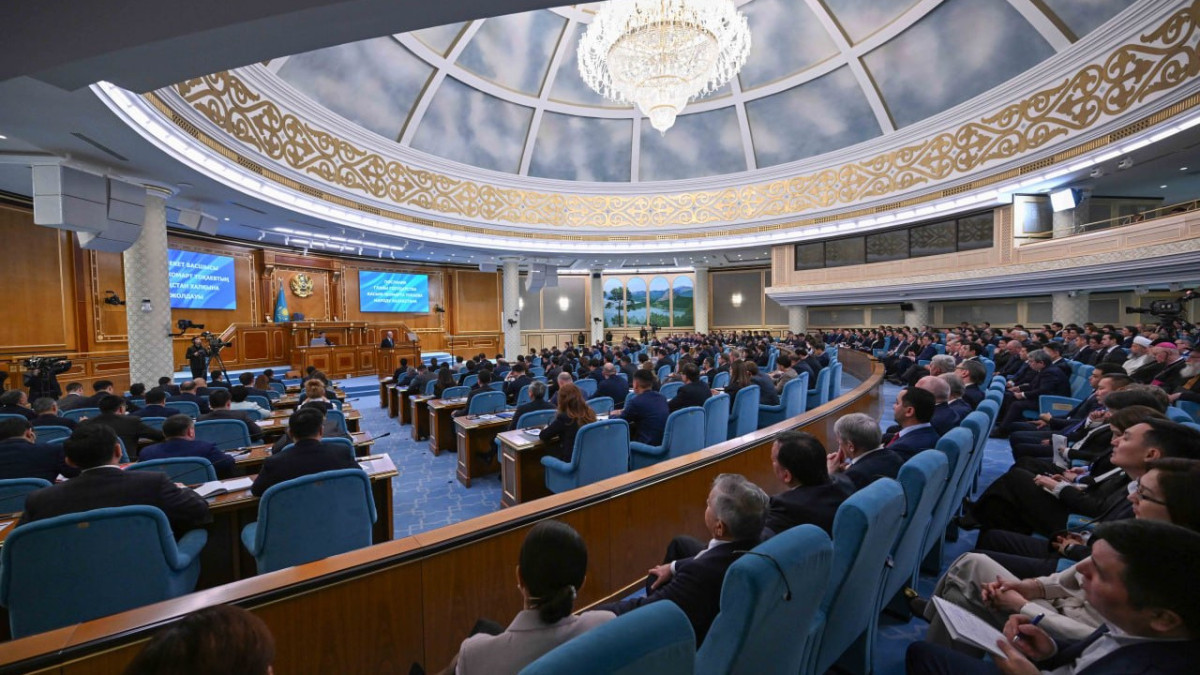
On October, 28 President Kassym-Jomart Tokayev stated that Kazakhstan must build a digital economy and instructed the Government to establish a simplified regulatory framework for digital employment by the end of the year.
The President stated that Kazakhstan must build a digital economy. Taking a realistic assessment of its capabilities, the country must leverage all the benefits that new technologies can offer to improve the well-being of its people.
“Construction of the core infrastructure required to implement the comprehensive Digital Qazaqstan strategy is already under way. Two supercomputers have been launched, and a third high-performance supercomputer will be commissioned by the end of the year. The laying of the fibre-optic cable across the Caspian Sea has been completed, and data centres are being built. This is only a small part of the work being carried out to digitally transform the country. We are at the beginning of a long journey towards a new technological paradigm,” the President said.
To keep pace with the times, he noted, the country must focus on delivering tangible results.
The President acknowledged that, for now, there is more talk than action: genuine digitalisation is sometimes reduced to automating existing processes or holding various events.
“Digitalisation must not be reduced to purchasing expensive software products without understanding their practical value,” the President emphasised.
The President noted that work on the commercialisation of AI, asset tokenisation, the development of blockchain technologies and digital platform ecosystems has only just begun in earnest. A programme for the practical application of digital technologies across the economy must be developed.
“Millions of our citizens now use online marketplaces, food delivery services, ride-hailing platforms and a wide range of other services, including banking services, where Kazakhstan, it must be acknowledged, has outpaced many countries that are widely regarded as advanced. However, we must continue moving forward. We have everything necessary to give a powerful boost to the development of a genuinely high-productivity digital economy. Our young people are educated and creative, internet access is widely available across the country, and a well-developed digital infrastructure is in place. Today, any citizen can open a bank account, arrange an instalment payment plan or purchase goods from home in just a few minutes,” the President stated.
According to the President, the next stage of digitalisation must shift the focus from ensuring access to services to expanding individual capabilities. The country must change its paradigm and approach the challenges it faces from a different perspective.
The President stated that the country’s goal is to build a truly people-centred digital economy.
“In the public consciousness, the internet must be perceived not merely as a space for consumption and entertainment, but also as a virtual domain for creativity, productive activity and work. For our citizens, smartphones can and should serve not so much as leisure devices - expensive gadgets that waste time as effective tools for work and income generation. Therefore, by the end of the year, the Government will establish a simplified regulatory framework for digital employment,” the President said.
The President stressed that, in building a people-centred digital economy, it is essential to ensure that people’s opportunities do not depend on where they live. Citizens in rural areas and cities alike must learn to use smartphones as tools for earning a legitimate income.
“We must integrate existing government support measures for entrepreneurship with the capabilities of private online marketplaces, banks, logistics companies and digital services. In addition to lending and subsidies, further digital tools are needed to support the production and sale of goods. Next year, the Government, in cooperation with the business community, must launch pilot digital development projects in a number of regions to help rural producers establish effective channels for marketing and selling their products. Successful practices must then be scaled up across all regions,” the President stated.
The President also said that the potential of asset tokenisation that is, the conversion of assets into digital form must be fully realised.
“This will enable citizens to become co-owners of companies and various assets, while allowing entrepreneurs to raise capital directly, without unnecessary intermediaries. The strategic objective of building a people-centred digital economy is to harness the potential of modern technologies for the well-being of every citizen,” the President said.
