

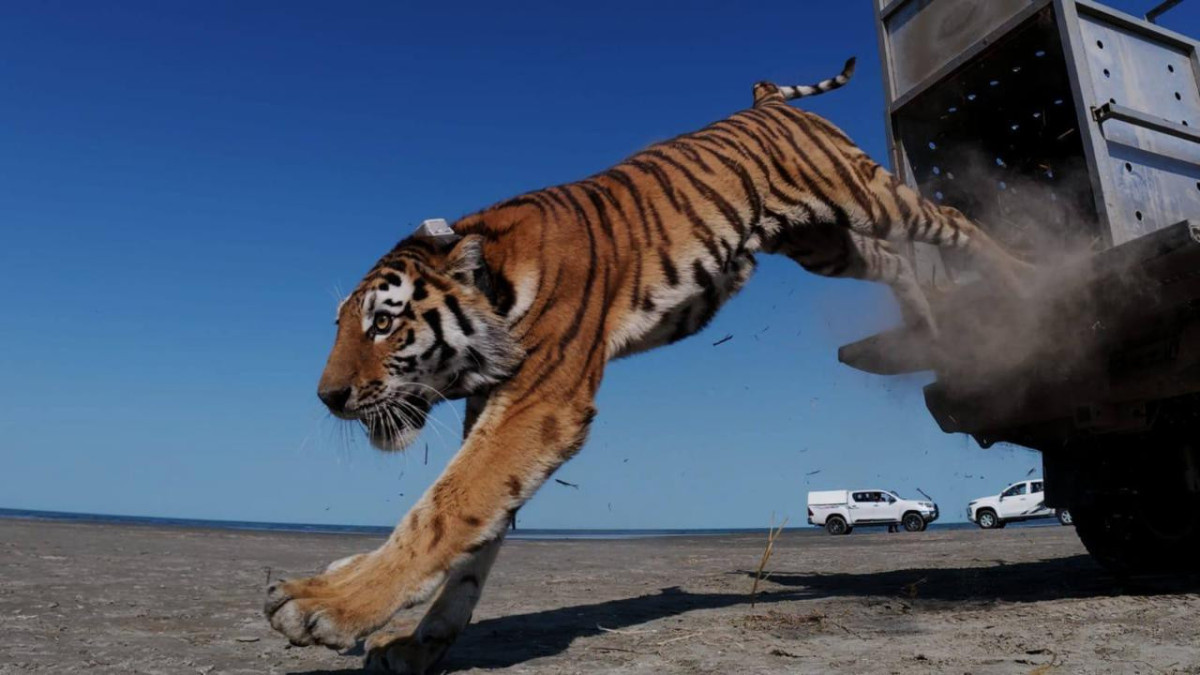
A landmark event has taken place at the Ile-Balkhash State Nature Reserve. For the first time in over 70 years since tigers disappeared from the territory of Kazakhstan, a female Amur tiger named Ümit has been released into her natural habitat, according to the Ministry of Ecology and Natural Resources of the Republic of Kazakhstan, El.kz reports.
The first step towards tiger restoration
The tigress was released on 31 July within the territory of the Ile-Balkhash State Nature Reserve. The release marks the first practical phase of the programme to restore the tiger population within its historical range.
The release ceremony was attended by Minister of Ecology and Natural Resources of the Republic of Kazakhstan Yerlan Nyssanbayev; Minister of Justice of the Russian Federation and Chairman of the Supervisory Board of the Amur Tiger Centre Konstantin Chuychenko, as well as scientists, representatives of international conservation organizations, and experts involved in the implementation of the project.
Minister Yerlan Nyssanbayev described the event as a significant milestone in Kazakhstan’s conservation efforts.
“Today we have witnessed a truly historic event. For the first time in more than 70 years since the tiger disappeared from the territory of Kazakhstan, a tiger has been returned to its historical range. This achievement is the result of many years of dedicated work by the Government of Kazakhstan, our Russian counterparts, the scientific community, and international partners. Considerable work still lies ahead, including continuous monitoring of the released animals and the establishment of a self-sustaining tiger population. Nevertheless, today marks an important first step.”
Why the Balkhash region was selected
Historically, the southern Balkhash region and the Ili River valley constituted part of the natural range of the Caspian tiger. Extensive tugai riparian forests and abundant populations of wild ungulates provided a suitable habitat and sufficient prey base for the species.
By the mid-20th century, tigers had become extinct in Kazakhstan. The principal causes included the destruction of tugai forests, the decline of prey populations, and poaching.
For this reason, the national restoration programme is focused on re-establishing the tiger within its historical range. Prior to the reintroduction, specialists undertook extensive measures to restore the prey base, strengthen the protection regime of the reserve, and create favourable ecological conditions for the survival of large carnivores.
More than a decade of preparation
Preparatory work for the project spanned more than ten years. During this period, the Ile-Balkhash State Nature Reserve was established, acclimatization enclosures were constructed, a scientific monitoring programme was launched, and comprehensive measures were implemented to increase populations of wild ungulates.
In May 2026, with the support of the Russian Federation, four wild-caught Amur tigers were transferred to Kazakhstan. The group comprised two adult tigers and two cubs, all of which were placed in specially designed acclimatization enclosures.
Prior to release, the tigress Umit underwent comprehensive veterinary examinations. Specialists assessed her health status, ability to hunt independently, behavioural responses to humans, and overall suitability for survival in the wild. Following a thorough evaluation, experts concluded that the animal was ready for release.
Immediately before the release, the tigress was fitted with a state-of-the-art GPS/GSM tracking collar. Her movements are now being monitored around the clock through satellite telemetry, camera traps, and other wildlife monitoring systems.
Future plans for the remaining tigers
The adult male Amur tiger remains at the acclimatization centre, where specialists continue to observe his behaviour and conduct the necessary assessments. A decision on his release will be made once his readiness for independent life in the wild has been confirmed.
The two tiger cubs arrived in Kazakhstan at the age of six to seven months. They continue to develop in dedicated acclimatization enclosures and will remain under professional care until they reach approximately 18 months of age. Following veterinary assessments and behavioural evaluations, specialists will determine whether the cubs are suitable candidates for release into the wild.
Why the Amur tiger was chosen
Historically, the Caspian tiger inhabited the floodplains and tugai forests of Central Asia, including the Ili River basin and the southern Balkhash region.
Contemporary molecular genetic research has demonstrated that the Caspian tiger and the Amur tiger are virtually identical at the genetic level. Consequently, the intl scientific community recognizes the Amur tiger as the most appropriate source population for restoring the species within its historical range.
