

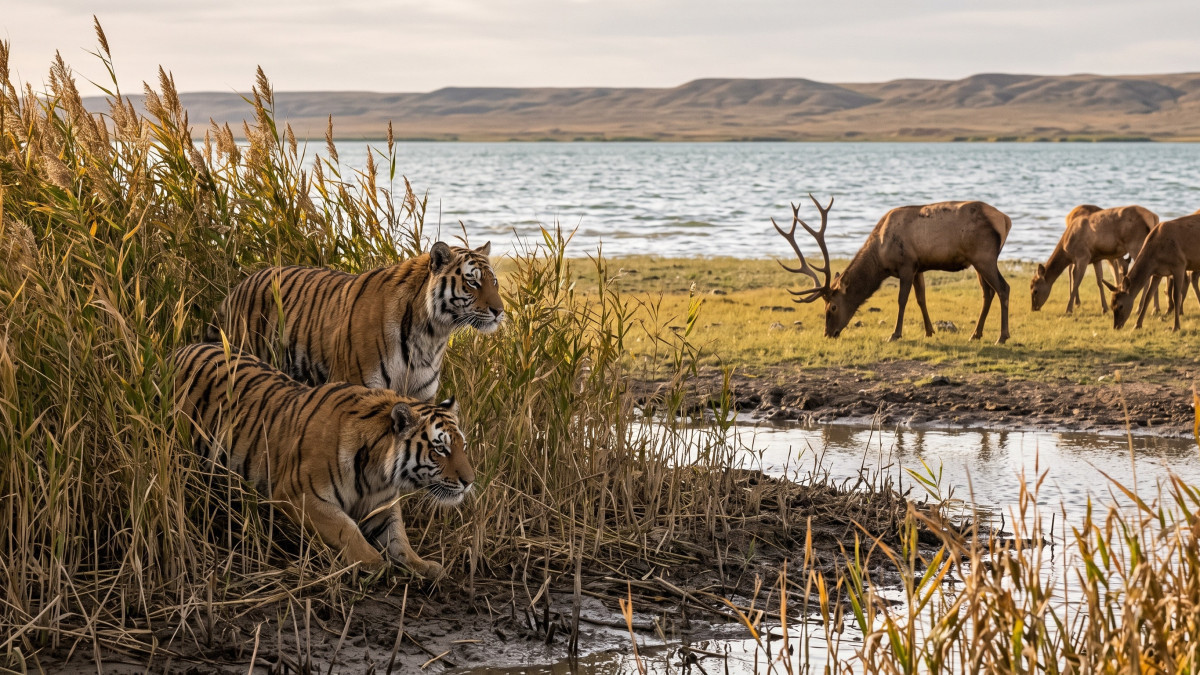
At the "Ile-Balkhash" State Nature Reserve, preparations are underway to return two Amur tiger cubs, Turan and Ussuri, to the wild. The preliminary release date is set for May 2027, but specialists will make a final decision only after assessing the animals' readiness.
The cubs were brought to Kazakhstan from Khabarovsk Krai in May 2026 along with two adult tigers. At the time of the move, the cubs were 6-7 months old. By summer 2027 they will reach precisely the age at which tiger cubs become independent in the wild.
What the residents of the Balkhash region themselves say
Local residents of the village of Karaoy also speak of their hopes for a tourism boost from the tiger's return.
According to locals, explanatory work has long been carried out continuously in the area. It's worth noting that the residents of Karaoy are not merely bystanders. Along with staff of the "Ile-Balkhash" reserve, villagers have also taken part in planting and watering turanga trees, which restore floodplain forests and are meant to become part of the tiger's future food base.
How many tigers are needed for a sustainable population
According to the Ministry of Ecology and Natural Resources, around 15-20 tigers are planned to be released into the reserve in stages to form the initial group. This number is considered the minimum sufficient starting stock for a future population.
The ultimate goal is far more ambitious. The ministry aims to create a sustainable population of about 50 individuals capable of reproducing on its own without a constant influx of new animals from outside.
According to specialists' calculations, the ecosystem of the Ile-Balkhash reserve is theoretically capable of feeding and supporting up to 120 tigers given a sufficient food base. But no one plans to reach such numbers in the foreseeable future — the entire project to restore the Turan tiger in Kazakhstan is designed to run for 35 years, and authorities hope to reach the target of 50 wild individuals by around 2035.
