

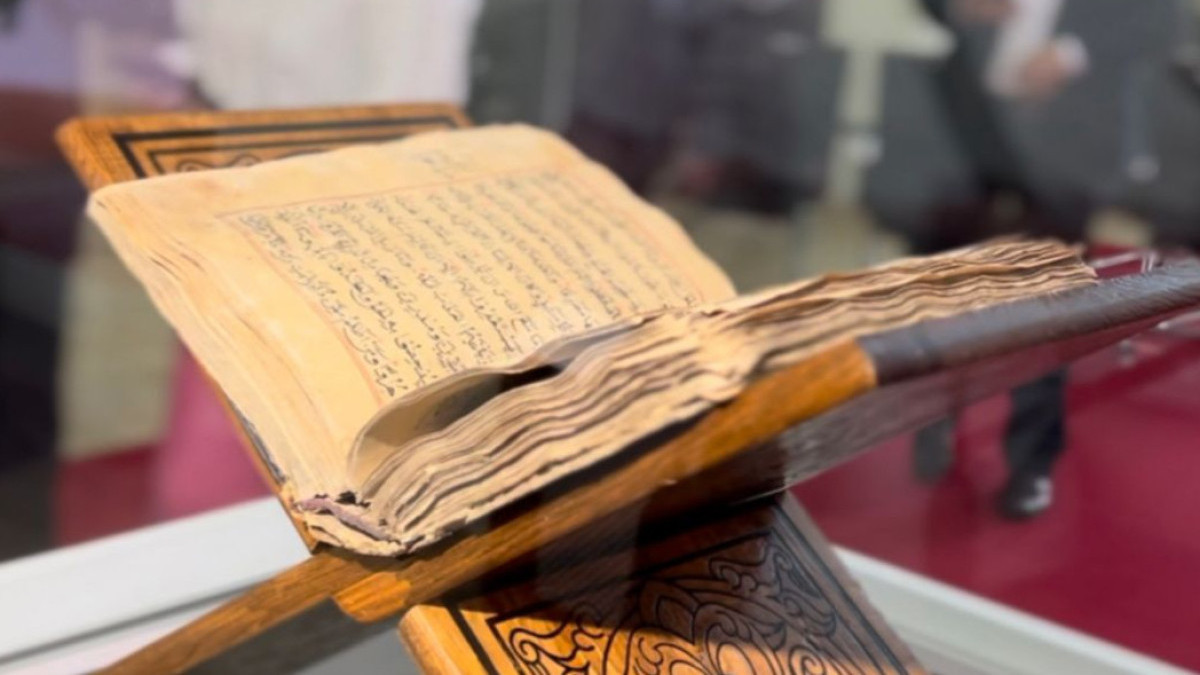
A personal relic of Khan Kenesary, bearing a handwritten inscription preserved for nearly two centuries, has once again attracted the attention of historians, El.kz reports.
Kinship that shaped history
Maral Ishan Qurmanuly, an Islamic scholar and educator, was Khan Kenesary’s maternal uncle. His sister Bibi was the mother of the future Khan, while another sister, Asyltas, gave birth to Nauryzbay, one of Kenesary’s closest associates during the national liberation uprising that began in 1837.
Maral Ishan enjoyed considerable authority not only among the Kazakh population but also among Tatars and Bashkirs in Western Siberia. As early as the beginning of the 19th century well before the uprising he openly opposed the construction of new military fortifications and the expansion of the administrative presence of the Russian Empire deeper into the Kazakh Steppe.
An inscription that survived two centuries
At the center of this story is Khan Kenesary’s personal copy of the Quran. Its pages preserve a handwritten inscription containing a prayer for the protection of the Kazakh Khan, signed by Mullah Maral bin Qurban.
Director General of the Institute of History of Kazakhstan and Central Asia Samat Zhumatay described the manuscript as one of the very few surviving written records confirming the personal connection between a prominent religious leader and the leader of the national liberation movement. According to him, documentary evidence of this nature is exceptionally rare, which explains the strong interest it has generated among historians.
Beyond its symbolic value, the manuscript provides tangible evidence that religious support for Kenesary’s uprising was not merely conceptual but was documented in writing on a volume that the Khan reportedly carried with him.
A diplomat before becoming a symbol of resistance
As early as 1822, approximately 15 years before the outbreak of the uprising, Maral Ishan sought to address issues affecting the Kazakh people through peaceful means. He sent letters to the leadership of the Russian Empire requesting a personal audience with Emperor Alexander I to discuss the situation of the Kazakh population.
The imperial authorities summoned him to Saint Petersburg; however, Maral Ishan never reached the imperial capital. Fearing arrest, he left Northern Kazakhstan and relocated to the area of the present-day Karmakshy district of Kyzylorda region, where he spent the final years of his life.
Support extended by an entire family
When Kenesary assumed leadership of the armed struggle, Maral Ishan’s sons Aitmagambet, Altai, and Qalqai Ishan provided the insurgents with horses, food supplies, and clothing. In this way, spiritual support for the national liberation movement was complemented by sustained material assistance throughout the years of resistance.
Today, the area where Maral Ishan spent the last years of his life still contains sites associated with his legacy. The story of the Quran bearing a prayer for the Khan remains one of the few surviving documentary links directly connecting the religious and political history of 19th-century Kazakhstan.
The story of Khan Kenesary’s Quran
President Kassym-Jomart Tokayev announced the return to Kazakhstan of Khan Kenesary’s unique Quran during a meeting of the National Kurultai in Turkistan. The relic is currently housed in the Mausoleum of Khoja Ahmed Yasawi.
How the sacred relic returned to Kazakhstan
According to the Head of State, the Quran was presented to Khan Kenesary by the renowned religious figure Maral Ishan. Over the course of two centuries, the sacred relic passed through numerous hands before eventually leaving the country.
Its return was made possible through the efforts of Kazakhstani philanthropists and concerned citizens. Following its repatriation, the manuscript underwent a comprehensive expert examination involving both Kazakhstani and international scholars.
The President noted that the findings confirmed the provenance of the manuscript.
“The findings confirm that the Quran belonged to Maral Ishan and that it was subsequently presented to Khan Kenesary,” President Kassym-Jomart Tokayev stated.
Where Khan Kenesary’s Quran Is preserved
Following its return to Kazakhstan, the sacred relic was transferred, on the instructions of the President, to the Spiritual Administration of Muslims of Kazakhstan. The Quran subsequently underwent conservation and restoration at the National Centre of Manuscripts.
The relic was later transferred to Turkistan, where it is now permanently preserved in the Aksarai Hall of the Mausoleum of Khoja Ahmed Yasawi.
Addressing the National Kurultai, President Kassym-Jomart Tokayev emphasized that the nation’s historical heritage requires special stewardship and should be preserved in places of spiritual significance.
“This relic is part of our national heritage. Such a valuable spiritual artifact should be preserved in a place that is sacred to our people. Therefore, I believe that the Quran should be kept in the Mausoleum of Khoja Ahmed Yasawi,” the President said.
