

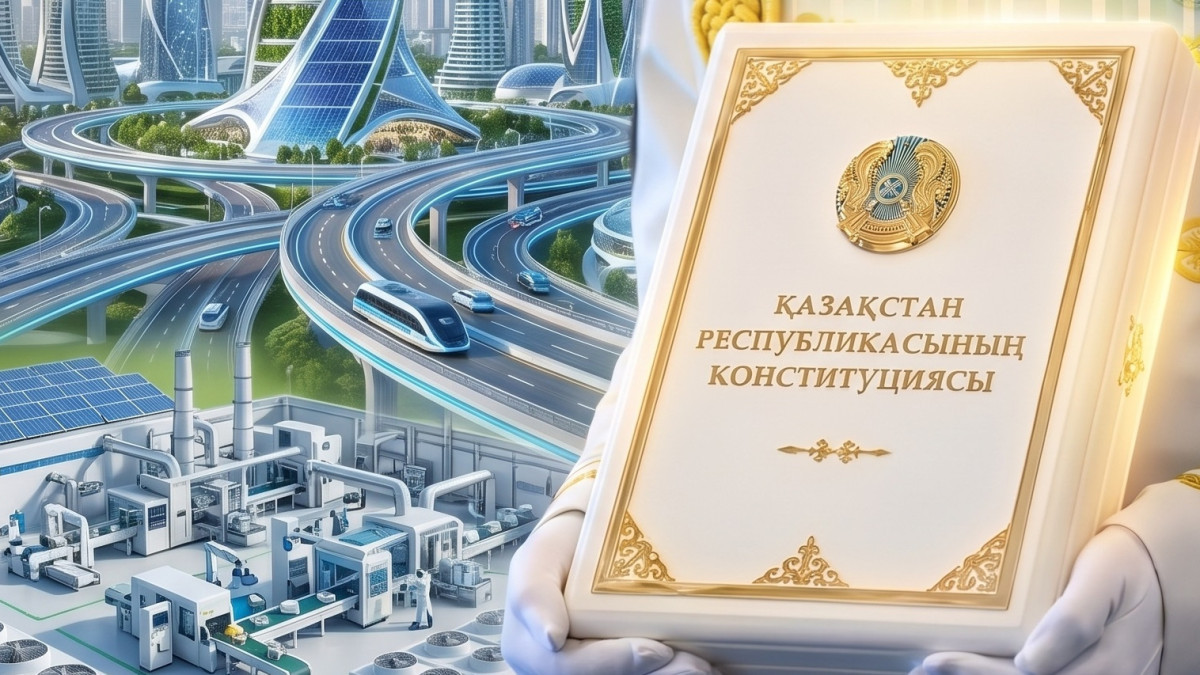
On July 1, 2026, the new Constitution of the Republic of Kazakhstan, ratified via a national referendum on March 15, officially entered into force.
This reform already serves as a benchmark for evaluating the strengthening of the nation’s position within the global community.
The new Constitution features a revised preamble that references the historical heritage of the Great Steppe and enshrines the principle of "Just Kazakhstan."
The document reaffirms the unitary status of the state, the inviolability of its borders, and its territorial integrity.
Furthermore, it places significant emphasis on strengthening inter-ethnic and inter-confessional harmony, advancing science and education, and ensuring environmental protection.
The referendum saw a voter turnout exceeding 73 %, with 87.15 % of participants voting in favor of the amendments. To facilitate the exercise of the public will, over 10,000 polling stations were established domestically, alongside 71 stations at diplomatic missions in 54 countries. The scale of this administrative effort serves as a testament to the maturity of Kazakhstan’s electoral system and the state's capacity to engage citizens in national processes, even those residing far beyond its borders.
A Unicameral Parliament: A Mark of Mature Democracy
The transition from a bicameral parliament to a unicameral Kurultai is often perceived as an unconventional move; however, the unicameral model has long been successfully utilized by some of the world’s most stable democracies. For instance, Iceland - home to one of the world’s oldest parliaments, the Althingi has operated under a unicameral system for years, securing top positions in global democracy and governance rankings.
In tandem with the Kurultai, a People’s Council has been established This institutional framework integrates representatives from government agencies, the expert community, and the civil society sector into a single structure. This aligns the legislative process more closely with societal demands, following a model familiar to other advanced parliamentary systems worldwide.
The State’s Readiness for Systemic Transformation
A defining feature of the Kazakhstani reform is the state’s commitment to profound structural change rather than mere cosmetic adjustments to existing norms. The Constitutional Commission justified the necessity of the reform by citing geopolitical volatility and mounting external challenges within the region. Within this logic, the transition to a more streamlined and manageable governance architecture appears as a calculated, proactive response to regional instability.
The speed and consistency with which Kazakhstan executed the reform from the initial proposal to the entry into force of the new Basic Law demonstrate the state system’s ability to promptly adopt and implement large-scale decisions while maintaining internal stability and administrative continuity.
The Economic Context of the Reform
This constitutional reform is taking place against a backdrop of robust economic performance. According to the International Monetary Fund (IMF), in 2025, Kazakhstan’s GDP per capita growth rate surpassed that of China, solidifying its status not only as the most economically prosperous nation in Central Asia but also as one of the world’s steadily growing economies.
According to the government’s updated socio-economic development forecast, Kazakhstan’s nominal GDP is projected to rise from 183.8 trillion tenge in 2026 to 229.8 trillion tenge by 2028. In US dollar terms, this represents an increase from approximately $340–386 billion to $426–443 billion. According to Deputy Prime Minister and Minister of National Economy Serik Zhumangarin, this growth will be driven by acceleration in the manufacturing, construction, transport, and trade sectors - the very structural economic reforms that are proceeding in parallel with the country’s political modernization.
International Community
The synthesis of political modernization and sustained economic growth reinforces Kazakhstan’s image as a state capable of conducting systemic reforms without economic upheaval or loss of investment attractiveness. The voluntary and systematic nature of the constitutional update demonstrates the country’s capacity for long-term strategic planning.
For international partners, investors, and regional neighbors, such consistency sends a clear signal: Kazakhstan remains a predictable and systematic actor in Central Asia, committed to long-term development and institutional stability.
