

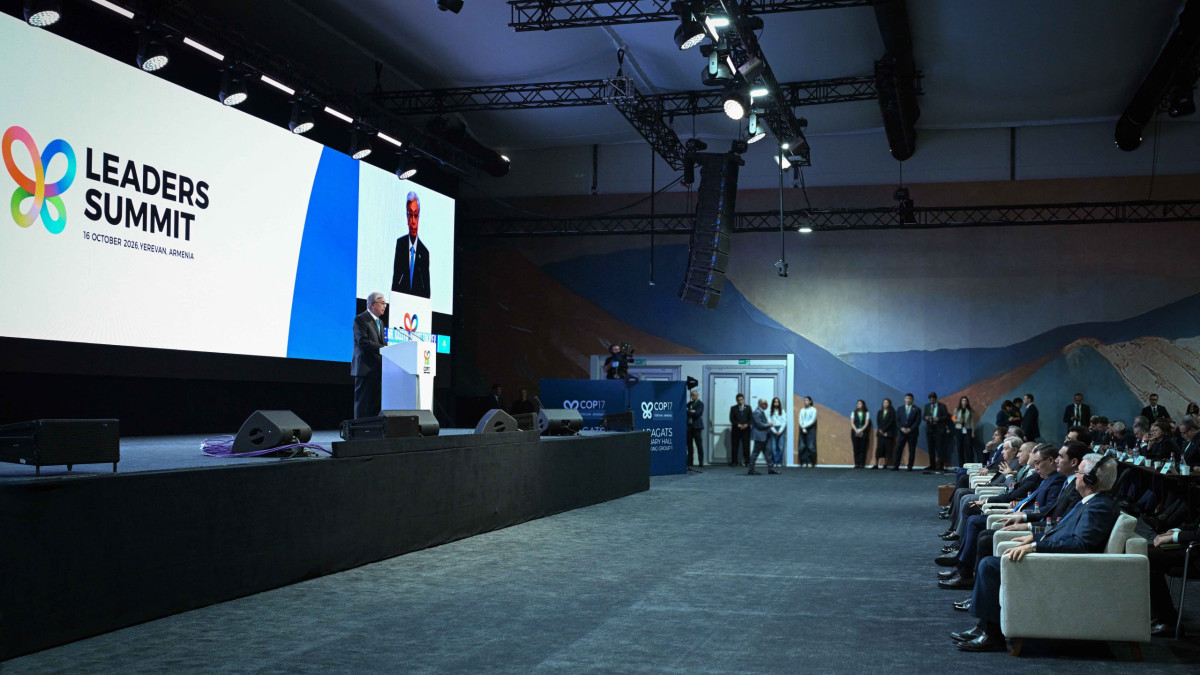
Respect for nature has been enshrined in the Constitution of Kazakhstan for the first time as one of the fundamental principles of statehood. President Kassym-Jomart Tokayev made this statement at the Leaders’ Summit on Biodiversity in Yerevan, El.kz reports citing Akorda.
Addressing participants at the international summit held as part of COP17, the President of Kazakhstan outlined changes in the country’s environmental policy. He placed particular emphasis on the nationwide “Taza Qazaqstan” initiative, which, in his assessment, is gradually shaping citizens’ worldviews and everyday habits.
Environmental culture becomes a constitutional principle
Kassym-Jomart Tokayev recalled that Kazakhstan ranks 9th in the world in terms of land area and is home to unique biodiversity. According to the President, safeguarding the country’s natural heritage has become one of the priorities enshrined at the constitutional level.
“Preserving this heritage is our duty to our people and our responsibility to the international community. This commitment is clearly reflected in Kazakhstan’s new Constitution,” the Head of State stated.
The President emphasised that, for the first time, environmental culture had been established as one of the fundamental principles of statehood.
“For the first time in our country’s history, the development of a high level of environmental culture has been enshrined in the Constitution as one of the fundamental principles of our statehood. Citizens are now obliged to preserve nature and use its resources responsibly,” Tokayev said.
The Head of State also recalled that protecting the environment in a manner conducive to human life and health has been designated as one of the objectives of the state. At the same time, in his view, environmental protection priorities must be aligned with the country’s economic development.
“Taza Qazaqstan” evolves beyond an environmental campaign
The President cited the nationwide “Taza Qazaqstan” initiative as one example of changing public attitudes towards the environment. In his assessment, the initiative is taking on broader significance and gradually influencing the habits of Kazakhstan’s citizens.
“The nationwide ‘Taza Qazaqstan’ initiative puts these values into practice. It is encouraging that this movement is evolving beyond a simple commitment to environmental cleanliness. It is having an increasingly significant impact on the worldview and lifestyle of our citizens and is becoming a nationwide ideology,” the President noted.
Tokayev linked the initiative to the development of an environmental culture based on responsible attitudes towards natural resources. In his address, he emphasised that environmental protection must become a shared responsibility of the state and society.
Environmental threats transcend national borders
Highlighting the need for international cooperation, the President recalled the consequences of desertification, water scarcity and land degradation. According to him, these processes affect economic performance, food security and the well-being of millions of people.
“Healthy ecosystems play an important role in food production, the protection of water resources and the maintenance of livelihoods for millions of people. At the same time, desertification, water scarcity and other environmental challenges pose a serious threat to the fragile balance between nature and humanity,” Kassym-Jomart Tokayev stated.
The President emphasised that the consequences of environmental problems have long extended beyond the borders of individual states. Environmental policy therefore requires coordinated solutions, irrespective of political differences between countries.
“It is essential that the environmental agenda, grounded in a balanced approach and concrete measures, take precedence over political differences. Our shared priority must be international cooperation based on genuine partnership and impartiality, and, above all, focused on achieving tangible results,” the Head of State said.
Kazakhstan calls for joint action to protect nature
At the summit, Tokayev announced an initiative to establish an International Fund for the Protection of Rare Species and Biodiversity Conservation. The President invited international partners to join the effort.
He also outlined a ten-year National Biodiversity Conservation Programme. The programme envisages the restoration of natural habitats, the protection of rare species and the expansion of the network of specially protected natural areas. In parallel, Kazakhstan is establishing a National Genetic Biodiversity Bank.
The President also highlighted the application of artificial intelligence in the environmental sector.
“Today, effective partnerships must be underpinned by digital technologies and artificial intelligence, which have the potential to fundamentally transform approaches to ecosystem monitoring, natural resource management and environmental risk forecasting,” Tokayev stated.
The Head of State proposed using the International Artificial Intelligence Centre in Astana as a platform for joint scientific research, environmental data analysis and the development of early warning systems.
Concluding his address, the President proposed locating a regional office of the Secretariat of the Convention on Biological Diversity in Almaty. According to him, such an office could support Central Asian countries in implementing the Kunming–Montreal Global Biodiversity Framework, promoting scientific exchange and developing joint environmental protection projects.
