

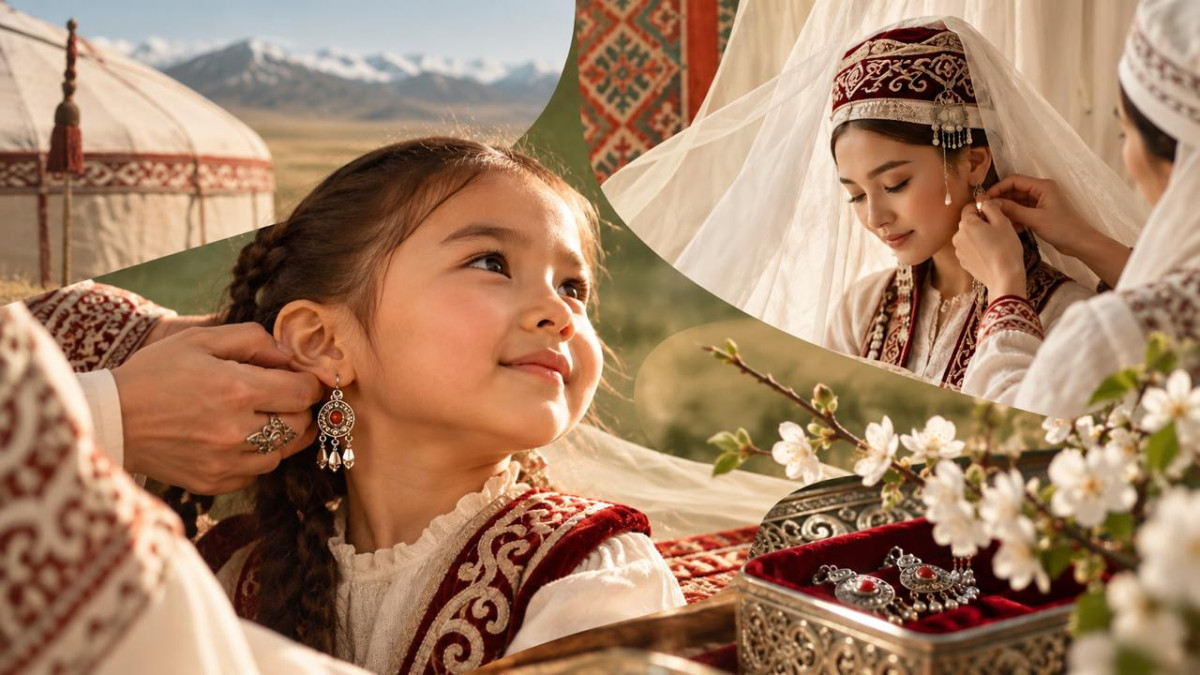
Syrga toi is one of the traditional Kazakh rites associated with girls. Today, some people confuse syrga toi with syrga salu. However, the two traditions have different purposes and meanings. The former is a celebration marking the occasion when a young girl has her ears pierced and wears earrings for the first time. The latter is a betrothal ceremony. In this article El.kz explores the origins of syrga toi, its role in upbringing, and the differences between these two traditions.
Kazakh culture has developed numerous rites associated with a child’s growth and transition to adulthood. One of these is syrga toi, a celebration held when a girl’s ears are pierced and she wears her first earrings.
According to the founder of the Qara Shanyraq School of Traditional Upbringing and a historian and ethnologist Turar Sattarkyzy, some families in the past marked this occasion by gathering relatives. A girl wearing earrings for the first time was regarded as one of the signs that she was beginning to mature.
Syrga toi was also closely linked to the girl’s upbringing. The mother and zhenge, the wives of older male relatives explained to the girl, upon her receiving her first earrings, what it meant to grow into womanhood. They also encouraged her to develop handicraft skills, neatness and good manners.
This tradition was reflected in a customary blessing: “May our daughter wear her earrings and grow into a worthy young woman.” The words expressed the hope that the girl would grow up healthy and well-mannered.
At what age were girls’ ears pierced?
Accounts differ regarding the age at which girls traditionally had their ears pierced. Some descriptions of the custom refer to the age of five, while writer and ethnographer Zeinep Akhmetova explains in her book Kureтамyr that girls’ ears were most commonly pierced from the age of 7.
According to Akhmetova, particular attention was paid to a girl’s upbringing from this age. Mothers and zhenge taught girls ornamental cutting and other handicrafts. In this way, ear piercing was associated with the transition from childhood towards maturity.
Ethnologist Turar Sattarkyzy also draws attention to this aspect of the tradition:
“Are Kazakh customs not a genuine school of upbringing? Yet, in recent years, such beautiful traditions of ours as kursak shashu, shildekhana, besik toi, tusaukeser, and the piercing of girls’ ears have undergone changes,” she says.
In the specialist’s view, some parents today have their daughters’ ears pierced for aesthetic reasons, often overlooking the rite’s educational significance.
What did earrings sumbolise in Kazakh culture?
In the traditional Kazakh worldview, earrings were valued not merely as ornaments but also as items of jewellery carrying symbolic meaning. Folk beliefs attributed special properties to gold and silver adornments. One such belief held that earrings could protect a girl from the evil eye. This, however, is a traditional folk belief rather than a scientifically established property.
Giving a girl her first earrings was also regarded as a gesture of respect and an expression of good wishes for her future. Ethnographic studies further indicate that jewellery served to signify a person’s social status and position within the system of traditional rites.
What is the difference between Syrga Toi and Syrga Salu?
Although both rites involve putting earrings on a girl, their purposes differ.
Syrga toi is a family celebration marking the occasion when a young girl has her ears pierced and receives her first earrings. The tradition is associated with her growth and upbringing.
Syrga salu is a betrothal rite. The groom’s family would place earrings on the bride, thereby confirming that the two families had agreed to proceed with the betrothal. This was regarded as a sign that the girl was formally promised in marriage.
Betrothal customs, however, were not uniform across all regions. In some areas, instead of earrings, a girl might be adorned with an owl feather, a tanu ornament or another piece of jewellery.
Therefore, syrga toi should not be confused with the rite of placing earrings on a prospective bride. The former marks the beginning of a girl’s transition towards maturity, while the latter is associated with betrothal prior to marriage.
How is this forgotten tradition being revived?
Today, various initiatives seek to reintroduce the public to traditional Kazakh rites. One such initiative is the work of the Qara Shanyraq School of Traditional Upbringing, led by Turar Sattarkyzy. The organisation also promotes syrga toi as part of the traditional system of upbringing.
“If we look closely, the Kazakh people have been wise since ancient times, attaching great importance to the upbringing of future generations. Whatever Kazakh custom we consider, it has deep educational principles, profound knowledge and a lesson drawn from life at its core.
“From the moment a child was born until they reached adulthood, our people marked every stage of life with a particular rite. Shildekhana, besik toi, tusaukeser and tilashar are not merely celebrations; each tradition has its own meaning and educational value.
“Through these traditions, our ancestors instilled kindness and humanity in children, taught them to respect their elders and care for those younger than themselves. Particular attention was also given to raising sons and daughters to become respected members of society, valued members of their families, and thoughtful, wise individuals.
“In other words, every Kazakh custom is intended to raise future generations to be worthy, educated, strong in spirit and noble in character. Therefore, we should regard tradition not only as a legacy of the past but also as an important means of educating the younger generation,” Turar Sattarkyzy noted.
Today, there is no single mandatory procedure for conducting syrga toi. Each family may celebrate the occasion according to its own preferences. Nevertheless, efforts to revive the tradition should prioritise a proper understanding of its historical and educational significance over its outward ceremonial aspects.
The central purpose of syrga toi is to mark a new stage in a girl’s life, show her respect and preserve the continuity between generations.
