

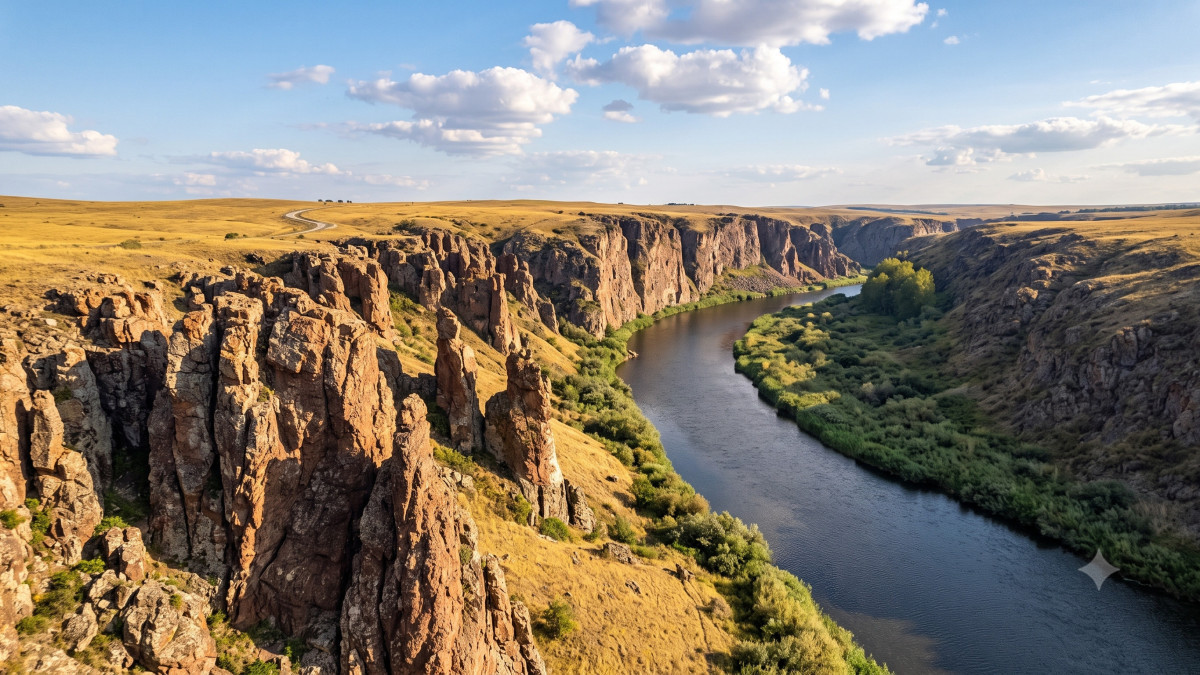
Located just two hours’ drive from Astana, the Seleti Canyons offer a remarkable natural destination that requires no international travel. Situated near the settlement of Bestobe, the canyons were formed over hundreds of millions of years, yet their fragile ecosystem came close to being significantly damaged within only a few summer tourist seasons. This article explains how to reach the site in a standard passenger vehicle, why its waters are regarded among the cleanest in the country, and what environmental cost the destination has already incurred as a result of its growing popularity.
The route follows the Kokshetau Highway, with a turn toward Akkol at the QazOil filling station, continuing through the settlement of Azat, via Stepnogorsk, and onward to Bestobe. After passing Seleti, the paved road gives way to a gravel section. While the route remains passable for conventional passenger vehicles, drivers are advised to proceed with caution. Local residents recommend parking at the top of the canyon rather than attempting to drive down the steep descent, and completing the final section on foot.
Pristine waters and scenic landscapes
The Seleti River originates in the Kazakh Uplands and is fed by underground springs, allowing the water within the canyon to remain exceptionally clear and cold even during the hottest months. Local residents often note, with a touch of humor, that crayfish inhabit the river - a widely recognized indicator of high water quality, as these species are typically found only in clean freshwater environments.
The canyon is characterized by steep cliffs and dramatic escarpments, with numerous vantage points overlooking the river valley and suitable areas for temporary stops. In its upper reaches, the river valley extends up to 700 metres in width, while the river channel narrows in places to just 40–50 metres, creating a striking contrast between the confined canyon landscape and the surrounding open steppe.
During late spring, increased water flow produces strong currents, attracting enthusiasts of diving and rock climbing. The presence of balbals - ancient stone anthropomorphic monuments located along the riverbanks adds an important cultural and historical dimension to the site’s outstanding natural heritage.
Geological formation and environmental challenges
According to geological research, the canyon’s rock formations date back to the Carboniferous Period, reflecting several hundred million years of geological evolution shaped by the combined effects of water erosion and wind weathering. The gradual erosion and removal of successive rock strata produced the present-day landscape of steep cliffs and narrow gorges, creating scenery that has become a popular destination for nature photography.
In recent years, however, the site has experienced the environmental consequences of rapidly increasing visitor numbers. Following extensive promotion through social media platforms, growing tourist flows resulted in significant littering. Residents of the nearest village were compelled to organize voluntary clean-up efforts, and access to the canyon was temporarily restricted in order to protect the area.
Today, one message is consistently repeated in the comments accompanying nearly every online publication about the canyon: visitors are urged to take all waste with them upon departure. Compliance with this principle is essential to preserving the site. Without responsible visitor behaviour, the destination may once again face access restrictions, as has occurred previously.
