

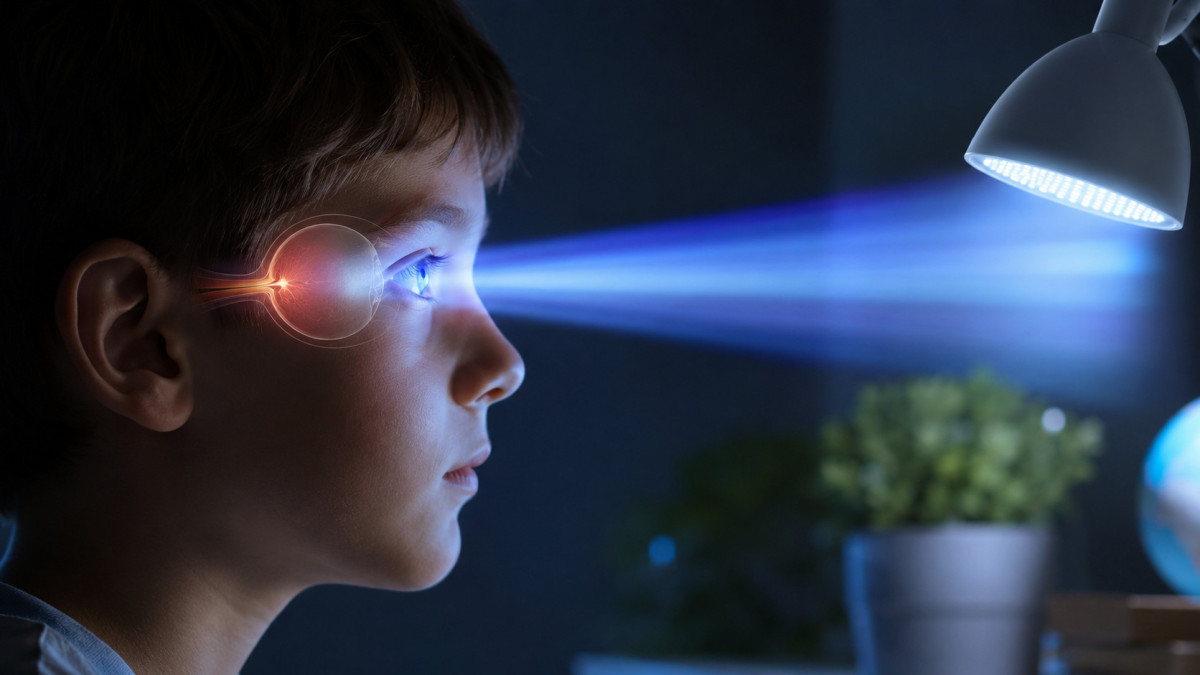
Researchers from Cincinnati Children’s Hospital and the University of Alabama have identified a range of indigo light that, in experiments, completely suppressed the development of myopia in animals, El.kz reports.
The light in question has a wavelength of 419–446 nanometres. According to the researchers, this range was the most effective in preventing myopia. Indigo light is present in the natural solar spectrum, but it is significantly less prevalent in standard indoor artificial lighting. The researchers suggest that a lack of certain short-wavelength light in modern urban environments may be one of the factors contributing to the increasing prevalence of myopia.
To test this hypothesis, the researchers conducted a series of experiments on tree shrews - small mammals whose visual system shares certain similarities with that of humans. The animals were fitted with special lenses designed to induce the development of myopia and were subsequently kept under lighting with different spectral compositions. The researchers regularly measured the length of the animals’ eyes and changes in their refractive error.
The study found that exposure to indigo light completely suppressed the characteristic elongation of the eye associated with myopia. Richard Lang, Director of the Ophthalmology Research Department at Cincinnati Children’s Hospital and one of the study’s authors, believes that the observed effect may potentially also occur in humans. However, this hypothesis will require confirmation through clinical studies involving human participants.
The researchers attribute the findings to the activity of the light-sensitive receptor OPN5, which is involved in regulating eye development. A similar effect had previously been observed in mice exposed to violet light. However, wavelengths of around 380 nanometres are unsuitable for further application because the human lens blocks a significant proportion of light below 400 nanometres.
The researchers suggest that the discovery could eventually lead to the development of new types of lighting or devices designed to prevent myopia. Glasses with integrated light-emitting diodes (LEDs) that emit indigo light are already being developed; however, the effectiveness of this approach in humans has yet to be established.
Myopia is becoming an increasingly widespread public health concern. According to researchers’ estimates, by 2050 the global number of people with myopia could reach approximately 4.8 billion, accounting for nearly half of the world’s population.
