


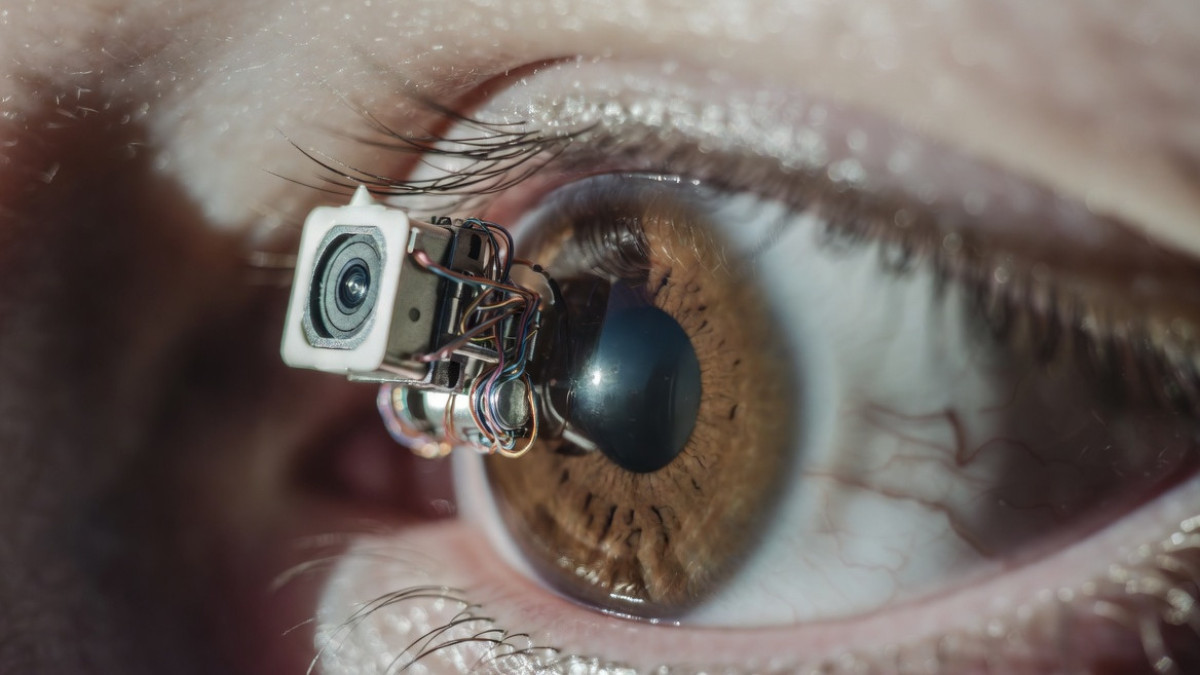
An artificial retina could restore sight and grant humans "night vision," El.kz reports.
South Korean scientists have presented a prototype of an artificial retina capable of partially restoring vision and expanding perceptual capabilities including vision in the infrared spectrum. So far, the technology has been successfully tested only on animals.
Many forms of blindness are associated with the destruction of photoreceptors cells that convert light into nerve signals.
However, the ganglion cells that transmit information to the brain often remain intact. Researchers decided to leverage this feature and developed a device that bypasses the lost photoreceptors. The technology is based on an array of phototransistors that amplify near-infrared light, as well as soft microelectrodes made of liquid metal. These electrodes transmit signals directly to the retinal ganglion cells. Experiments showed that after implantation, blind mice began to respond to infrared radiation. The device also successfully integrated into sighted animals: they did not lose their normal vision but gained the ability to perceive infrared light. The developers note that the implant does not interfere with natural sight. If only a portion of the retina is damaged, the healthy areas continue to function in the normal light range. However, the question remains as to how the human brain will interpret two perception channels simultaneously.
The technology is currently in its early stages: the prototype has an extremely low resolution just 6×6 pixels and requires an external power source. Before clinical trials can begin, scientists must prove the safety and efficacy of the development. The results of the study were published in the journal Nature.
