

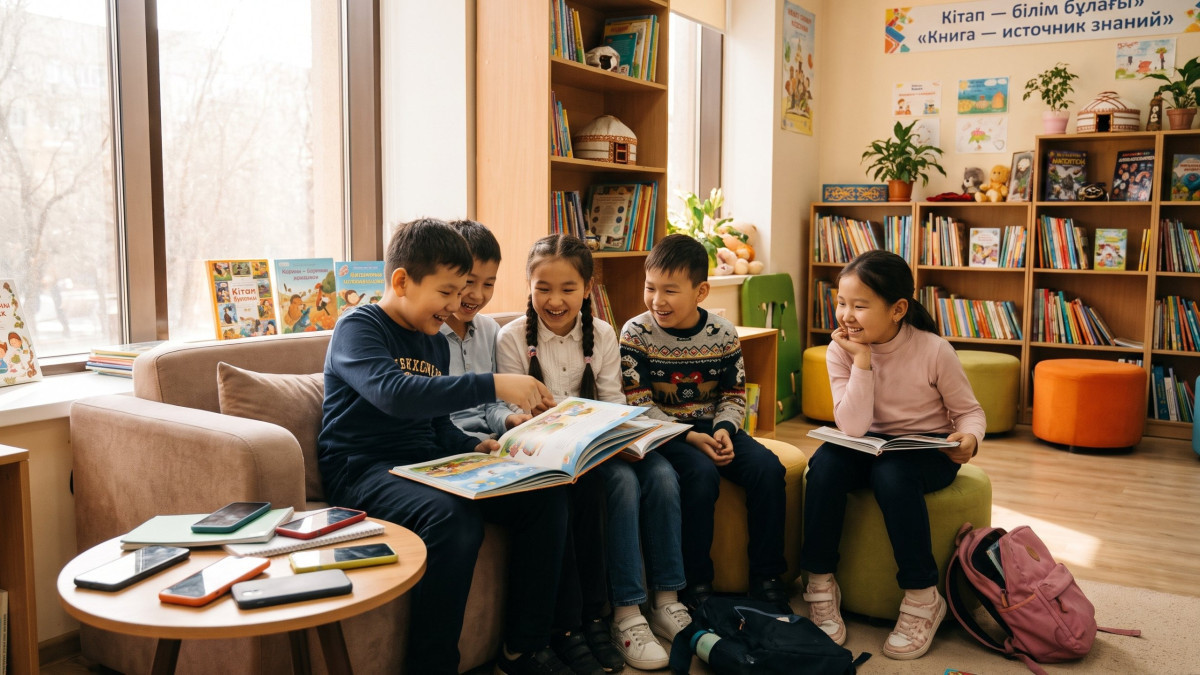
Kazakhstan is preparing to launch a five-year programme to promote reading. Its defining feature is already reflected in its title: the development of a reading culture is to take place with due regard to the fact that artificial intelligence is transforming both the ways in which people acquire knowledge and their ability to think independently.
Presidential Instructions
On May,16, 2026, the Head of State signed a Decree “On Measures to Promote a Reading Culture and Foster a Reading Nation”. The document is aimed at developing human capital, strengthening the intellectual and cultural potential of society, and promoting reading as an essential component of education and personal development.
The Decree requires the Government to approve, by the end of 2026, the Concept for Promoting a Reading Culture and the Book Industry in the Context of Artificial Intelligence Development, entitled “Reading Nation”, for 2027–2031.
In addition to adopting the Concept, the Government has been assigned several tasks. By January,1, 2027, it is required to draft a new Law “On Library and Publishing Activities”, establish a National Award for Achievements in Promoting a Reading Culture, and create a National Digital Library Platform providing unified access to library resources. The Government will also be required to submit annual progress reports on the implementation of the Concept to the Presidential Administration.
“We can confidently state that fostering a culture of reading is a fundamental requirement for building a civilised society and shaping a progressive nation,” President Kassym-Jomart Tokayev emphasised.
Key Priorities of the Concept
The Concept provides for the development of digital reading culture, the formation of an intellectually engaged society, the transformation of the book industry into a sector of the creative economy, and the promotion of Kazakhstani literature internationally.
The draft document is already being discussed across the regions. A round-table discussion involving representatives of government agencies, librarians, writers, poets, journalists and publishers was held at the National Library in Almaty. The draft envisages a systematic approach to developing a reading culture, supporting domestic authors and publishing houses, modernising libraries, and establishing reading as a sustainable habit among the population. Similar meetings have been held in Shymkent and Atyrau.
Why Books Still Matter in the Age of Artificial Intelligence
Experts from the Kazakhstan Institute for Strategic Studies under the President explain why artificial intelligence features so prominently in the Concept.
Gulmira Tukanova, Chief Expert of the Strategic Analysis Division, notes that artificial intelligence tools provide instant answers, but speed alone does not teach people to reason independently. “Reading is not the only means, but it is a cornerstone in developing critical thinking skills,” she believes.
Myrzabek Tuiganov, Chief Expert of the Regional Studies Division, warns that the volume of information is growing faster than people’s ability to comprehend it. “This creates a dangerous gap between the amount of information available and the depth of understanding,” he points out.
According to Marat Zhumagulov, Chief Research Fellow, reading should become a natural part of everyday life rather than a formal obligation. “It is important to establish a sustainable motivational environment,” he emphasises.
Where It All Began
There are reasons for concern. Kazakhstan previously featured in a CEOWORLD magazine ranking of countries with the lowest levels of book readership.
However, the initial initiatives are already producing results. Last year, the Reading Nation project was piloted in the Karaganda and Kostanay regions and in Shymkent, attracting nearly 190,000 readers. Kostanay region ranked first in the project’s 2025 results.
In September 2026, the nationwide “Reading Nation” marathon was launched. Over a six-month period, participants can read 15 books, write reviews and compete for cash prizes of up to 600,000 tenge.
The project comprises seven categories: school students, college and university students, teachers, families, civil servants and the “intellectuals” category. Participants select books from a list of 330 titles, comprising 165 works in Kazakh and 165 in Russian. The list includes works by domestic authors, world literary classics and contemporary literature.
More than 1.4 million participants have registered on the platform. They have read over 842,000 books and published more than 50,000 video reviews.
Libraries of a New Generation
Libraries represent another key area of the initiative. As of January,1, 2026, there were 3,912 public libraries operating across the country, with more than 55.2 million visits recorded in 2025. Under the project, 36 urban and rural libraries have already been modernised, with a further 30 scheduled for upgrading in 2026.
Nevertheless, significant challenges remain. As of July,1, 2026, Kostanay region had 337 libraries, only 158 of which had internet access. Experts warn that without a comprehensive approach to addressing funding and digitalisation challenges, the library network may be preserved while its core purpose and functions are undermined.
Minister of Culture and Information Arman Kyrykbayev announced that the National Library in Almaty would extend its opening hours until midnight. “Digitalisation and artificial intelligence are creating new opportunities for creativity and expanding access to cultural heritage,” the Minister noted.
Reading Clubs from Early Childhood
The regions are already preparing for the next phase of the initiative. Starting on December,1, 366 reading clubs will open in 122 schools in Astana, bringing together students, teachers and parents.
A further 200 clubs will begin operating in 100 kindergartens across the capital under the “Reading Teacher” and “Reading Family” initiatives, which will encourage teachers and parents to read books together.
The “Reading Nation” Concept is intended to bring all these initiatives together within a unified five-year framework. Its objective is to ensure that, in a world where artificial intelligence can provide an instant answer to virtually any question, the people of Kazakhstan retain their ability to think independently.
