

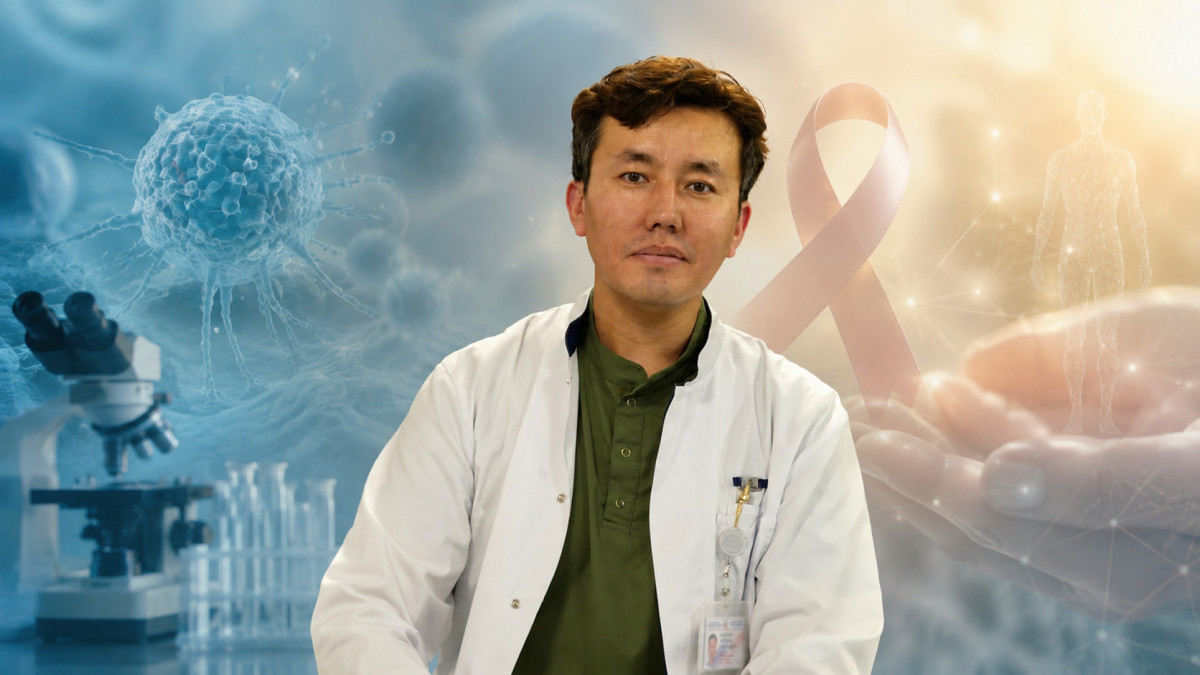
Approximately 40,000 people are diagnosed with cancer in Kazakhstan every year. What is behind the annual increase in this figure? How long does treatment for cancer take, and what is the likelihood of recurrence? These questions were addressed by Kuantkan Zhabagin, an oncologist at the Hospital of the Medical Center of the Presidential Affairs Administration of the Republic of Kazakhstan, in the MedRoom podcast.
According to the specialist, the increase in the number of cancer cases is not unique to Kazakhstan but reflects a global trend. It is driven by population growth, increased life expectancy, and advances in medical diagnostics.
“The medical situation in rural areas during our childhood cannot be compared with the present day. Today, even rural healthcare facilities are equipped with ultrasound, computed tomography and magnetic resonance imaging systems,” Kuantkan Zhabagin said.
According to the oncologist, when he began his professional career, approximately 20,000 people in Kazakhstan were diagnosed with cancer each year. This figure subsequently increased to 35,000 and has now reached approximately 40,000.
At the same time, the physician believes that there is no need to be alarmed by the increase in the number of cancer cases. In his view, the key challenge is the late detection of malignant tumors, particularly at advanced stages.
Early detection is critically important
One of the key objectives of Kazakhstan’s oncology service is to detect cancer at an early stage. To this end, screening programmes are implemented, while oncology examination rooms operate at primary healthcare facilities.
“The objective of the oncology service is to detect the disease at an early stage. Screening programmes and oncology examination rooms are available at all outpatient healthcare facilities. People should visit an oncology examination room once a year and undergo an examination,” the physician noted.
According to the specialist, the duration and type of treatment vary depending on the type of malignant tumor. For example, the treatment strategy for breast cancer differs from that for lung cancer.
Some patients receive chemotherapy before surgery in order to reduce the size of the tumor or localise it to a specific area. Additional chemotherapy or radiation therapy may be required after surgery. In some cases, treatment takes several months, while in others it may continue for up to two years.
Even patients with the same diagnosis may require different treatment approaches
In modern oncology, the principle of applying the same treatment approach to all patients is gradually becoming a thing of the past. Treatment strategies are determined on an individual basis, taking into account the diagnosis, type and characteristics of the tumor, as well as other relevant factors.
For this reason, the physician advises patients not to compare their situation with that of other people.
“Today, each patient has an individual treatment strategy. Patients should not compare themselves with other patients. I always tell my patients to ask their doctor any questions they may have, because accurate information gives the patient a clear path forward. Kazakhs use the expression ‘жолың ашық болсын’ not only when seeing someone off on a journey, but also in the sense of knowing clearly what you are going to do in life. If the patient and physician work as a team, treatment will be effective,” the oncologist said.
According to the physician, mutual understanding between the patient and doctor is essential throughout the treatment process. Patients need to understand their diagnosis and treatment plan and feel comfortable asking their doctor questions.
Can a malignant tumor recur?
Cancer recurrence is not uncommon in clinical practice. Therefore, the physician advises caution when using the phrase “completely cured of cancer.”
In oncology, transforming a malignant tumor into a chronic, controllable disease is already considered a significant achievement. In some cases, individual tumor cells that cannot be detected using available diagnostic methods may remain in the body after treatment. They may remain inactive for a period of time before becoming active and beginning to proliferate again.
“A malignant tumor is highly adaptable. These are also our own cells, but they are a type of cell that no longer responds to the regulatory mechanisms of the body. We watch a lot of films about zombies. I would compare tumor cells to zombies because they do not obey anyone. Sometimes they do not respond to the prescribed treatment. Tumor cells can adapt to chemotherapy. In such cases, doctors have to change the treatment regimen,” the oncologist said.
There is a view that factors such as stress, an unhealthy diet, or a weakened immune system may contribute to the reactivation of the disease. In addition, tumor cells can adapt to treatment and become resistant to certain medicines. In such cases, physicians may modify the treatment regimen.
Cancer is not necessarily “getting younger”
Kuantkan Zhabagin disagrees with the view that cancer is “getting younger.” According to him, advances in diagnostic capabilities make it possible to detect diseases earlier and more accurately than before.
Certain types of malignant tumors occur in children and adolescents as well. For example, some types of blood cancer are more commonly diagnosed in children. In addition, some children are born with congenital oncological conditions.
The specialist therefore emphasised that cancer is not associated with age. The key priority is to detect the disease in a timely manner and initiate the necessary treatment without delay.
