

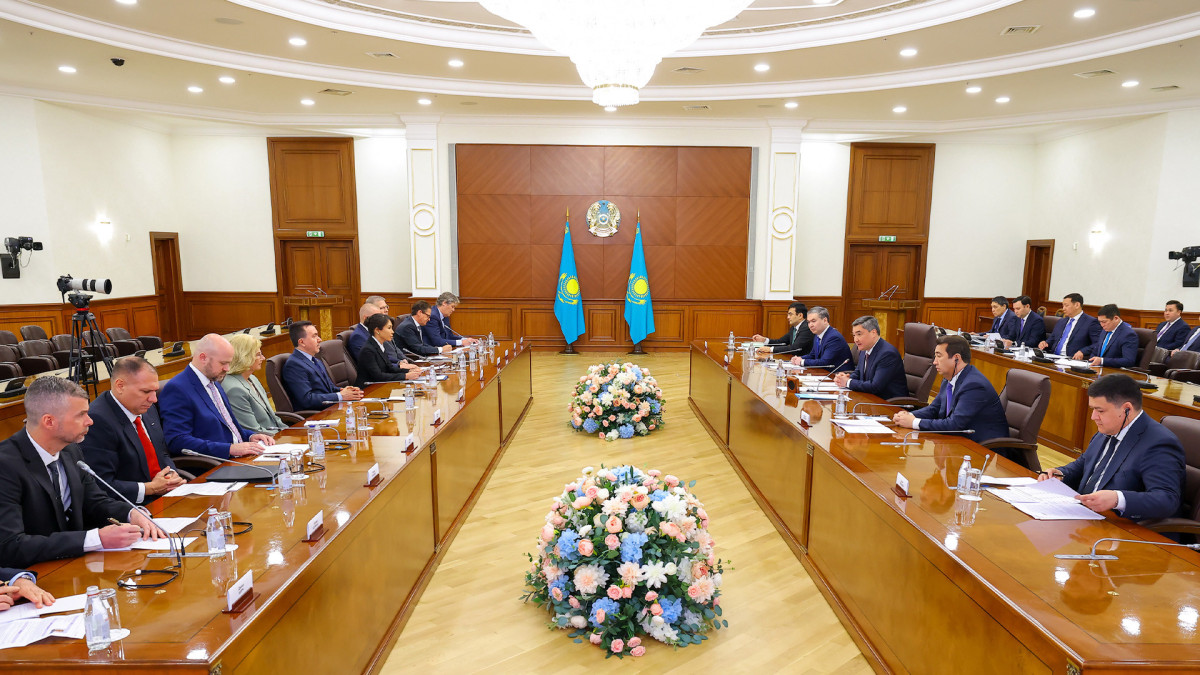
Prime Minister Olzhas Bektenov held a meeting with heads of leading foreign companies in the agricultural machinery sector from Europe, Canada, and the USA. The meeting, held in line with the Head of State’s instructions on the development of mechanical engineering and import substitution, focused on deepening industrial cooperation, localizing production, and introducing modern agricultural technologies at domestic enterprises, El.kz cites primeminister.kz.
The Prime Minister emphasized that the growing needs of the agricultural sector create a stable and predictable market for agricultural machinery. Kazakhstan ranks 6th in the world by area of agricultural land. Sown areas amount to about 24 million hectares. The gross output of agriculture last year exceeded 9 trillion tenge, with growth of more than 6%. Grain harvest reached 26 million tons, and oilseeds — 5 million tons.
“President of Kazakhstan Kassym-Jomart Tokayev pays special attention to the development and enhancement of the technological potential of the agricultural sector. Growth in production volumes, increased productivity, and expansion of export supplies raise the requirements for the technical equipping of farmers. Therefore, machinery renewal, its availability, and support for domestic producers are considered as basic conditions for the further development of the industry. Kazakhstan’s partnership with leading foreign manufacturers is of a stable, mutually beneficial nature and is oriented toward long-term cooperation. The Government is ready to create conditions for new production facilities with project support at all stages — from localization to entering foreign markets,” Olzhas Bektenov emphasized.
More than 130,000 tractors, about 30,000 combines, and over 200,000 units of trailed and mounted equipment are currently in operation in the country. At the same time, the level of fleet renewal last year was 6.5%. The target is to bring this indicator to 10% annually. To achieve this, the state has built a consistent system of support measures, including subsidies of up to 30% of the cost of machinery, reduction of credit and leasing burdens, and preferential financing at 5% for domestically produced equipment. The measures taken are already yielding results — over the past two years, the volume of domestic machinery sales has increased by 35%, from 7,700 to 10,400 units, with demand shifting toward more complex and high-tech machines. Currently, 8 large enterprises operate, producing over 8,000 tractors and 1,200 combines annually. The share of domestic machinery in the domestic market has reached about 90%.
International partners expressed interest in further deepening localization, technology transfer, development of service infrastructure, and expanding their presence in the Kazakh market. Issues of forming a complete technological chain and improving the availability of modern high-tech machinery for domestic farmers were discussed.
“The consistent industrial policy of the President and the Government has created a foundation of trust. First, the market leader John Deere entered the country, and this success became a powerful signal: today we see how other global players have followed. We are adopting new technologies, implementing advanced standards, improving the qualifications of our technical specialists, and are ready to provide farmers with high-tech machinery of Kazakhstani production,” Dinarа Shukizhanova, President of JSC AgromashHolding KZ, said.
“We highly value Kazakhstan’s openness to long-term cooperation and the conditions created for investors. An important step in our partnership was the strategic localization agreement signed in November last year in Kostanay. Our company plans to produce about 3,000 units of equipment in the coming years. John Deere views Kazakhstan as its main strategic partner in Central Asia. We are ready for further localization and increased productivity. We plan to produce modern machinery with attention to digitalization and sustainable development of agriculture,” Peter Sachse, Vice President of John Deere for CIS countries, noted.
“Thanks to the new mechanisms, a fundamentally new level has been achieved in agriculture. The created investment and institutional climate makes Kazakhstan an attractive platform for foreign investment in the context of technology transfer, localization, and long-term project development. In addition, I would like to note the importance of human capital. We have launched a program for training and subsequent employment,” Sergey Glokke, Chief Operating Officer of Eurasia Group AG, emphasized.
Kristina Stark, Member of the Board of Directors of Väderstad Group (Sweden) — a leading manufacturer of agricultural machinery sold in more than 40 countries — noted interest in expanding cooperation with Kazakhstan: “Our company plans to become a stable partner of Kazakhstan and participate in the development of the country’s agriculture. The development of our cooperation potential will ensure the production of new products focused on the needs of Kazakhstani farmers.”
Readiness for further development of partnership was also expressed by top managers of companies Dewulf – Hendrik Dekramer, Amity Technology – Mike Sprenger, Lindsay Corporation – Richard Harold, Frans Vervaet B.V. – Robin Vervaet, Brandt – Philip Korczak, Kuhn Group – Jackie Kirch, and others.
From the Kazakh side, comments were heard from Ministers of Industry and Construction Yersaiyn Nagaspayev, Agriculture Aidarbek Saparov, and Chairman of the Board of Baiterek Holding Rustam Karagoyshin.
Following the meeting, a ceremony was held to sign multilateral agreements aimed at localizing agricultural machinery production in Kazakhstan based on the production facilities of the Localization Center in Kostanay.
Agreements were concluded between JSC AgromashHolding KZ, LLP Eurasia Group AG, and leading global manufacturers — Väderstad Group, Dewulf, Lindsay Corporation, Amity Technology, Frans Vervaet B.V., Kuhn Group, and Brandt.
The implementation of these agreements is aimed at strengthening the potential of the industry and reinforcing Kazakhstan’s status in the global industrial production system.
