

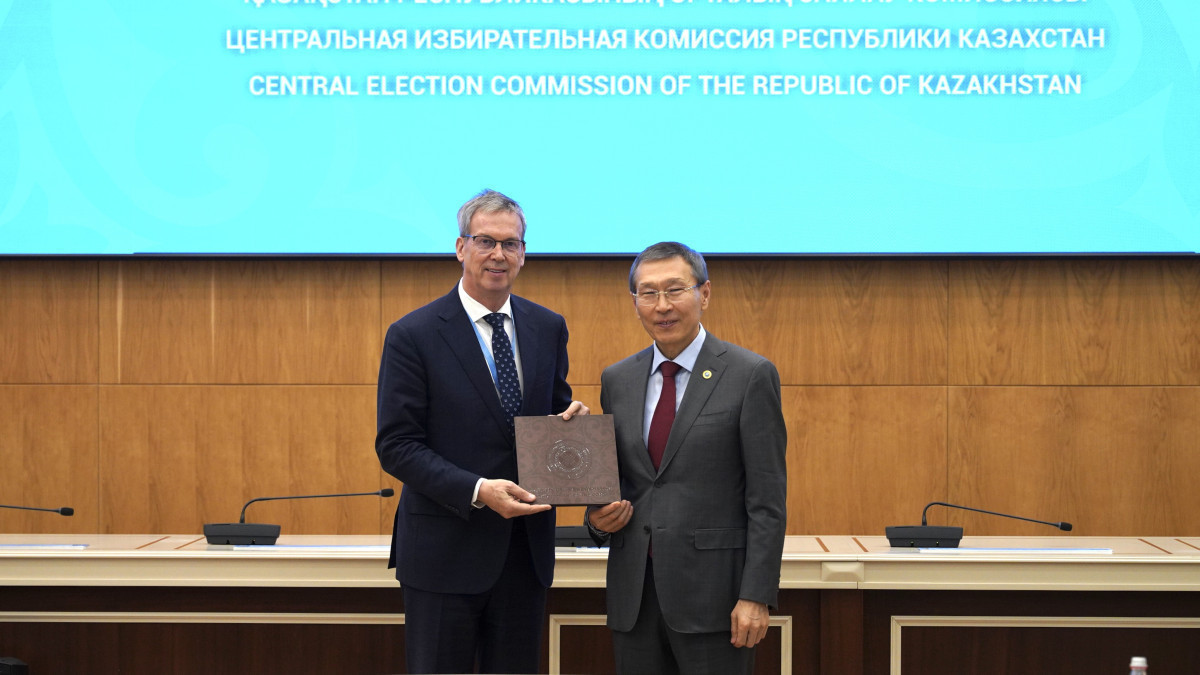
The OSCE ODIHR mission gave high marks to the technical organization of the elections of Kurultai deputies in Kazakhstan. At the same time, the observers noted that it was incorrect to call the elections "early parliamentary."
The results of the campaign were discussed at a final meeting between CEC Chairman Nurlan Abdirov and the head of the OSCE ODIHR mission, Vincent Piket. According to Piket, the work carried out by the Central Election Commission proved effective and was performed at a high technical level, with the commission applying a methodical approach in preparing regional and local polling stations.
Dispute over wording
The meeting separately addressed the wording used by the mission in its preliminary statement. Nurlan Abdirov noted that it was incorrect to call the elections "early parliamentary," since the Kurultai represents a new political institution created as a result of constitutional reforms.
The CEC recalled that the transition to a unicameral parliament was proposed by the President back on September 8, 2025, after which preparation of the corresponding amendments began. In the commission's view, the decree calling the elections was merely the final legal stage of a process already underway, rather than a decision to dissolve the previous parliament early.
According to the CEC, 7,567 seminars were held in preparation for the elections, reaching 71,270 members of election commissions. A further 1,131 separate events were organized for representatives of political parties, media, and public organizations, involving 23,323 people.
The commission paid particular attention to personal data protection, accessibility of polling stations for people with disabilities, and working conditions for observers.
Observers and the absence of complaints
On election day, more than 51,000 national observers and 7,003 authorized representatives of political parties worked at polling stations. International observation was provided by 777 accredited observers from 42 countries and 13 international organizations.
Nurlan Abdirov stated that the institution of observation is not a formality for the commission but a crucial element of an open electoral process, and that throughout the campaign the CEC did not deny accreditation to public associations or revoke certificates already issued. According to him, no reports of procedural violations were received from observers on election day, and no official complaints from observers or journalists were recorded.
What's next
In its preliminary conclusions, the OSCE ODIHR mission noted that the campaign generally proceeded calmly and in an organized manner, and that the commissions observed the deadlines set by law. The mission will present its final conclusions and recommendations later in its final report.
The CEC stated that after the final document is published, it will study all recommendations, including at meetings of the Expert Council under the Central Election Commission.
