

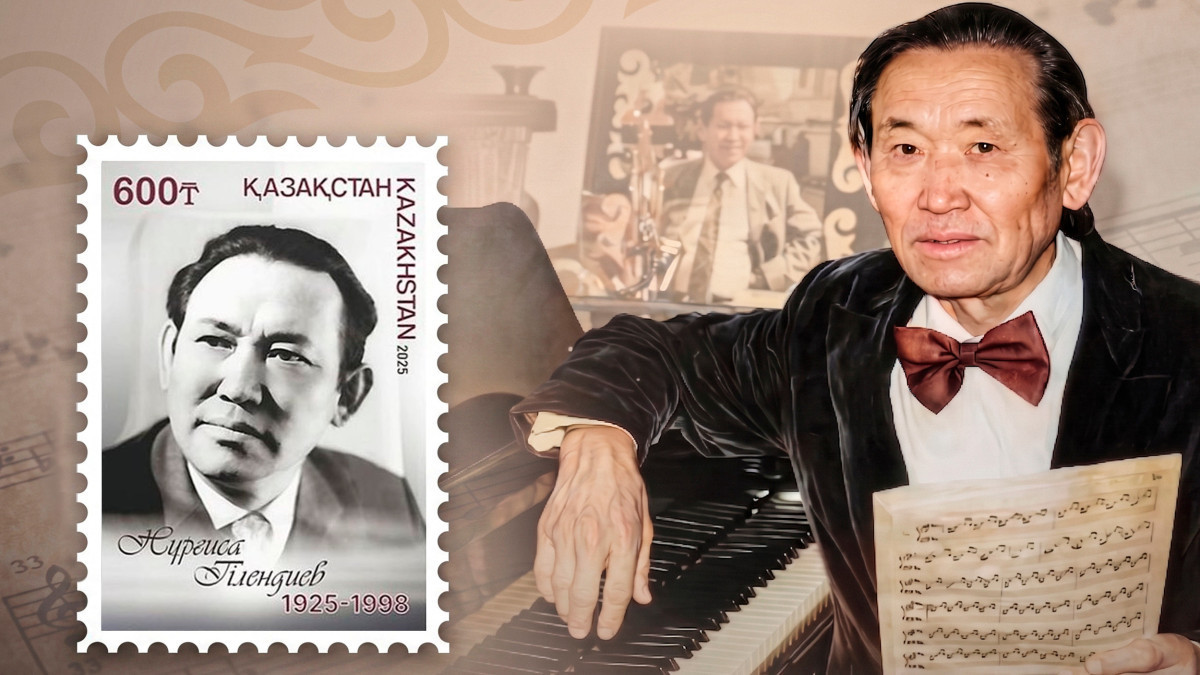
In the history of Kazakh culture, there are names become part of the nation’s very breath. Nurgisa Tlendiyev was exactly such a person. In this article El.kz presents the art of the great composer.
The Voice of the Steppe and National Memory
Nurgisa Atabayevich Tlendiyev was born on April 1, 1925, in Shilikemer village of the Almaty region. He passed away on October 15, 1998, in Almaty. Official biographical sources describe him as a Kazakh composer, conductor, and dombra player, a People’s Artist of the Kazakh SSR, a People’s Artist of the USSR, and a National Hero (Halyk Kaharmany) of Kazakhstan.
Childhood, the Dombra, and First Music Lessons
His father taught the young boy to play the dombra, while his mother, according to accounts, was also musically gifted and played the syrnay (a traditional flute). In his childhood, there was no boundary between song and daily life: music accompanied labor, celebrations, and family memories. Later, this sense of the naturalness of folk music would become one of Tlendiyev’s defining traits.He did not merely "decorate" folklore with academic forms; he revealed its inner power.
A decisive turning point in young Nurgisa’s life was his meeting with Ahmet Zhubanov. In 1933, Zhubanov brought the boy to a music college that housed the Kurmangazy Orchestra of Folk Instruments. By the age of twelve, Tlendiyev was appointed concertmaster, and by fourteen, he was a conductor. For Kazakh music, this was a symbolic scene: a boy with a dombra, raised in the tradition of the steppe, entering the world of professional art and leading an orchestra.
Tlendiyev considered Ahmet Zhubanov his primary mentor. Zhubanov taught him not only musical literacy but a special attitude toward art: how to understand both folk and classical music, how to work hard, and how to love life in all its manifestations. This lesson proved vital. In Tlendiyev’s work, the academic school did not suppress the folk source; rather, it gave it space, discipline, and scale.
War, Education, and the Making of a Conductor
During the Great Patriotic War, Nurgisa Tlendiyev volunteered for the front. After demobilization, he continued his education, studying at the Kurmangazy Kazakh State Conservatory and later graduating from the conducting faculty of the Moscow Conservatory under Professor Nikolai Anosov.
Theatre Work and the Creation of "Otyrar Sazy"
Following his studies, Tlendiyev worked at Kazakhstan’s leading musical venues. From 1953 to 1961, he was the chief conductor of the Abay Kazakh Opera and Ballet Theatre. From 1961 to 1964, he headed the Kurmangazy Kazakh State Academic Orchestra of Folk Instruments. Later, he served as the director of the Abay Opera and Ballet Theatre, and from 1968 to 1981, he was the chief music editor at the "Kazakhfilm" film studio.
A special chapter of his life is linked to the "Otyrar Sazy" orchestra.
In 1980–1981, a folklore-ethnographic ensemble was created, which Tlendiyev led as artistic director and conductor. In 1982, the ensemble attained the status of an orchestra. "Otyrar Sazy" became more than just a performing group; it was a musical laboratory of national memory. Under Tlendiyev, ancient instruments and archaic intonations resonated on the big stage with a modern, powerful, and solemn voice.
Under his leadership, "Otyrar Sazy" became a laureate of the World Festival of Youth and Students, the Lenin Komsomol Prize, and the Jambyl International Foundation Prize. Perhaps more important than any official titles, the orchestra helped several generations hear folk music not as a museum exhibit, but as a living language. Tlendiyev knew how to transform antiquity into the present.
Musical Heritage and Kuis That Became Classics
The composer’s creative legacy is immense. He is credited with over 500 works across various genres: songs, kuis, romances, overtures, poems, cantatas, and music for theatrical productions and films. Among his famous compositions are the kuis "Akku," "Ata Tolgauy," "Alkissa," "Makhambet," and "Farabi Sazy," as well as the songs "Saryzhailyau," "Alatau," "Akzhaiyk," and "Oz Elim." His music was featured in feature films, documentaries, and animated films, including My Name is Kozha, Kyz-Zhibek, and Aksak Kulan.
For Tlendiyev, the orchestra was not a mechanical collection of instruments; it sounded like a polyphonic nation, where every timbre maintained its own character.
Recognition and State Awards
Throughout his life, Nurgisa Tlendiyev received the highest titles and awards. He was an Honored Artist of the Kazakh SSR, a People's Artist of the Kazakh SSR, a People's Artist of the USSR, and a laureate of the State Prize of the Kazakh SSR. In 1998, he was awarded the Republic of Kazakhstan’s highest title, "Halyk Kaharmany" (National Hero), along with the Order of Otan. These awards were not just state recognition; they showed that Tlendiyev had become a figure of national scale during his lifetime. His music accompanied the Soviet era, the independence of Kazakhstan, and the formation of a new cultural memory. He belonged to his time but was not dissolved by it. On the contrary, with each passing year, his works have come to sound even deeper because they were built on human and national foundations rather than political ones.
Memory of Tlendiyev: Museums and Monuments
Since the composer’s death, his memory has lived on in the names of schools, streets, museums, monuments, and concerts. In 2014, the Nurgisa Tlendiyev Memorial Museum was opened in Almaty in the house where he spent his final years with his family. The museum houses handwritten scores, personal photographs, belongings, an antique grand piano, orders and medals, and his famous dombra, named "Dariga."
The museum is more than a memorial apartment; it is a quiet continuation of his music. The atmosphere is as important as the exhibits: the desk, the instruments, family photos, and everyday objects. They return Tlendiyev from the realm of bronze statues and portraits back to the human dimension. Visitors see not an abstract "classic," but a man who lived, wrote, hosted guests, listened, remembered, and searched for the perfect sound.
Monuments to Tlendiyev have been erected in various cities across Kazakhstan. In Almaty, a bronze monument was unveiled in 2011 in the park near the Central State Museum. A monument appeared in Taraz in 2010, and a bronze bust was installed in Taldykorgan. His name is carried by streets in Almaty, Astana, and Shymkent, as well as numerous educational and cultural institutions.
The Centenary of Nurgisa Tlendiyev and International Recognition
In 2025, on the 100th anniversary of Nurgisa Tlendiyev’s birth, the commemoration of his life reached a new scale. In the Almaty region, in the village of Otegen Batyr, a House of Culture named after him was opened, and a new bronze monument was installed. Anniversary events took place not only in Kazakhstan but also abroad: in Paris, Beijing, Moscow, and Bishkek. The international organization TURKSOY declared 2025 the "Year of Nurgisa Tlendiyev," and an exhibition dedicated to his legacy was presented at the UNESCO headquarters in Paris.
Music That Became Part of the People's Voice
His name resonates in classrooms, concert halls, museum tours, and family memories. His music continues to be performed because it requires no special occasion. It is needed whenever one wants to feel a connection to the land, the language, history, and something larger than a single human life.
His work serves as proof that national music can be deeply rooted yet professional, ancient yet modern, simple in feeling yet complex in internal structure. When "Akku" or "Saryzhailyau" is played, it is difficult to perceive the music as the work of just one author. One hears something more: the memory of migrations, the voice of the dombra by the hearth, the breath of Zhetysu, and the turbulent beauty of the 20th century. Tlendiyev succeeded in making his personal talent a part of the collective voice of his people.
