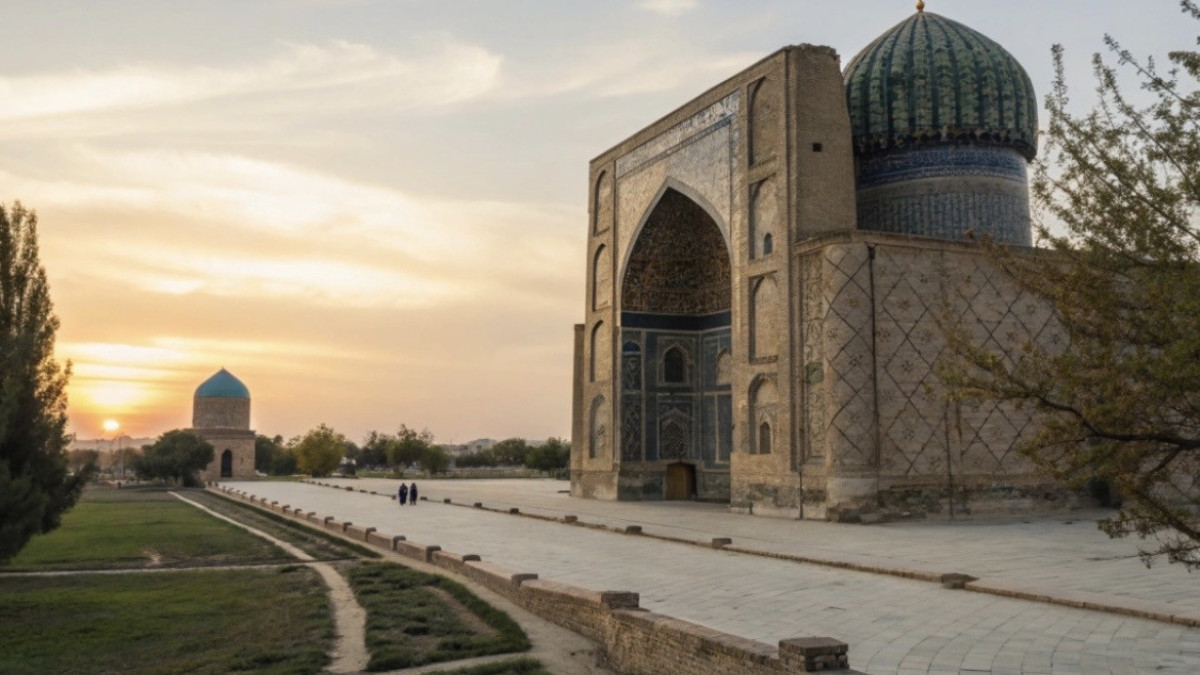
Mausoleum of Khoja Ahmed Yasawi: The spiritual soul of steppe and symbol of Kazakhstan’s historical memory
Алима Муслиманова Журналист El.kz
The Mausoleum of Khoja Ahmed Yasawi is a unique architectural and historical masterpiece located in the city of Turkestan, Central Asia. The mausoleum has become not only a symbol of the city of Turkestan but also a vital part of the nation’s cultural heritage, preserved through the ages. Today, it serves as a site of pilgrimage, scientific interest, and tourism, bridging the past and present within a single historical space.
The history of the Mausoleum’s creation
Khoja Ahmed Yasawi is a major Sufi figure of the 12th century whose spiritual teachings had an influence on the development of Turkic Islam. Born in the city of Sayram, Yasawi became one of the most revered religious figures of his time. His sermons, written in the Turkic language, made spiritual knowledge accessible to the broad populations of the steppe.
Following Yasawi's death in 1166, a small tomb was built at his burial site. However, the true architectural masterpiece emerged much later. In the late 14th century, the great commander and ruler Timur (also known as Tamerlane) ordered the construction of a grand mausoleum over the Sufi saint's grave.
There are several theories as to why Timur made this decision. According to one, the ruler sought to consolidate his power in the steppe regions and searched for spiritual legitimacy. By immortalizing the memory of Yasawi, who was deeply revered by the Turkic peoples, Timur demonstrated respect for religious traditions and aimed to unite numerous tribes under his rule.
Construction began around 1389. For its time, it was one of the largest architectural projects in Central Asia. Masters from various cities of Timur’s empire - Samarkand, Bukhara, and Khwarazm participated in the construction. However, due to the ruler's death in 1405, the work was never fully completed. Despite this, the building was so massive and magnificent that even in its unfinished state, it became an outstanding architectural monument.
Architectural features
The Mausoleum of Khoja Ahmed Yasawi is not merely a tomb, but a vast architectural complex comprising many rooms for various purposes. The building's total length exceeds 60 meters, and its width reaches approximately 45 meters. The central dome of the mausoleum is one of the largest in Central Asia.
The main hall of the complex is the Kazandyk. In its center stands an enormous bronze cauldron - the Taykazan, a symbol of unity and hospitality. This unique object is considered one of the largest cast-bronze vessels in the world.
The decorative design of the mausoleum deserves special attention. The ornaments combine geometric patterns and floral motifs characteristic of Timurid-era architecture.
The interior space includes more than thirty rooms: prayer rooms, meeting halls, a library, quarters for pilgrims, and the burial chamber of Yasawi itself. Such a complex structure made the mausoleum a fully functional spiritual center of its time.
Historical and cultural value
Over time, the Mausoleum of Khoja Ahmed Yasawi evolved into one of the region's primary religious and cultural centers. For centuries, pilgrims from all over Central Asia flocked here. Many rulers and members of the nobility sought to be buried near the saint.
The architectural complex significantly influenced the development of Islamic architecture in the steppe regions. Its composition, decorative elements, and scale served as a model for subsequent structures.
The mausoleum also plays a special role in the history of the Kazakh people. At various periods, it hosted important events related to the political and spiritual life of the steppe. The site became a symbol of unity and historical continuity.
In 2003, the mausoleum was included in the UNESCO World Heritage List. This decision highlighted the monument's exceptional universal value and the necessity of preserving it for future generations.
Modern state and preservation
Today, the Mausoleum of Khoja Ahmed Yasawi is protected by the state and international organizations. Over the past decades, large-scale restoration work has been carried out to preserve architectural elements and strengthen the building's structure.
Specialists are involved in restoring ceramic tiles, reinforcing walls and domes, and researching the monument's historical layers. Thanks to these efforts, the mausoleum continues to maintain its original appearance, remaining one of the best-preserved monuments of the Timurid era.
The area surrounding the complex is also being actively developed. New cultural spaces, museums, hotels, and tourist infrastructure are being created in Turkestan. All this makes the city one of Kazakhstan's largest centers for pilgrimage and cultural tourism.
The role of the mausoleum in tourism development
The Mausoleum of Khoja Ahmed Yasawi is currently one of Kazakhstan's top tourist attractions. Every year, it is visited by thousands of tourists and pilgrims from around the world.
For many travelers, it is not just an architectural monument but an opportunity to touch the spiritual history of the region. The mausoleum helps visitors gain a deeper understanding of Turkic culture, traditions, religious views, and historical heritage.
The development of tourism around the complex contributes to the region's economic growth. New jobs are created, the hotel business is expanding, and cultural projects and educational programs are being established. Furthermore, the mausoleum plays a vital role in shaping Kazakhstan’s international image as a country with a rich history and unique cultural heritage.
The significance of domestic tourism and historical memory
Traveling within one's own country offers a completely different perspective on familiar spaces. Often, it is the encounter with historical sites that allows one to feel the depth of time and understand how rich and multifaceted a nation's heritage is. When people travel to cities like Turkestan, they are not just visiting sights - they are connecting with the history that shaped entire generations.
Domestic tourism acts as a bridge between the past and the present. It helps people rediscover cultural symbols that have preserved the spiritual foundation of society for centuries. Ancient monuments and historic cities serve as reminders that history is not just found in the pages of textbooks but is a living memory reflected in stone, patterns, and ancient walls.
Maintaining an interest in historical heritage fosters respect for one's roots. When people travel more frequently within their own country, they better understand its cultural diversity, feel the connection between generations, and realize the value of places that have survived for centuries.
Historical monuments like the Mausoleum of Khoja Ahmed Yasawi become focal points not only for tourists but for those seeking a deeper understanding of the path their people have traveled. Through such places, a special perspective on time opens up where the past, present, and future intertwine, creating a sense of historical continuity.
The development of domestic tourism is not only an economic opportunity for the regions but also a crucial part of cultural self-awareness. By traveling through the country, people rediscover it for themselves, seeing familiar places in a new light and perceiving the wealth of national history differently.
This is why focusing on historical monuments and cultural centers remains a vital direction for social development. They remind us that behind every stone, every arch, and every ancient building lie the destinies of people, eras, and events that continue to live in the memory of the nation.

El recommends 
