
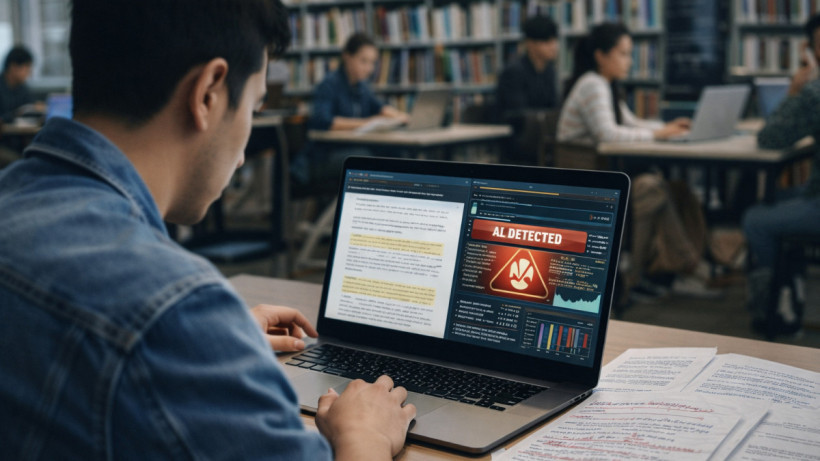
Kazakhstani universities are preparing new rules for verifying coursework and dissertations written with the help of AI, El.kz reports, citing official sources.
Minister of Science and Higher Education Sayasat Nurbek announced the upcoming update to anti-plagiarism systems during a government briefing. The logic behind the innovation is simple: technology can be used as a tool, but not as a replacement for one’s own thoughts.
The update involves next-generation systems capable of recognizing texts generated by algorithms. In other words, universities want to learn to identify not just direct plagiarism, but also "machine-made" academic fraud. For universities, this is no longer a theoretical debate about the future, but a very practical management task.
According to the Minister, neural networks can assist where a large volume of data needs to be processed quickly. However, when it comes to conclusions, interpretations, and the overall meaning of a study, the student must perform this work themselves.
Why universities are taking action now
The problem did not arise yesterday, but it has now become too visible to ignore. Students are mastering digital tools faster than many university procedures can be updated. This creates tension within the system and a sense of urgency to build new barriers.
The Ministry also explicitly points to another factor: the digital divide between students and teachers. While some students are already comfortably using neural networks in their daily routines, many educators have yet to figure out where the tool provides genuine benefit and where the imitation of knowledge begins.
How teachers will be trrained
In parallel, the Ministry intends to enhance the training of teachers, researchers, and supervisors. Training sessions will be organized to teach them how to work with modern digital tools, including the educational version of ChatGPT. This is a crucial detail, as control without understanding usually turns into a mere formality and formalities, as we know, multiply faster than rabbits.
The Ministry's logic is quite clear. On one hand, it is impossible and pointless to ban technology. On the other hand, the state is trying to prevent universities from sliding into a situation where a diploma text exists, but the author is no longer present within that text.
What Changes for Students
Students can use AI, but no longer expect the machine to come up with arguments, compile conclusions, and handle the intellectual portion of the research for you without risk.
This means that the value of independent work is rising again. Not it is vital not just to submit a text, but to prove that there is a human behind it who actually understands what they have written.
