

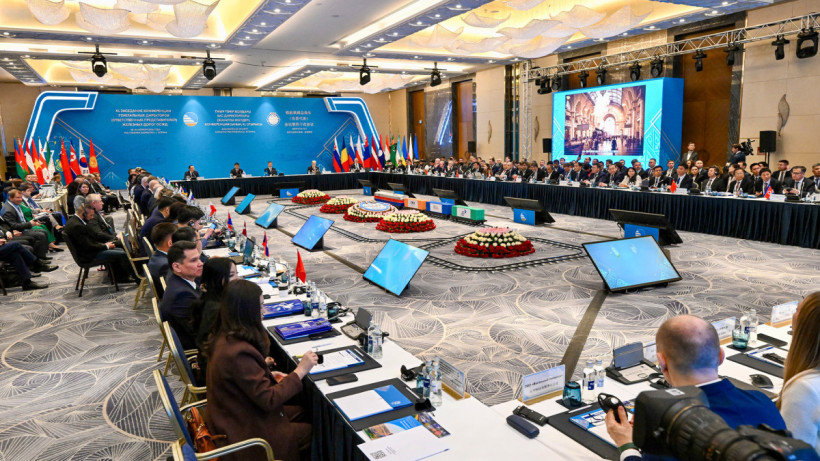
In Astana, Prime Minister of the Republic of Kazakhstan Olzhas Bektenov participated in the 40th Meeting of the Conference of General Directors of Railways of the Organization for Co-operation between Railways (OSJD), dedicated to the organization’s 70th anniversary. The forum brought together more than 300 heads and representatives of railways and railway transport companies from over 30 countries. The OSJD unites a network of more than 320,000 km of railways, which annually transport about 5.5 billion passengers and approximately 5 billion tons of cargo.
The anniversary meeting served as a platform for finding coordinated approaches to the development of international railway transportation, discussing the achievements of member countries, and exploring prospects for further cooperation. Attention was focused on increasing freight volumes, modernizing infrastructure, transitioning to paperless technologies, introducing intelligent management systems, and training personnel.
Prime Minister Olzhas Bektenov emphasized the role of railways in ensuring sustainable economic growth and noted that holding the Conference creates opportunities for constructive dialogue and strengthening partnership between countries.
The Head of the Kazakh Government informed the participants that under the leadership of President Kassym-Jomart Tokayev, Kazakhstan has entered a new stage of development. In March this year, a new Constitution was adopted, which will also give additional impetus to economic development.
“The railway sector of Kazakhstan, which plays a crucial role in economic development, is aimed at improving the quality of life of the population and achieving sustainable growth. It is symbolic that the meeting dedicated to the 70th anniversary of the Organization is taking place here — at the crossroads of great routes, in the very heart of Eurasia. A modern and efficient transport system allows us to integrate into the global economy and fit into international supply chains,” Olzhas Bektenov noted.
Emphasis was placed on further increasing Kazakhstan’s transit potential.
“Our common goal is to turn Eurasia into a single, seamlessly functioning transport mechanism. Kazakhstan is the world’s largest landlocked country. However, we are working to turn this geographical challenge into our strategic advantage. Over the past 15 years, we have invested about $35 billion in the transport sector and built more than 2,500 km of new mainline railways. Today, about 85% of all overland transit traffic along the Western Europe–Western China route passes through Kazakhstan. We are not stopping there. In the next four years, we plan to build another 5,000 km of new railways. Our goal is to increase transit volume to 100 million tons per year by 2035,” the Prime Minister emphasized.
Among the key directions is the development of the Trans-Caspian International Transport Route (Middle Corridor), within which the modernization of railway and port infrastructure is underway. In particular, container capacities at the ports of Aktau and Kuryk are being expanded with the involvement of international partners. By 2029, it is planned to increase cargo volumes from 80,000 to 300,000 TEU per year. Cargo delivery times have already been reduced to 18 days, and in the future they will be shortened to 10 days.
The international North–South transport corridor is also being developed, providing the shortest access to the markets of the Persian Gulf and India.
A priority for the state remains the introduction of digital technologies in the sector.
“Attaching great importance to the development of digital technologies, President Kassym-Jomart Tokayev has declared 2026 the Year of Digitalization and Artificial Intelligence. We are implementing the TezCustoms platform, which has already reduced border clearance time with China from 8 hours to 30 minutes. This work continues with other countries,” the Prime Minister emphasized, calling on participants of the Organization for Co-operation between Railways to actively use advanced digital solutions to increase the capacity of railway networks.
