Kazakh PM Participated in the XIII Forum of Kazakhstan Machine Builders

EL.KZ Информационно-познавательный портал
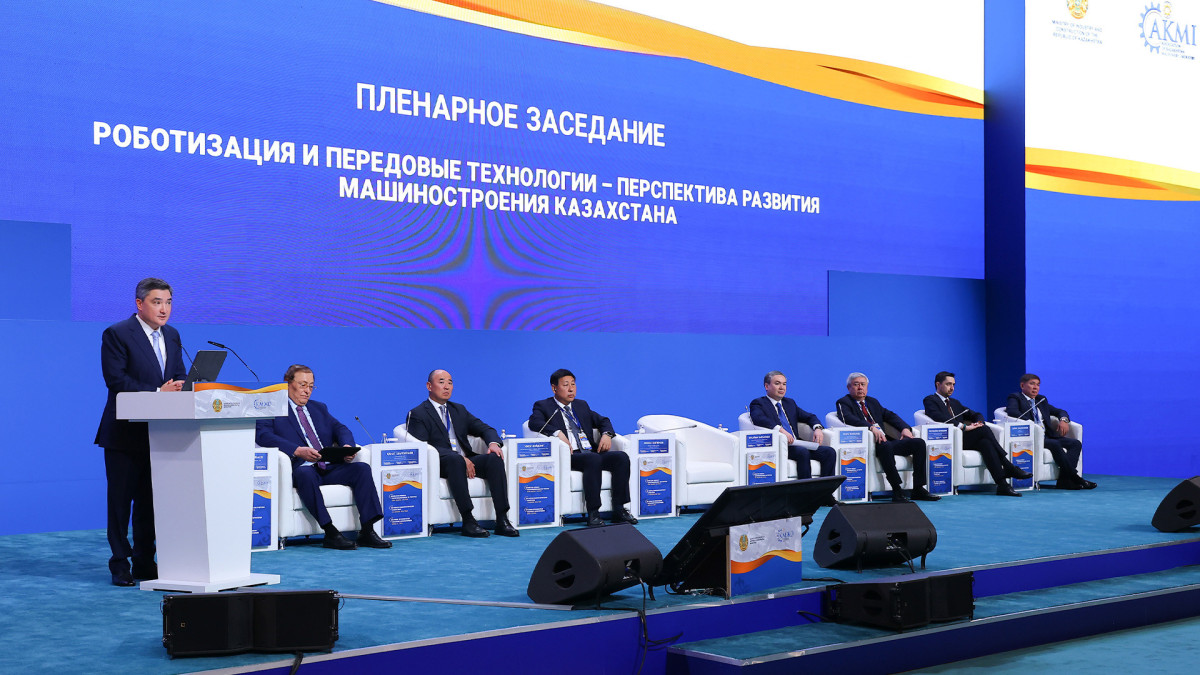
Prime Minister Olzhas Bektenov took part in the plenary session of the XIII Forum of Kazakhstan Machine Builders and familiarized himself with the development of Kazakhstani manufacturers at the international specialized exhibition Kazakhstan Machinery Fair 2026.
The Machine Builders Forum brought together over 1,300 delegates, including leading domestic manufacturers, specialists, and business representatives from more than 20 countries – Austria, Germany, Italy, the People’s Republic of China, and other states.
In his welcoming address to the forum participants, Prime Minister Olzhas Bektenov focused attention on the adoption of the new Constitution in Kazakhstan, which has become the institutional foundation for the modernization of industries and sustainable economic growth.
“We have all witnessed a fundamental event of historical significance that determined the fate of the country – the new Constitution was adopted by referendum with the active support of Kazakhstanis. As we all know, the Head of State Kassym-Jomart Tokayev is the main author of our Constitution, which provides for the further modernization of all spheres of the economy and society. This most important document determines the future development of the nation for the long term and makes Kazakhstan more resilient to any challenges. A solid foundation has been laid for building a ‘Just Kazakhstan’. This imposes a special responsibility on the industry and requires the creation of strong processing industries capable of turning raw material potential into real growth in the well-being of the population,” Olzhas Bektenov noted.
The Prime Minister emphasized that, in accordance with the instructions of the Head of State given in the Address to the Nation and at the extended meeting of the Government, work is underway in Kazakhstan to form a predictable and stable environment for the development of the machine-building industry. The joint task of the state and business is to ensure fair and safe working conditions and the development of a system of social partnership.
The volume of production in machine building reached 5.7 trillion tenge last year, with an increase in the physical volume index of almost 13%. Domestic manufacturers are entering foreign markets more confidently, as evidenced by a twofold increase in exports over 5 years: from $1.3 billion to $3.1 billion. In total, about 4,000 factories operate across the republic, employing more than 130,000 qualified specialists.
The basis for further modernization is provided by a one-third increase in investments in fixed assets – up to 376 billion tenge. Positive dynamics cover all key areas, including automotive, agricultural, railway, and electrical engineering.
The state’s priority remains increasing the level of localization and transitioning to the production of high value-added products. At the current stage, it is important to accelerate the transition from assembly to the development of our own engineering solutions and the creation of high-tech assets within the country.
“In the context of global competition, technological sophistication is becoming a key factor. This refers to digitalization, robotization, and the introduction of artificial intelligence. These processes are of particular importance within the framework of the large-scale tasks set by the President. As the Head of State Kassym-Jomart Tokayev emphasized, Kazakhstan should become one of the leading digital hubs in the region. The declaration of the current year as the Year of Digitalization and Artificial Intelligence will give machine building a new impetus for a technological breakthrough,” Olzhas Bektenov noted.
The accelerated integration of new technologies is a key element of transformation. According to global experience, the use of AI by enterprises reduces equipment maintenance costs by up to 40%. There are already specific examples on the Kazakhstani market.
At the SaryarkaAvtoProm enterprise, AI predicts possible breakdowns in advance, which has made it possible to eliminate sudden conveyor stops.
At ERG, digital assistants and analytical platforms optimize all processes – from logistics to electricity consumption, thanks to which the company saved about 55 billion tenge last year. Thus, “smart” technologies bring real economic benefits.
The use of AI in product design and quality management will ensure the transition from partial automation to the creation of “smart factories”. In the long term, innovations will enable domestic manufacturers not only to compete with foreign companies, but also to set new quality standards in global markets.
Special attention is paid to the development of human capital with an emphasis on training the new generation of engineers. More than 60% of educational grants in Kazakhstan are already directed toward engineering and IT specialties. Advanced educational approaches and practices are being implemented both in domestic universities and in branches of leading foreign technical universities.
During the plenary session, the Prime Minister responded to a question from the Chairman of the Board of the “Union of Machine Builders of Kazakhstan” Meyram Pshembayev regarding the measures taken by the Government to develop industrial cooperation, expand sales markets, modernize production, and introduce new technologies.
“The development of the manufacturing sector of industry is the main priority in the work of the Government. The prospects for the development of Kazakhstan depend on how successfully we solve this task. Will we become a high-tech country producing high value-added products, or will we continue to develop as an economy with a predominantly raw material orientation? Therefore, the state and business must direct all efforts to create production chains to the maximum extent and retain added value within the country,” Olzhas Bektenov emphasized.
Last year, the volume of production in the manufacturing sector amounted to 30.6 trillion tenge, which for the third year in a row exceeds the figures of the extractive industry. On the instruction of the President, the Government is building a balanced industrial policy with an emphasis on localization and support for companies opening production on the territory of the Republic of Kazakhstan.
The new Tax Code enshrines the norm on “super deductions” of up to 300% for business expenses on R&D. This tax incentive measure makes it possible to ensure the integration of scientific achievements and their implementation into the production process.
Attention is paid to the availability of export support with wide involvement of Kazakhstani manufacturers. An important step is the provision of benefits to enterprises implementing AI and process automation.
First Deputy Minister of Artificial Intelligence and Digital Development Rostislav Konyashkin reported on the development of an interstate program for the development of industrial robotics, in which Kazakhstan is actively participating. This will make it possible to synchronize national measures with the integration agenda and expand opportunities for cooperation, localization, and technology transfer to the country.
The experience of the People’s Republic of China in robotization of industrial production was shared at the forum by the President of the Machinery Council of the China Council for the Promotion of International Trade Zhou Weidong.
Minister of Industry and Construction Yersaiyn Nagaspayev noted that the Government is working to create a new industrial model with an emphasis on the development of technological competencies and engineering base. The formation of the ecosystem is also carried out through institutional mechanisms.
General Director of JSC Tynys Kairat Kalmanbayev raised the issue of more active participation of Kazakhstani enterprises in the implementation of large projects, including within the framework of the National Project for the modernization of the energy and utilities sectors.
The Prime Minister instructed the Ministry of Energy, together with the Ministry of Industry and Construction, to maximally involve domestic manufacturers in all large projects.
The Chairman of the Presidium of the NCE Atameken Kanat Sharlapayev also spoke, noting the importance of introducing digital tools to expand contracting between small businesses and large companies.
During the visit to the Kazakhstan Machinery Fair 2026 exhibition, Prime Minister Olzhas Bektenov familiarized himself with the plans of domestic companies to open new production lines, increase localization, and expand the range of manufactured equipment.
The AGROMASH plant has mastered the production of grain harvesters and tractors of well-known brands such as John Deere, Lovol, Deutz-Fahr, Amazon, and others. Last year, production was increased by 20%, with over 2,000 units of agricultural machinery produced for a total amount of over 90 billion tenge. The equipment is sold on the domestic market, including on preferential terms for farmers at 5% per annum. It was reported that in March of this year, three more well-known brands were additionally attracted to Kazakhstan – Vaderstad, DeWulf, and Linstar.
KARLSKRONA LC AB, with the participation of an international technological partner, has begun work to increase the localization of manufactured pumping equipment to 70%. The plant produces electrical and block-modular equipment used in the oil, mining, and nuclear industries, agriculture, housing and utilities, and others. Cooperation with international manufacturers such as CLAAS and Alstom is being developed. Production processes are regulated in accordance with international ISO standards.
The management of Allur company is preparing to open a Localization Center with an area of 30,000 m² in the city of Kostanay this year. This will ensure the creation of a full-fledged automotive components cluster with the production of all types of products: from wiring and structural elements to car interior parts. The capacity of the center is up to 60,000 kits per year. At the same time, work is underway to develop a testing base within the country. The launch of the new production will create 800 new jobs.
QazTehna annually produces more than 1,500 buses and commercial vehicles for transport, mining, and industrial enterprises. Using the small-unit assembly method, the production of 5 bus models has been mastered. At the plant with an area of over 40,000 m², there is a line for welding truck cabs. In addition, the launch of component base production is planned.
At the Atyrau Wagon-Building Plant, a full production cycle has been formed with its own design bureau. The enterprise produces gondola cars, container platforms, and tanks for the transportation of petroleum products and liquefied gas. The capacity of the investment project is up to 8,000 wagons per year. The full launch of all lines will ensure the creation of 3,500 highly qualified jobs.
KamLitKZ in Kostanay has launched an iron foundry with a capacity of up to 45,000 tons of products per year. Plans include opening an enterprise for the production of gearboxes and increasing the localization of the production of drive axle beams with subsequent export to the CIS and EU countries.
The Kazakhstan Machinery Fair 2026 also features products from manufacturers of 24 countries, including Germany, Italy, Austria, Turkey, China, and others. The annual exhibition has become an effective platform for strengthening business ties, attracting investment, exchanging experience, and developing the export potential of industrial companies of the Republic of Kazakhstan and the region as a whole.

El recommends 
