

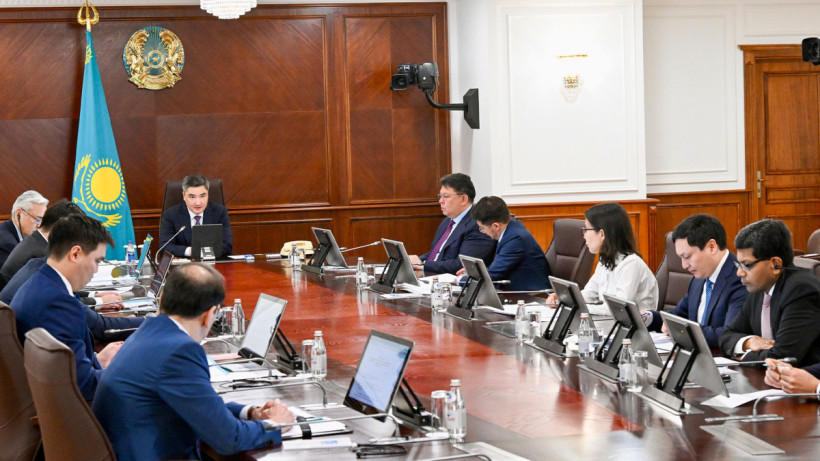
At the Ukimet Uyi, under the chairmanship of Prime Minister of the Republic of Kazakhstan Olzhas Bektenov, a meeting of the Coordination Council for Cooperation between the Government of the Republic of Kazakhstan and International Financial Institutions was held. The meeting was attended by representatives of the World Bank, International Monetary Fund, European Bank for Reconstruction and Development, Asian Development Bank, Islamic Development Bank, Eurasian Development Bank, Investment Bank for Lending to Eastern Neighbors and Central Asian Countries, and others.
The meeting reviewed the progress of projects on the construction and modernization of the country’s infrastructure. Attention was also paid to initiatives in strengthening macroeconomic stability, developing human capital, and introducing productive innovations and artificial intelligence technologies.
It was noted that with the adoption of the new Constitution, Kazakhstan is entering a new stage of development aimed at progressive economic growth and improving the quality of life of its citizens. In turn, the improvement of the legal framework enhances the country’s investment attractiveness by providing the necessary guarantees for project implementation.
On economic policy, the importance of implementing the Joint Action Program of the Government, the National Bank, and the Agency for Regulation and Development of the Financial Market on macroeconomic stabilization and improving the well-being of the population for 2026–2028 was emphasized. Since October 2025, a slowdown in annual inflation has been observed, which is the result of comprehensive measures taken.
“We intend to decisively continue the policy of reducing price pressure and inflation. The joint Program of the Government, the National Bank, and the Agency for Regulation and Development of the Financial Market to ensure macroeconomic stability and improve the well-being of the population is being implemented. This year, we have set ourselves the goal of increasing real incomes of citizens by at least 2–3%. This is a major undertaking that is currently underway,” Olzhas Bektenov stressed.
Regional Head of Fiscal Policy and Economic Growth at the World Bank Antonio Nucifora and Head of the International Monetary Fund Mission to Kazakhstan Amina Laresh voiced proposals for ensuring further macroeconomic stability. Emphasis was placed on continuing to increase the productivity of the economy and gradually strengthening the role of the private sector as a driver of sustainable economic growth.
Representatives of state bodies and organizations commented on the work being carried out in this direction.
Advisor to the President – Chairman of the Agency for Strategic Planning and Reforms Aset Irgaliyev noted the importance of reducing the state’s share and strengthening the role of the banking sector in lending to the real economy. This will help avoid competition between state and private capital. Regarding the reduction of food inflation, attention was focused on further improving the efficiency of trade markets, developing wholesale distribution center infrastructure, increasing production volumes, improving logistics, and other measures.
Deputy Chairman of the National Bank Aliya Moldabekova reported that, in order to reduce inflation, coordination between fiscal and monetary policies is being carried out. A consistent monetary policy is being implemented aimed at creating monetary conditions for inflation stabilization and anchoring inflation expectations. Macro- and micro-prudential tools are actively used to limit excessive credit growth, especially in the consumer lending segment. According to the National Bank of Kazakhstan, while the growth in lending to the population stood at 21.9% in 2024, in 2025 this figure slowed to 8.7%. Thus, the measures taken by the Government, the National Bank, and the Agency demonstrate their effectiveness and exert a restraining influence on inflationary processes.
Deputy Minister of National Economy Asan Darbayev reported on the measures being taken to reduce food inflation within the framework of the Comprehensive Plan to Control and Reduce Inflation. The main directions include saturating the market with necessary products, increasing production volumes with an emphasis on import substitution, ensuring transparency in retail sales and price accessibility of food products, supporting producers of socially significant food products, temporarily expanding their range, implementing a restrained tariff policy, as well as measures in foreign trade and monetary policy. As a result, positive dynamics of gradual inflation reduction have been observed in the first quarter. To maintain and continue this positive trend, a step-by-step algorithm has been additionally developed.
The meeting also reviewed an institutional project implemented with the support of the International Bank for Reconstruction and Development, focused on the development of human capital, entrepreneurship, and markets in the field of artificial intelligence.
Deputy Prime Minister – Minister of Artificial Intelligence and Digital Development Zhaslan Madiyev and World Bank Permanent Representative to Kazakhstan Andrei Mikhnev outlined approaches to improving support mechanisms and accelerating the commercialization of innovations in key sectors of the economy. In particular, tools for developing the ecosystem were clarified, including the expansion of programs and international cooperation through the development of AI, big data, and additive technologies.
The Prime Minister noted the importance of developing digitalization and artificial intelligence. 2026 has been declared the Year of Digitalization and AI in Kazakhstan.
“The development of artificial intelligence and digitalization is an unconditional priority for our country, designated by the Head of State. 2026 in Kazakhstan is defined as the Year of Digitalization — scaling up AI, transitioning from digital services to intelligent government platforms, and the widespread introduction of data-driven approaches in all sectors of the economy. We must move forward in this direction at an accelerated pace,” Olzhas Bektenov emphasized, calling on representatives of international financial institutions to actively cooperate in the field of AI.
Regarding the project for the construction and reconstruction of wastewater treatment facilities in Aktobe, implemented under the National Project “Modernization of the Energy and Utilities Sector” with the support of the European Bank for Reconstruction and Development, the results of optimizing the debt burden due to a reduction in the loan amount were considered.
Deputy Minister of Industry and Construction of the Republic of Kazakhstan Iran Sharkhan reported that, following the procedures carried out, optimization of the project parameters was achieved without reducing the scope of work. The signed EPC contract is approximately 7.9 billion tenge lower than the original loan agreement amount. The position of the international partner was presented by EBRD Managing Director for Central Asia and Mongolia Huseyin Ozhan.
The meeting also considered expanding the composition of the Coordination Council. The proposal to include the Eurasian Fund for Stabilization and Development in the Council was supported. It should also be noted that, in order to increase the effectiveness of interaction between the Government and international financial institutions, since February of this year, the Council’s decisions have become mandatory for execution by all state bodies and organizations.
Prime Minister Olzhas Bektenov emphasized the importance of active cooperation between the Government and international financial institutions and instructed the relevant state bodies to study the proposals voiced at the meeting.
“We highly value your active participation and contribution to the socio-economic development of Kazakhstan. The Government is always open and ready for dialogue, recommendations, and proposals aimed at strengthening our mutually beneficial partnership. Coordinated efforts of the state and international financial organizations will provide an additional impetus to the implementation of structural reforms, infrastructure modernization, and the introduction of best practices,” Olzhas Bektenov noted.
