

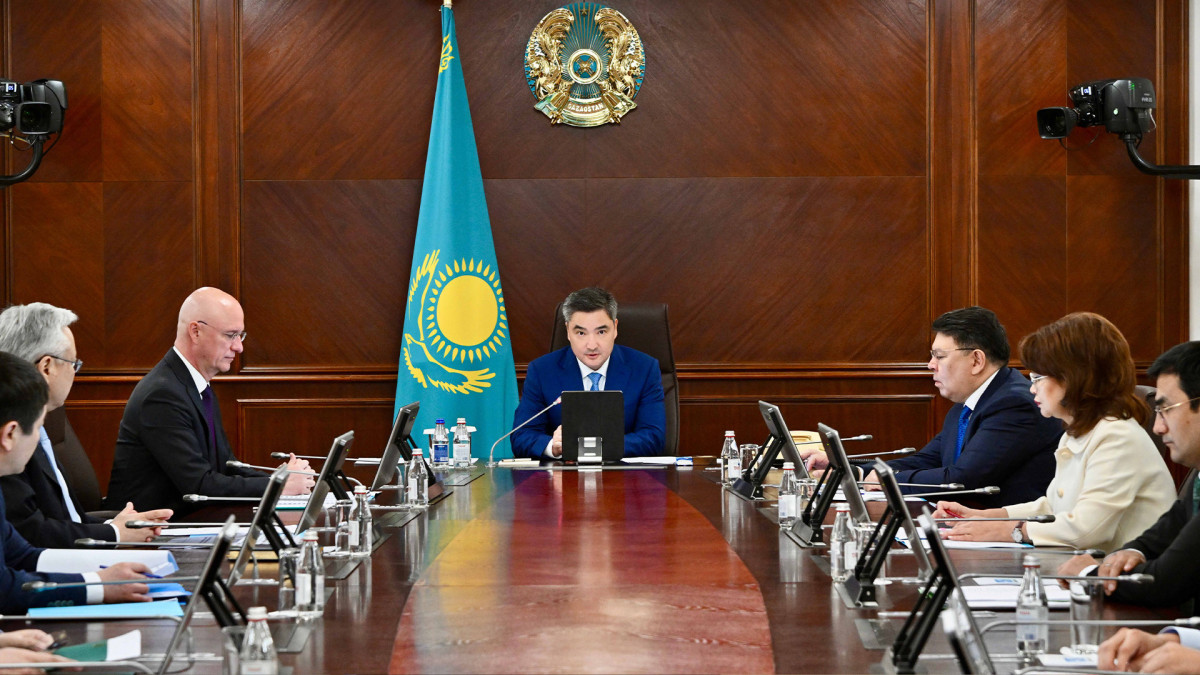
Under the instructions of the President on the modernization of energy infrastructure, Prime Minister Olzhas Bektenov chaired the Government session to review the results of the past heating season and the progress of preparations for the upcoming heating season, El.kz cites primeminister.kz.
Reports were delivered by Vice Minister of Energy Sungat Yesimkhanov, Chairmen of the Boards of KEGOC Nabi Aitzhanov and Samruk-Energo Kairat Maksutov, as well as the akims of Karaganda, Mangystau, West Kazakhstan, and Zhambyl regions.
The Prime Minister noted that the past heating season was completed without critical emergencies. The number of technological disruptions at power plants decreased by 15% compared to last year. At the same time, a historical maximum electricity generation of about 17,000 MW was achieved, which is 7% higher than the previous heating season.
“These facts confirm a sufficiently high level of preparation for the past winter. In his Address to the Nation, the Head of State set the task of modernizing energy infrastructure and utilities. Under the program ‘Tariff in Exchange for Investments’, almost 384 billion tenge has been allocated this year for the repair and modernization of power plants, which is 9% more than last year. The implementation of the National Project for the Modernization of the Country’s Energy Infrastructure is in the active phase. This year alone, it is planned to modernize 130 km of heat networks and 10,500 km of power supply networks. The implementation of these measures will reduce the wear rate of these networks to 48% and 62%, respectively,” Olzhas Bektenov emphasized.
At the same time, the Head of Government drew the attention of ministries and akimats to the inadmissibility of reducing the volume of repair works and their financing. Measures will be taken against both owners and management companies in case of any such instances. In this regard, KEGOC, together with the Ministry of Energy, was instructed to approve the operating modes of equipment for nationally significant stations by May 25.
It was noted that the key task for the regions is to ensure high-quality and timely preparation for the upcoming heating season. Repair and modernization works on power equipment and engineering networks must be carried out according to plan and within the established deadlines. Special attention must be paid to conducting pressure tests of heat networks — they must be performed on time and with proper quality.
The Government is providing all necessary support. More than 25 billion tenge has been approved from the Government reserve for the repair and construction of heat sources and networks. These funds are directed toward the modernization of facilities in Zhetisu, Abay, Akmola, and East Kazakhstan regions, as well as the repair of about 30 km of heat networks in four regions.
Olzhas Bektenov emphasized the need for strict control over the effective use of allocated funds and preventing any delays in work schedules. In case of failure to obtain readiness passports for energy facilities for the heating season, regional akims will bear personal responsibility. Akimats were instructed to complete all tender procedures and begin repair works within two weeks.
“There should be no unnecessary bureaucracy here. Repair works on heat supply facilities must be completed no later than the end of August. The Ministry of Industry and Construction and regional akimats must ensure full readiness of education and healthcare facilities by September 1. For northern, central, and eastern regions, all engineering infrastructure and housing and utilities facilities must be fully prepared for launch by September 15, and in other regions — by October 15. I instruct the akims to personally control the situation with regular visits to the sites,” the Prime Minister emphasized.
The Ministry of Energy, together with the Ministry of Transport and akimats, was instructed to ensure the timely accumulation of fuel reserves at heat sources and dead-ends by September 1. Coordination and control over the implementation of the instructions were assigned to First Deputy Prime Minister Roman Sklyar.
