Kazakh Government Discusses Implementation of the New Constitution
Алима Муслиманова Журналист El.kz
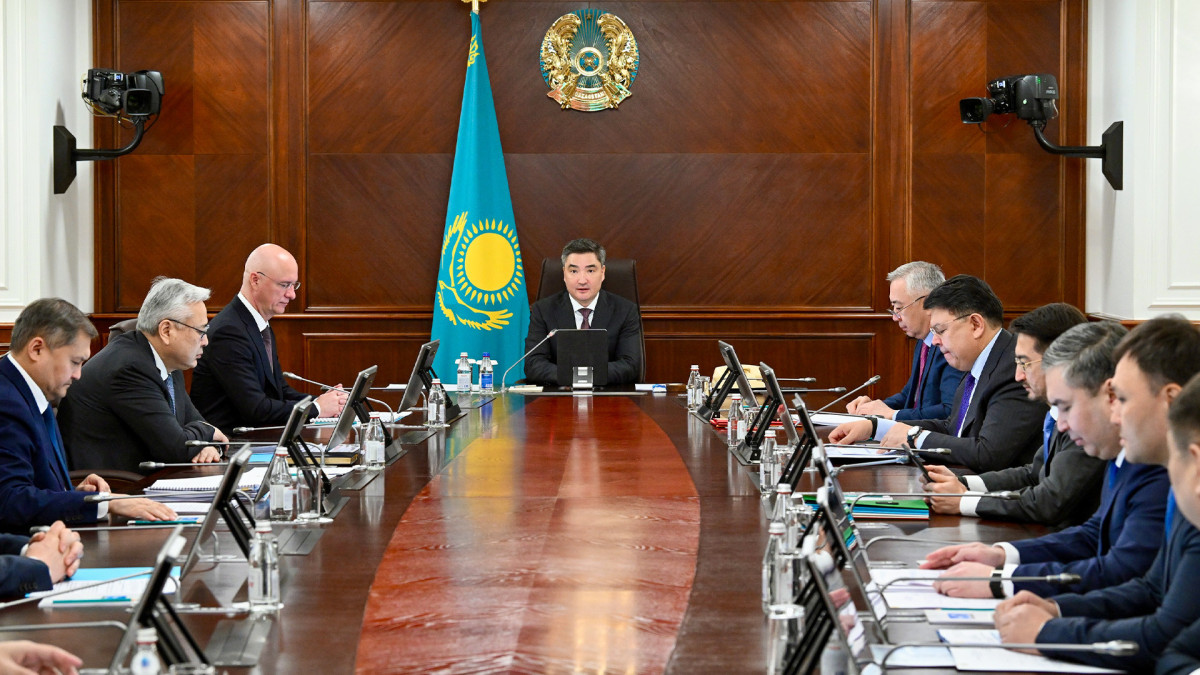
Under the chairmanship of Prime Minister Olzhas Bektenov, the Government session was held to discuss the development of innovation as a strategic priority of the state, enshrined in the new Constitution, El.kz cites primeminister.kz.
Reports on the work being done to ensure the institutional framework, attract investment in science, and introduce domestic developments into production were presented by Deputy Prime Minister – Minister of Artificial Intelligence and Digital Development Zhaslan Madiyev, Minister of Science and Higher Education Saiasat Nurbek, and Minister of Industry and Construction Yersaiyn Nagaspayev. Presentations were also made by the heads of JSC NC “KazMunayGas” and Kazakhstan Temir Zholy, while the akims of East Kazakhstan and Karaganda regions delivered reports.
“One of the key principles proclaimed by the new Constitution is commitment to the values of education, science and innovation. At the extended Government meeting, the President emphasized that innovation is elevated to the rank of unconditional priorities. The scale and pace of innovative development directly determine breakthroughs in many sectors of the economy. Innovations serve as the foundation for increasing labor productivity and creating high-tech jobs,” Olzhas Bektenov noted.
Following the President’s instruction, funding for science from the republican budget has increased sixfold over the past six years. The state is providing optimal conditions for the development of science and innovation in Kazakhstan.
- Since January 1 of this year, significant tax incentives — up to 300% of expenses — have been introduced in Kazakhstan to stimulate private investment in scientific research.
- The Budget Code establishes the obligation for subsoil users to allocate 1% of their extraction expenses to the budget for science and innovative technologies.
- Tools for venture financing of innovations have been expanded, and support for technological brokerage and business acceleration has been strengthened.
- Various financial instruments for the commercialization of scientific research results are being introduced.
- In grant funding for commercialization projects, the minimum co-financing share from businesses has been set at no less than 25% of the total grant amount.
A legal and budgetary framework for the development of regional science has been established in Kazakhstan. The indicator of scientific achievements has been included in regional development plans. The Prime Minister instructed that it also be included in the rating of regions and akims themselves.
An additional impetus to the development of technology and innovation will be provided by the implementation of the recently adopted Concept for the Creation of Science-Intensive Territories. This includes a science city in Kurchatov, as well as two technology parks based at the Institute of Nuclear Physics in Almaty and Nazarbayev University in Astana.
Akims have been tasked with ensuring the formation and sustainable development of regional innovation systems, taking into account the sectoral specifics of each region. Particular attention should be paid to developing long-term ties between innovation actors to significantly increase investment, including from private enterprises and domestic businesses.
“The Head of State, at a recent meeting with the scientific community, emphasized that he expects practical returns from science funding and the introduction of new technologies. The Ministry of Science, together with the Academy of Sciences, scientists, and the business community, should prepare a specific action plan within one month to improve the efficiency of scientific and innovative activities. The plan must include key performance indicators, measures for digitalization, and the responsibility of all participants,” the Prime Minister stressed.
Regional akimats have been instructed to ensure a phased increase in funding for science and innovation, bringing it to at least 1% of gross regional product by 2029. In addition, the share of innovative products in GDP should be increased to 3% by 2035. To achieve this, a number of systemic problems in the innovation sphere must be addressed.
In particular, in recent years this sphere has developed under conditions of institutional fragmentation, with regions not conducting independent work. There is also an excessively large number of priorities among innovation system participants. Industrial enterprises, scientific organizations, and sectoral ministries independently determine their own development directions. There is no unified focus at the national level, which leads to reduced efficiency. At the same time, the increase in state funding for applied science does not improve its effectiveness.
“Systemic integration of applied research and economic processes is required, along with stimulation of localization and modernization of production, and the development of export-oriented technologies. We need a real contribution of innovations to the development of the country’s industrial potential, rather than isolated ideas and approaches presented for show,” Olzhas Bektenov emphasized.
Following the discussion, the Prime Minister issued several instructions to relevant ministries and government agencies.
- The Ministry of Science, together with interested government agencies, must establish an Innovation Headquarters under the Government within three days for inter-agency coordination of the sphere and development of technological priorities. The headquarters, chaired by Deputy Prime Minister – Minister of Culture and Information Aida Balaeva, should ensure the consolidation of all participants in the innovation ecosystem across the entire cycle: from idea to product launch. To stimulate innovation activity among enterprises, a comprehensive inventory of innovation activity and technological development of all enterprises must be carried out by June 1 of this year.
- The Ministry of Science, together with interested government agencies, must develop a Concept for the Development of Innovations by June 1 of this year, with a focus on specific priority sectors and technologies.
- The Ministries of Science and Artificial Intelligence, together with sectoral ministries and akimats, must implement a digital platform by July 1 that provides a “single window” for the registration, support, and monitoring of innovation projects. In addition, a publicly accessible national register of innovation projects should be created, containing information on developers, technologies, and potential investors.
Coordination of this work has been assigned to Deputy Prime Minister — Minister of Culture and Information Aida Balaeva.

El recommends 
