Kazakh Government completes implementation of projects to provide drinking water to residents of all cities and villages

EL.KZ Информационно-познавательный портал
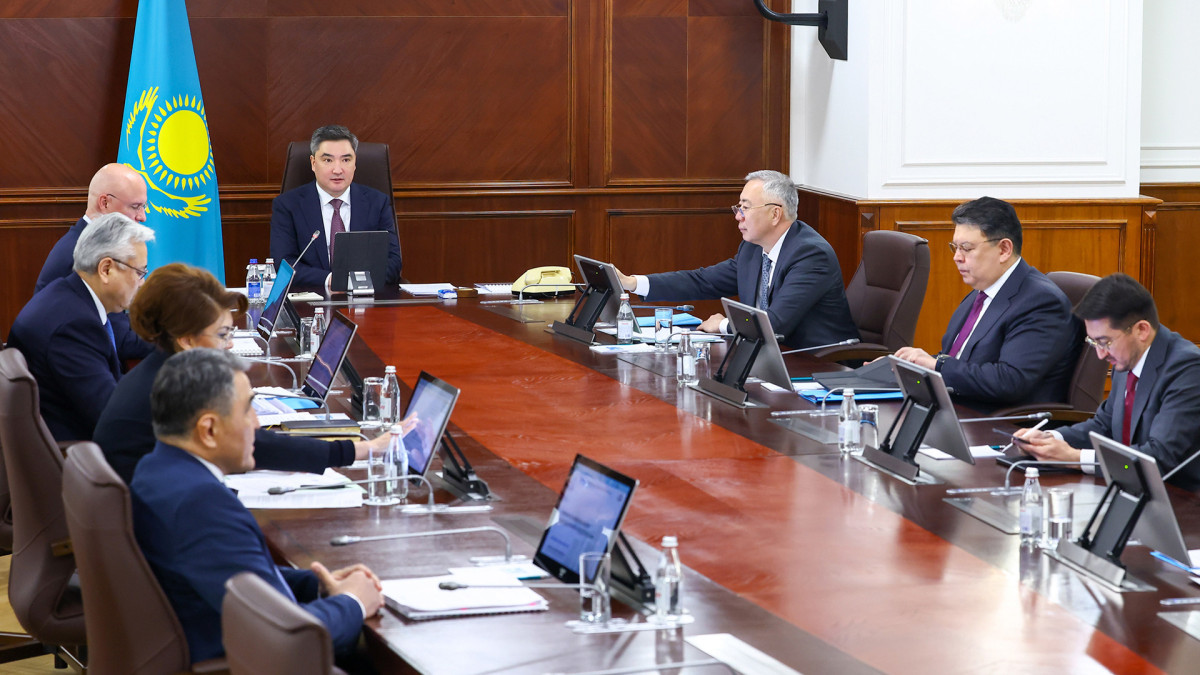
At the Government session chaired by Prime Minister Olzhas Bektenov, issues related to the development of water supply and wastewater systems, as well as the introduction of digitalization and water-saving technologies, were considered, El.kz cites primeminister.kz.
The President’s election program set the task for the Government to ensure that all cities and villages are provided with drinking water within five years.
Reports were delivered by Deputy Minister of Industry and Construction Kuandyk Kazhkenov; Minister of Water Resources and Irrigation Nurzhan Nurzhigitov reported on the implementation of group water pipeline projects and water conservation; Minister of Agriculture Aidarbek Saparov spoke about the level of water supply for water-intensive crops; Deputy Prime Minister – Minister of Artificial Intelligence and Digital Development Zhaslan Madiyev reported on digitalization in the water sector. Reports by akims of a number of regions were also heard.
According to the Ministry of Industry and Construction, in line with the President’s instructions, work to ensure full access to drinking water for the population was completed by the end of 2025. As of today, the target indicator has been achieved: all 90 cities and 6,087 rural settlements with a population of 7.5 million people are connected to centralized drinking water supply systems.
The Prime Minister emphasized the importance of a systematic approach to the further development of water management infrastructure.
“Taking into account population growth and overall economic development, water consumption will increase. Therefore, the issue of access to clean drinking water will become increasingly relevant every day. On the President’s instructions, projects to provide water supply services to cities and villages have been completed. However, considering that drinking water provision is a continuous process, all responsible government bodies must keep this issue under constant control,” Olzhas Bektenov stressed.
Attention was paid to the maintenance of water supply networks and the quality of drinking water. Over the past year, around 70,000 appeals from citizens were received by government bodies. In this regard, akimats were instructed to carry out inspections based on citizens’ requests and take measures against unscrupulous organizations.
In the context of growing population needs and active construction of new districts, the need to upgrade engineering infrastructure was noted. Olzhas Bektenov emphasized the importance of using the capabilities of the National Project for the Modernization of the Energy and Utilities Sectors, the implementation of which already makes it possible to consistently reduce the level of network wear and tear.
According to forecasts, water inflow for the 2026 vegetation period is estimated to face a deficit of up to 1 billion cubic meters. In this regard, the importance of introducing water-saving technologies, especially in agriculture, was emphasized.
Within the framework of the Year of Digitalization and Artificial Intelligence, the need to intensify efforts on digitalizing the water sector was highlighted. By the end of the current year, it was поручено to create a Unified Water Resources Platform that will consolidate data on surface and groundwater sources. The implementation of the project will make it possible to develop a National Water Balance map and ensure hydrogeological monitoring. Work on the digitalization of irrigation canals must also be continued.
“In addition, we face the task of fully automating and digitalizing the production processes of municipal water utilities using best global practices. It is necessary to ensure full control over water from the source to the end consumer. All work must be carried out efficiently and on time,” Olzhas Bektenov noted.
Following the Government meeting, the Prime Minister gave a number of instructions.
- The Ministry of Industry and Construction, together with akimats, was tasked with ensuring regular control over the implementation of water supply and wastewater projects financed through general transfers and within the framework of the National Project for the Modernization of the Energy and Utilities Sectors. It is important to prevent technical failures in the operation of the unified electronic platform of the National Project, taking into account the growing number of applications and the volume of processed information.
- The Ministry of Water Resources and Irrigation was instructed to take measures to implement, by the end of the current year, 12 projects aimed at improving drinking water supply in 142 rural settlements. By July 30, the Shardara group water pipeline in the Turkestan Region must be commissioned. By November 15, the reconstruction of the Presnovsky and Sokolovsky group water pipelines in the North Kazakhstan Region must be completed.
- The Ministry of Finance was instructed to ensure timely financing for water supply projects предусмотренные by the republican budget, as well as to provide akimats with methodological support in attracting loans for the modernization of wastewater treatment facilities.
- The Ministries of Agriculture, Water Resources and Irrigation, as well as the akimats of the Kyzylorda, Turkestan and Zhambyl Regions, must approve the structure of sown areas for water-intensive crops in strict accordance with water use limits.
- The Ministry of Water Resources and Irrigation was tasked with ensuring the conclusion of all contracts for water supply to farmers in accordance with the indicators of the Roadmap for Diversifying the Structure of Sown Areas.
At the same time, the Government pays attention to fostering a culture of rational use of water resources.
“As the Head of State noted in his Address to the People, a careful, respectful and responsible attitude toward water and nature as a whole must become an integral part of our national ideology,” Olzhas Bektenov emphasized.
The Ministries of Education, Science and Higher Education were instructed to join the work on forming a culture of careful water use so that the foundations of this approach are laid from a young age.

El recommends 
