

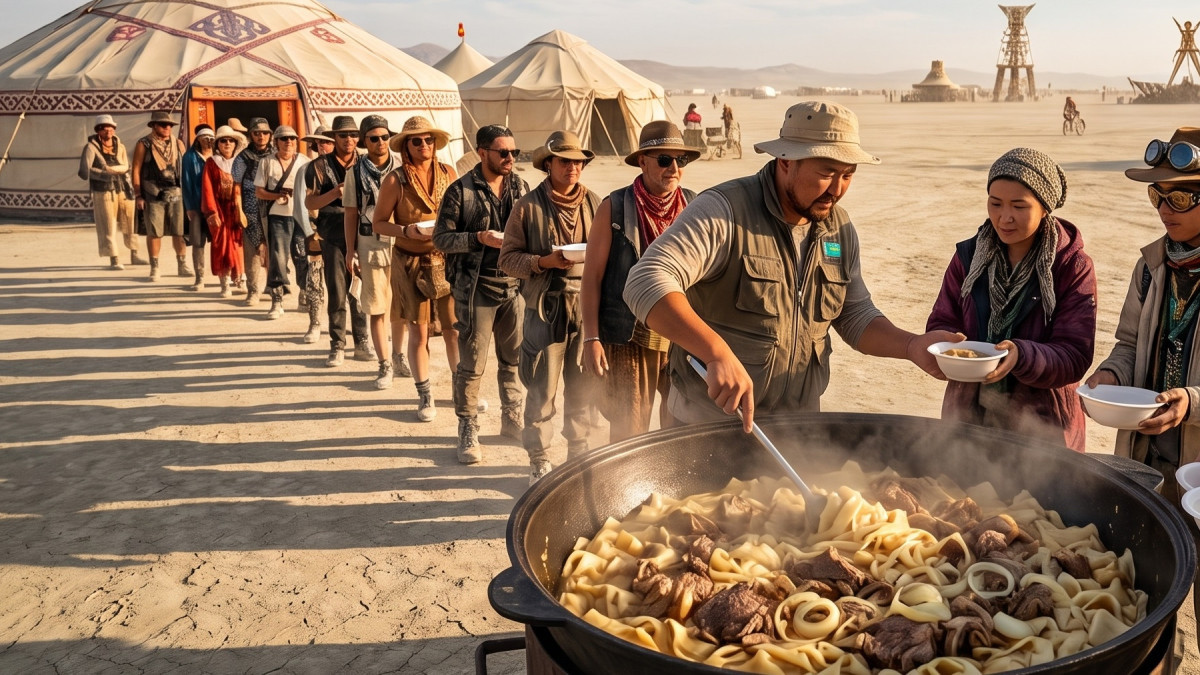
For the second consecutive year, the "Tengri Camp" delegation has successfully deployed traditional Kazakh yurts to the Burning Man festival in Black Rock City, Nevada. Following the inaugural mission a year ago, which featured a single yurt, the current season has seen an expansion to 11 structures. In a strategic move to broaden cultural outreach, organizers have established a comprehensive field kitchen within the camp’s perimeter.
The initiative was conceived following a 2024 visit to the US by project founder Askhat Muratov. Since then, the team has managed the complex logistical requirements of transporting traditional dwellings, specialized equipment, and provisions across intercontinental distances to re-establish the Kazakh cultural enclave annually.
Strategic Objective: Large-Scale Cultural Outreach
The primary objective for the current mission is to provide a traditional "Beshbarmak" reception for approximately 5,000 festival attendees. The budgetary allocation for the procurement of provisions alone is estimated at $16,000 USD.
Logistical preparations involved the acquisition of 12 head of sheep, which required specialized processing and transport to the arid festival site.
According to the organizers, the scale of the procurement presented significant administrative challenges for local retail systems, requiring complex bulk-order documentation and coordinated logistical handling for the large volume of goods.
Field Operations: Culinary Traditions in Arid Environments
The culinary program adheres to traditional standards, utilizing lamb, kazy, karta, handmade dough, and concentrated shurpa broth. Large-scale kazans have been strategically deployed at the center of the camp, serving as the focal point of the yurt ensemble.
Operational conditions in the Black Rock Desert remain extreme. Organizers have reported significant environmental challenges, including dust, high diurnal temperature fluctuations, and severe wind gusts throughout the week-long event. In addition to public-facing cultural engagement, the kitchen maintains a rigorous schedule to meet the daily subsistence requirements of its 70-80 personnel, ensuring the operational continuity of the entire delegation.
