

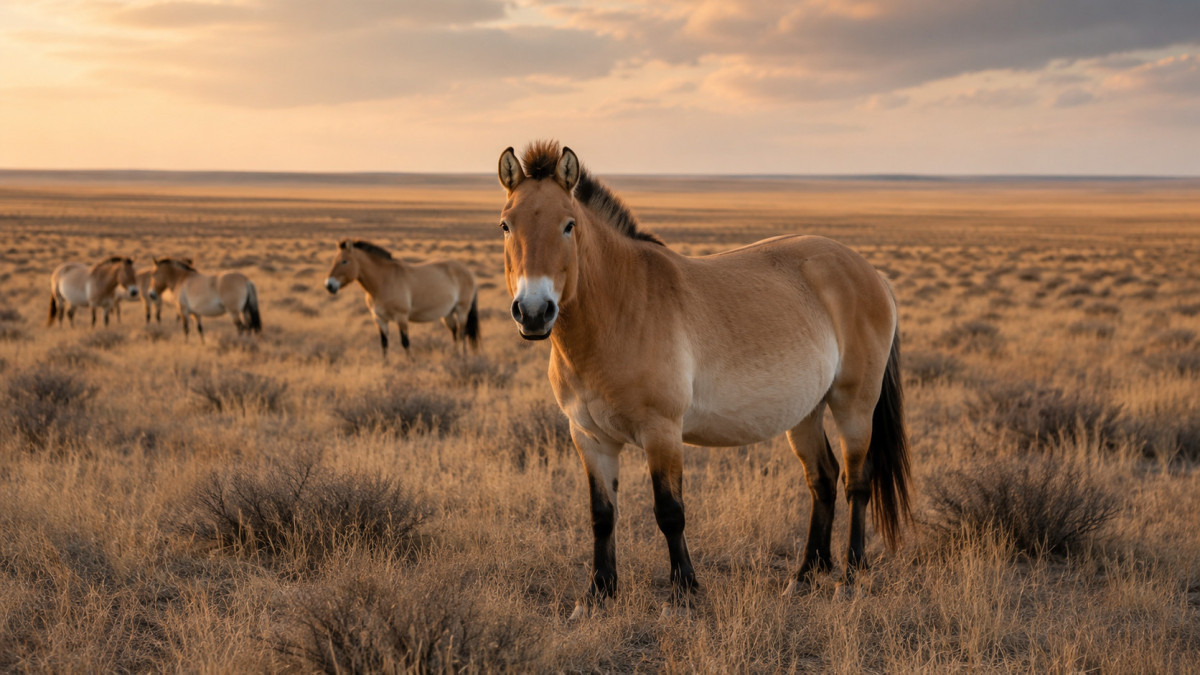
Przewalski’s horses disappeared from the wild during the second half of the 20th century. However, international captive breeding and conservation programmes made it possible to restore the species to the steppes of Central Asia. In June 2024, the first group of Przewalski’s horses was returned to Kazakhstan, El.kz reports.
The last wild horse of Central Asia
The Przewalski’s horse is one of the few remaining truly wild horse species that has survived into the present day. Unlike mustangs and other feral horse populations, which descend from domesticated horses that returned to the wild, the Przewalski’s horse represents a distinct wild lineage.
The species is characterised by a stocky build, a short erect mane, and a sandy-brown coat. It has 66 chromosomes. Despite this difference, Przewalski’s horses and domestic horses are capable of interbreeding and producing fertile offspring.
For many years, the Przewalski’s horse was regarded as the only horse never domesticated by humans. However, genetic analyses of archaeological remains from the Botai culture have complicated this view. Ancient horses from present-day Kazakhstan were found to be closely related to modern Przewalski’s horses. Researchers continue to debate whether today’s population descends from an ancient managed population or from a closely related wild lineage.
Why the species disappeared from the wild
By the beginning of the 20th century, wild herds survived mainly in Dzungaria and western Mongolia. Their numbers declined due to hunting, competition with livestock, expansion of grazing lands, and severe winters.
The last confirmed sighting of a wild Przewalski’s horse was recorded in 1969. Subsequent field expeditions failed to locate any viable wild populations, and the species was consequently classified as Extinct in the Wild.
The species survived exclusively in zoological institutions. The entire contemporary population descends from a very small number of individuals removed from Central Asia at the turn of the 19 and 20th centuries. This limited founder population continues to constrain genetic management and increases the risk of inbreeding.
How Zoos preserved the species
Following the Second World War, the global population reached a critically low level. Conservation breeding continued primarily in European zoological institutions, including those in Prague and Munich.
International studbook management was subsequently established. Breeding pairs were selected on the basis of pedigree to maximise the retention of genetic diversity.
As population numbers gradually increased, conservation organisations were able to prepare the first groups for reintroduction into their natural habitat. Animals were selected according to their health status, age, genetic background, and ability to form stable social groups.
Reintroduction in Mongolia
One of the first major reintroduction programmes commenced in Mongolia in 1992. Horses were transported from European breeding centres, kept in acclimatisation enclosures for a period of adaptation, and subsequently released into protected areas.
The transition to life in the wild presented significant challenges. The animals had to locate water sources, forage beneath snow cover, protect foals, and avoid predators.
The winter of 2009-2010 proved particularly severe. An extreme dzud caused substantial losses in one of the reintroduced populations and demonstrated the continuing vulnerability of small, isolated groups.
Developments in China
China’s conservation programme began in 1985 with the importation of eleven Przewalski’s horses from overseas zoological institutions. The animals were placed at the Xinjiang Wild Horse Breeding Centre, where they adapted to local climatic conditions and successfully reproduced.
The horses were not released immediately after their arrival. By 2001, the breeding centre maintained more than one hundred individuals, after which gradual reintroductions began in the Kalamaili region.
Over time, self-sustaining herds capable of reproducing under natural conditions became established within the reserve. However, there is no verified scientific evidence that these horses halted the expansion of the Gobi Desert or restored groundwater levels in the Dzungarian Basin.
The Ecological Role of Przewalski’s Horses
Large herbivores play an important role in shaping steppe ecosystems. By grazing, horses create a mosaic of vegetation heights that provides habitat for insects, birds, and small mammals.
Their manure returns organic matter to the soil and facilitates seed dispersal. Hoof action disturbs patches of topsoil, while shallow depressions created by trampling may temporarily retain rainwater or snowmelt.
The ecological impact depends on climatic conditions, herd density, pasture quality, and the presence of other herbivores. At moderate population densities, horses contribute to maintaining habitat heterogeneity, whereas excessive grazing pressure may damage vegetation.
Accordingly, claims that a single species can independently reverse desertification require robust scientific evidence. Likewise, there are no verified scientific assessments demonstrating annual ecosystem benefits amounting to tens of thousands of US dollars per individual horse.
Seven Horses Arrived in Kazakhstan
The first group of Przewalski’s horses arrived in Kostanay Region in early June 2024. It consisted of one stallion and six mares selected from Prague Zoo and Berlin Tierpark.
The animals were transported by Czech Army aircraft to Arkalyk before undertaking an approximately seven-hour road journey to the reintroduction centre located within the Altyn Dala State Nature Reserve.
Upon arrival, the horses were placed in an acclimatisation enclosure. Under the programme, the first group was expected to remain there for approximately one year to adapt to local forage resources, water availability, and the winter conditions of the Turgai Steppe.
A Second Group Arrived in June 2025
In June 2025, an additional eight Przewalski’s horses were transferred to Altyn Dala. The animals were selected from Prague Zoo and Hungary’s Hortobágy National Park.
The second group also entered an acclimatisation phase. Before their release into the open steppe, the horses were required to adapt to local vegetation, climatic conditions, and seasonal water availability.
Verified publicly available sources do not specify the exact date on which the first group was released from the acclimatisation enclosure. Consequently, it cannot presently be confirmed that the animals entered the wild specifically in June 2025.
Nevertheless, the project advanced to its next implementation phase. The first group successfully completed its adaptation period, while the additional animals from Europe are expected to facilitate the establishment of multiple breeding groups and reduce the long-term genetic vulnerability associated with the limited founder population.
Why Przewalski’s Horses Are Important for Altyn Dala
The return of Przewalski’s horses forms part of a broader programme aimed at restoring steppe ecosystems. The reserve also protects the saiga antelope and supports initiatives to re-establish other large herbivores.
Different herbivore species utilise pastures in different ways. Horses are capable of grazing coarse grasses and can remain longer in areas that are less frequently used by other ungulates.
Their presence helps maintain a heterogeneous vegetation structure. Some areas remain closely grazed, while others retain taller vegetation, thereby increasing habitat diversity for birds, insects, and small mammals.
The project initially envisaged relocating approximately forty Przewalski’s horses to Kazakhstan over a five-year period. The long-term objective is to establish a self-sustaining, reproducing population capable of surviving in the Turgai Steppe without continuous supplementary feeding by humans.
Remaining Challenges
One of the principal challenges is the species’ limited genetic diversity. All living Przewalski’s horses descend from a small number of founders; consequently, every translocation and every breeding pair must be carefully planned.
Additional risks include drought, severe winters, and limited water availability. For a small population, a single extreme climatic event may have long-term consequences.
Contact with domestic horses poses risks of disease transmission and hybridisation. Conservation specialists must also monitor grazing pressure and potential competition with other ungulate species.
The success of Kazakhstan’s reintroduction programme will be assessed against measurable indicators, including survival rates, successful reproduction, the establishment of stable breeding herds, and the animals’ ability to locate food and water independently throughout the year.
