

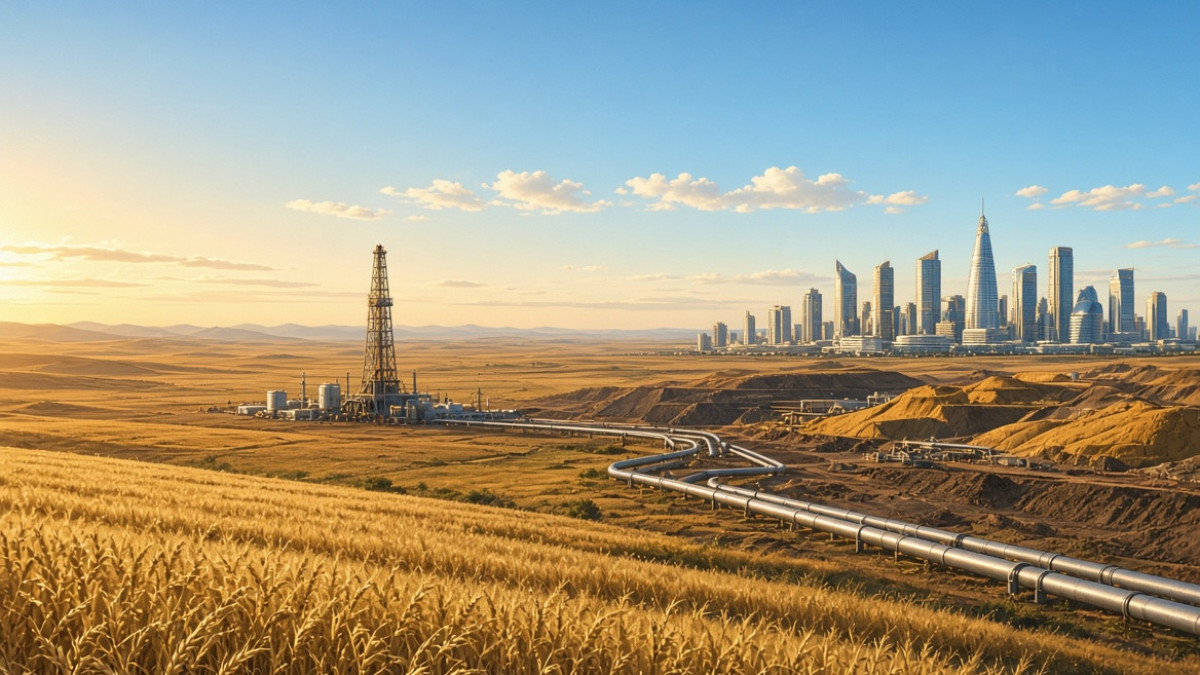
Kazakhstan has made a significant step towards a modern and diversified economy. The country closed 2025 with GDP growth of 6.5 %, strengthened its manufacturing sector, accelerated investment, expanded transport capacity, and laid the groundwork for the large-scale adoption of artificial intelligence. The President’s policy directives are increasingly being translated into concrete legislation, projects, and economic outcomes, El.kz reports.
The Address set a new economic pace
The Address delivered on September 8, 2025, was titled “Kazakhstan in the Age of Artificial Intelligence.” In substance, it represented a comprehensive programme for economic modernisation. The President linked digitalisation to a new investment cycle, the reallocation of capital from raw materials towards processing, greater involvement of banks in financing the real sector, the development of transport, energy and agriculture, as well as reducing the administrative burden on business.
The central objective was clearly defined: to transform Kazakhstan into a fully-fledged digital country within three years. The Head of State instructed the Government to accelerate the adoption of the Digital Code, establish the Ministry of Artificial Intelligence and Digital Development, and introduce AI across all sectors of the economy. At the same time, specific economic priorities were identified, including investment in manufacturing, modernisation of border crossing points, digitalisation of tax administration, and a more service-oriented relationship between the state and businesses.
The key strength of the Address was the coherence of its policy objectives. Digital solutions were viewed not as an end in themselves, but as instruments for increasing productivity, transparency, and investment attractiveness. Within a year, this approach has already become evident at several levels: through new public institutions, legislation, major infrastructure projects, and the structure of investment in the real sector.
Robust growth gained new foundations
Kazakhstan closed 2025 with GDP growth of 6.5 %. The size of the economy exceeded USD 300 bln, while GDP per capita reached USD 15,000. These are record levels for the country. According to data presented to the President by the Government in December, more than 70 % of GDP growth was driven by industry, trade, and transport. This structure indicates that economic expansion was not concentrated in a single sector but was supported by several major areas of the economy.
The acceleration in economic activity was supported by higher oil production, large-scale public infrastructure projects, investment demand, and consumer activity. Against this backdrop, the Address provided an overarching policy framework, bringing together projects already under way with new priorities focused on diversification, digitalisation, and capital mobilisation. As a result, the strong growth rate has become a foundation for the next stage of reforms rather than merely a one-off statistical record.
In the first half of 2026, real GDP increased by a further 4.1 %. Following the high base established in the previous year, this still represents solid growth. Particularly strong performance was recorded in construction, manufacturing, transport, and trade. The economy is therefore developing a broader growth base, in line with the President’s objective of economic diversification.
Investment is shifting towards production
One of the most specific policy directives contained in the Address concerned the launch of a new investment cycle. President Tokayev called for greater allocation of capital to production and high-technology industries. Statistics for the first seven months of 2026 indicate that this priority has already begun to influence the direction of investment.
Investment in fixed assets reached KZT 11.46 trln, representing real growth of 7.7 %. In manufacturing, growth reached 36.1 %. Manufacturing accounted for 14.7 % of total capital investment, compared with 14 % for extractive industries. For the first time during the period under review, the manufacturing sector surpassed the extractive sector in terms of its share of investment. This can be regarded as one of the clearest indicators of the new policy direction.
The positive trend is also evident in industrial output. Manufacturing production increased by 9 % in January–July. Manufacturing accounted for 47.1 % of total industrial output by value, compared with 46.1 % for extractive industries. Pharmaceuticals, chemicals, machinery, fabricated metal products, and food production recorded particularly rapid growth. Kazakhstan is strengthening industries that generate higher value-added products and create new domestic production and supply chains.
Banks are playing a more active role in supporting development
The President specifically instructed second-tier banks to become more actively involved in financing the real sector and called for the development of an investment programme for high-technology industries worth up to USD 1 bln.
Over the past year, the role of banks in financing capital investment has expanded significantly. The share of bank lending in financing investment in fixed assets increased from 3.5 % in January–July 2025 to 5.6 % during the same period in 2026. In absolute terms, this amounted to approximately KZT 644 bln.
The increase of more than half in the share of bank financing indicates that banks are gradually returning to the financing of productive investment projects, while enterprises are gaining an additional source of funding for modernisation.
There remains considerable potential for further growth. Enterprises currently finance around two-thirds of their investment from their own funds, while the policy rate stands at 16.25 %. A decline in inflation and the development of mechanisms for sharing project-related risks could strengthen the process already under way and make bank financing more accessible to small and medium-sized manufacturers.
Digital transformation has become a reality
The implementation of the President’s directives has been particularly rapid at the institutional level. The Ministry of Artificial Intelligence and Digital Development was established in autumn 2025. The Digital Code was adopted in January 2026 and entered into force on July 12.
The Code established a unified regulatory framework for data, digital platforms, artificial intelligence, and automated decision-making systems. It also enshrined citizens’ digital rights, including the right to challenge decisions made by algorithms.
At the same time, the international alem.ai centre was opened in Astana, the Alem.Cloud supercomputer was launched, and a national artificial intelligence platform is being developed. According to the relevant ministry, over 900,000 people completed basic and applied training in digital and AI skills in 2025, while more than 650,000 students received AI Sana programme certificates.
For the economy, this represents a large-scale investment in three areas simultaneously: computing infrastructure, a clear and predictable regulatory framework, and human capital. The emerging ecosystem has the potential to reduce the cost of public-sector and business processes, accelerate the development of digital products, support start-ups, and increase productivity. Large-scale skills development is creating the human capital base required for the adoption of artificial intelligence in industry and public administration.
Logistics has strengthened Kazakhstan’s position
One of the most tangible outcomes has been the development of transport infrastructure. The second railway track on the Dostyk–Moiynty route, spanning 836 km, was completed in 2025. According to the Ministry of Transport, it increases the capacity of the Kazakhstan–China route 5 fold.
A container hub at the Port of Aktau was completed, construction of new railway lines commenced, and the modernisation of roads and border infrastructure continued.
Economic data confirms growing demand for this infrastructure. Transport services increased by 20.3 % in January–November 2025, while transport and warehousing grew by a further 7.1 % in the first half of 2026.
Kazakhstan is strengthening its role as a land bridge between Europe and Asia. The expansion of transport capacity enables the country to handle growing freight volumes more efficiently and generate greater non-resource revenues from transit.
A new business environment is taking shape
In the Address, entrepreneurs were identified as a key driving force behind digital development. The President called for excessive regulatory requirements to be reviewed, the Register of Mandatory Requirements to be introduced, tax administration to be digitalised, and development institutions to be relaunched.
By the end of 2025, the Government reported the launch of the Register of Kazakhstani Goods Producers and the adoption of a unified small business support programme, Isker Aimaq.
The contribution of small and medium-sized enterprises to GDP remained at approximately 40 percent in 2025. This indicates that the entrepreneurial sector has established a stable position within the national economy. The next step is to increase the number of manufacturing enterprises, as at the time of the Address fewer than 6 percent of small businesses were engaged in the production of goods.
The new Tax Code entered into force in 2026. Its objectives are to make relations between the state and businesses more transparent, strengthen the revenue base of the state budget, and transition towards a more service-oriented approach to tax administration.
The reform will require businesses to adapt. However, over the longer term, clear rules and digital procedures can reduce administrative costs and strengthen trust between entrepreneurs and public authorities.
Inflation has begun to decline sustainably
In 2025, the President identified reducing inflation as one of the country’s key policy priorities. One year later, a clear positive trend has emerged.
Annual inflation declined from 12.2 % in August 2025 to 9.8 % in August 2026. Following eleven consecutive months of moderation, inflation returned to single-digit territory.
The improvement enabled the National Bank to reduce the policy rate to 16.25 % in September. The regulator attributes the outcome to the cumulative effect of monetary policy, a stable tenge exchange rate, the normalisation of consumer demand, and coordinated anti-inflationary measures implemented by the Government and the National Bank.
The medium-term objective is to bring inflation down to around 5 percent.
Policy directives are being translated into practice
Over the past year, the Address has influenced Kazakhstan’s economy through a comprehensive set of policy and institutional measures. A dedicated ministry has been established, the Digital Code has been adopted, a new artificial intelligence ecosystem has been developed, a strategic railway project has been completed, greater emphasis has been placed on productive investment, and new instruments to support businesses have been introduced. The country has thus developed a more coherent architecture for economic modernisation.
Economic indicators support this policy direction: manufacturing, construction, and transport are growing at a faster pace; investment in manufacturing is significantly outpacing overall investment activity; and the share of bank financing in capital expenditure is increasing. The priorities set out by the President have therefore acquired not only a regulatory and institutional dimension but also measurable economic outcomes.
Many of the programmes launched are designed to run for several years, meaning that their full impact is yet to materialise. The foundations already established create favourable conditions for further growth in productivity, private investment, and non-resource exports.
A particularly important next step will be the transition from launching platforms and training users to the large-scale adoption of technologies by enterprises and the creation of high-productivity jobs.
