

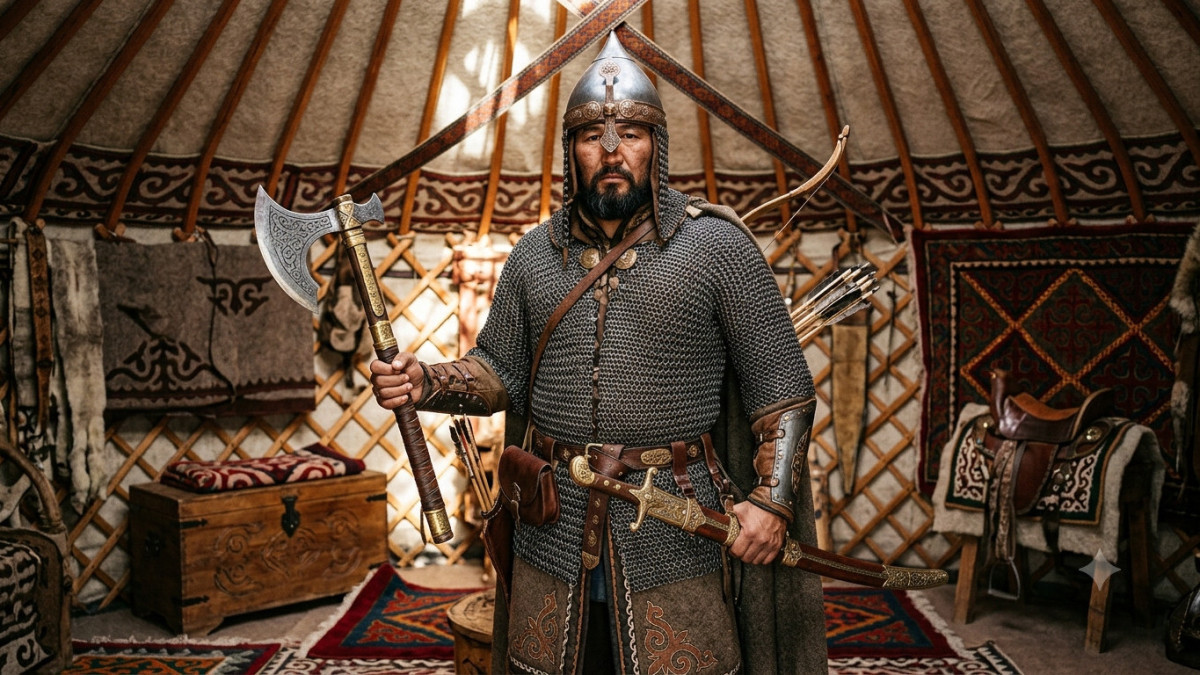
A high-quality saber, or qylysh, could be worth an entire herd of horses. This was noted by historical fencing expert Stanislav Mikheyev, who studies the weapons of Kazakh warriors of the Middle Ages. Such a price did not represent a one-time purchase but rather the wealth of an entire clan, as a blade of this quality was passed down through generations and changed hands only in exceptional circumstances.
Straight swords and broadswords were less common than sabers but belonged to the same price category. Head of the Exhibition Department at the Atyrau Museum Yerlan Tlekkabylov explains that weapons were carefully preserved and handed down from father to son. Valuing a blade at an entire herd of horses reflects the fact that wealth in the steppe was measured primarily in livestock rather than money.
What was a warrior’s armor made of and how much did it weigh?
A warrior’s armor, known as sauyt, weighed up to 12 kg. This weight allowed mounted warriors to remain agile in the saddle, an advantage that was often more important in cavalry combat than the thickness of the metal or the level of protection.
Chainmail was woven from iron rings of various sizes, with the diameter of the rings determining both its purpose and its value. According to museum data, standard chainmail consisted of rings measuring 10–12 millimeters in diameter, while denser armor was made from 7–9 millimeter rings. Finer weaving required considerably more labor and was therefore significantly more expensive.
Particularly prized was the badana chainmail, named after the rhizome of the bergenia plant because of the distinctive shape of its rings. Other types of protective equipment included kobe scale armor, zhalankat cuirasses, and torgauyt multilayered leather armor, each designed for specific purposes and carrying its own value.
Who could afford a full set of armor?
A complete set consisting of an iron helmet, chainmail, and a shield was beyond the means of many ordinary soldiers. Historian Larisa Morozova, Senior Research Fellow at the South Kazakhstan Museum, notes that iron helmets were typically worn by professional warriors and members of the tribal elite, while ordinary fighters often relied on copper helmets. The choice of metal reflected not only the level of protection but also the social status of the owner.
The qalqan shield measured approximately 60–70 centimeters in diameter. Its relatively compact size reduced both the weight of the equipment and the amount of material required without compromising effectiveness in close combat.
Khans and sultans distinguished their armor with decorative elements unavailable to ordinary warriors. Noble helmets were adorned with owl feathers known as zhyga, while renowned batyrs decorated theirs with tassels made from ribbons and horsehair. These custom-made embellishments further increased the overall value of the armor.
How much did other weapons cost?
A spear, or naiza, was less expensive than a saber because its iron tip required considerably less metal and craftsmanship than a full-length blade. Axes and battle axes, known as balta and aibalta, were even more affordable and could be found in many households, as they served both practical and military purposes.
Firearms appeared much later than edged weapons and armor. The Atyrau Museum’s collection includes a five-shot rifle (besatar myltyq) manufactured in 1891. Owing to its rarity and the complexity of its production, such a rifle was more expensive than a contemporary saber.
