

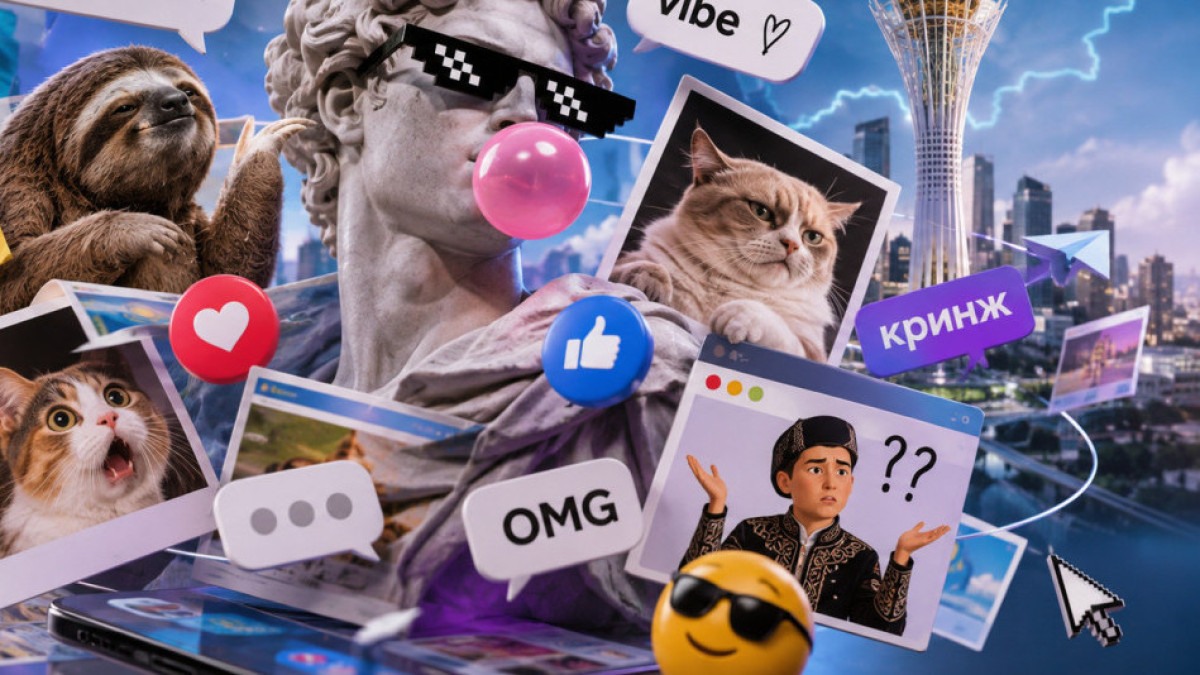
Memes, internet slang, and language mixing of Kazakh, Russian, and English are transforming the everyday communication practices of Generation Z. In Kazakhstan, local jokes, catchphrases, and short-form videos have become a means of expressing emotions, maintaining social connections, and discussing shared experiences. Why can a single image sometimes replace an entire message, and how is meme culture shaping the language of young people, El.kz reports.
Generation Z has grown up alongside social media and video-sharing platforms. However, memes are not exclusive to this generation: schoolchildren, university students, and adults also use them, although the same joke may carry different meanings for different age groups.
Universal Memes
In early May, social media feeds were flooded with an image of a full-bearded man with wide-open, anxious eyes. The character was identified as Reginald Skulinski, nicknamed Skull, a supporting character in the 2006 American animated film Monster House.
The image was initially picked up by English-speaking users before spreading to the Kazakh internet. For most members of Generation Z, the character looks strikingly familiar. For example, a visa consultancy company in Kazakhstan shared a meme depicting how a manager looks at a client when asked whether it is possible to travel to Europe without a visa.
“Six-Seven”
The meme originated from the track “Doot Doot (6 7)” by American rapper Skrilla, released in 2024. By the autumn of that year, the song had begun appearing in TikTok and Instagram videos featuring basketball players. One of the individuals in the video shouted “Six-seven” with a straight face, while his companion standing nearby made a hand gesture. The person featured in the video subsequently became known online as the “67 Kid”.
In 2025, the American dictionary publisher Dictionary.com selected “67” as its Word of the Year.
Teachers in various countries prohibited students from using the phrase during lessons and even introduced creative disciplinary measures in response. The “67” trend reached the Kazakh internet in 2025 and became particularly popular among children belonging to Generation Alpha.
What memes tell us about the digital generation
Users combine text, images, video, and audio, while individual conversations increasingly incorporate written messages, voice notes, stickers, and video clips. The scale of the digital environment enables these communication formats to reach audiences rapidly. According to the Digital 2026 report by DataReportal, Kazakhstan had 19.5 mln internet users as of October 2025.
The report’s authors note that the number of social media user identities does not correspond directly to the number of individuals, as one person may maintain multiple accounts. Consequently, these figures do not make it possible to determine precisely how many people in Kazakhstan encounter memes on a daily basis. Nevertheless, the scale of digital reach indicates that locally produced humour has a substantial audience.
Memes are unlikely to replace meaningful face-to-face or written conversations, but they have become an established means of communication. The jokes people create, share, and understand provide insight into their concerns and the ways in which language evolves. In Kazakhstan, this phenomenon is further shaped by the interplay between Kazakh and Russian, which gives local memes their distinctive character. An individual meme may disappear from social media feeds within a few days, while a successful catchphrase can remain part of everyday speech long after the trend has faded.
