

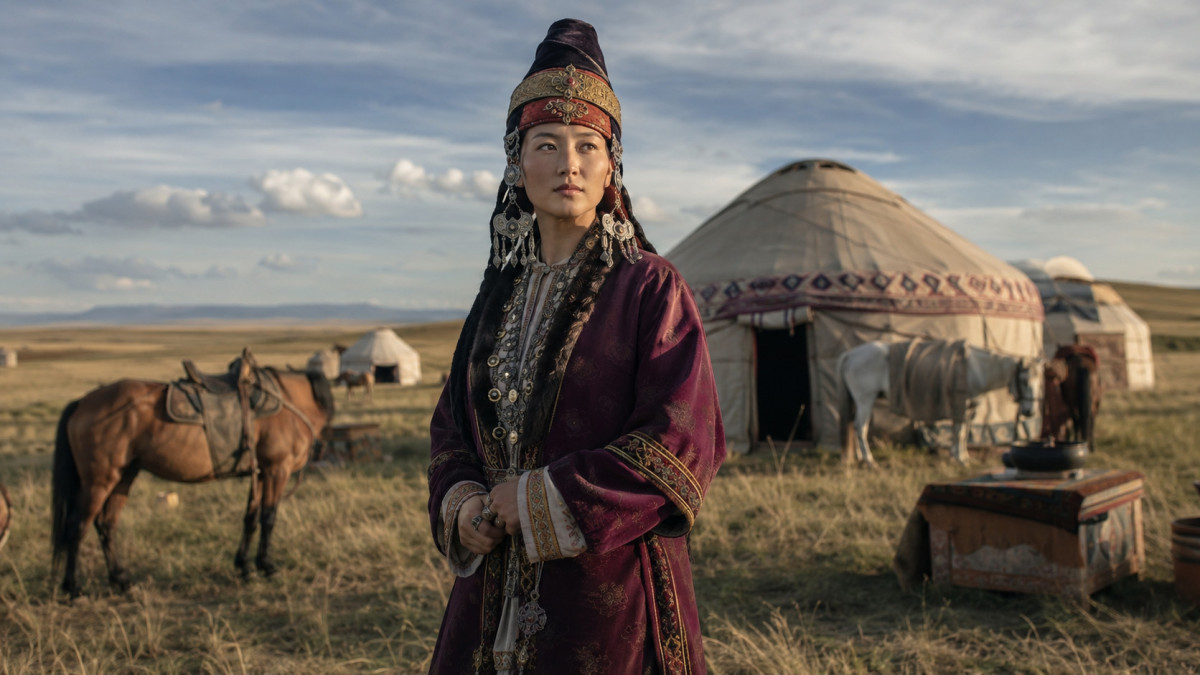
Researcher Anastasia Antonova examined the image of a Kipchak woman in her video and explained why the long-standing legend of the steppe Amazons has proved to be historically inaccurate, El.kz reports.
Clothing designed for life in the saddle
The foundation of both women’s and men’s Kipchak attire was clothing adapted to a nomadic way of life. A long tunic was worn with trousers, over which a caftan or other outer garment was worn.
“A Kipchak woman could be identified by the fact that she wore trousers underneath her clothing. The nomadic way of life was literally lived in the saddle,” Anastasia Antonova said.
Trousers enabled women to ride comfortably and perform everyday tasks. For the inhabitants of the steppe, clothing had to be suitable both for travelling long distances and for the conditions of nomadic life.
Jewellery and headwear indicated social status
“The female appearance was distinguished primarily by jewellery, hairstyles and headwear,” Anastasia Antonova noted.
Among the characteristic elements, she identified headbands, pendants, tall caps and horn-shaped pendants.
According to the researcher, these elements are among the features most frequently documented in archaeological excavations of Kipchak burial sites and enable archaeologists to distinguish female burials from male ones.
The origins of the steppe amazon myth
For a long time, scholarship maintained the view that Kipchak women not only managed the nomadic community while their husbands were away on military campaigns, but also participated directly in warfare. According to Antonova, this interpretation was advocated by Soviet archaeologists Svetlana Pletnyova and German Fyodorov-Davydov.
Later, researcher Tatyana Potemkina demonstrated that the famous “Kipchak Amazon” was in fact a composite object.
“The lower part is a Kipchak stone sculpture of a male warrior, while a female bust dating from the 18th–19th centuries was subsequently attached to its upper part,” Antonova explained.
This does not mean that women never took up arms. In the absence of men, some women may indeed have participated in the defence of the nomadic community. However, as the researcher emphasised, the existence of a distinct military class of steppe Amazons among the Kipchaks is not supported by current scholarship.
Archaeological evidence confirms the richness of women’s attire
Unlike the Amazon myth, the richness of Kipchak women’s clothing is a historical fact supported by archaeological evidence.
“Silk, brocade, fur, silver and gilded elements - all of these can be seen in the reconstructions by Svetlana Pletnyova and Zoya Dode, as well as in contemporary research on Kipchak clothing,” Antonova concluded.
Thus, historical scholarship distinguishes between an attractive legend and an evidence-based fact: there is no reliable evidence of a separate warrior caste among Kipchak women, whereas the richness and sophistication of women’s attire are well documented by archaeological and historical research.
