


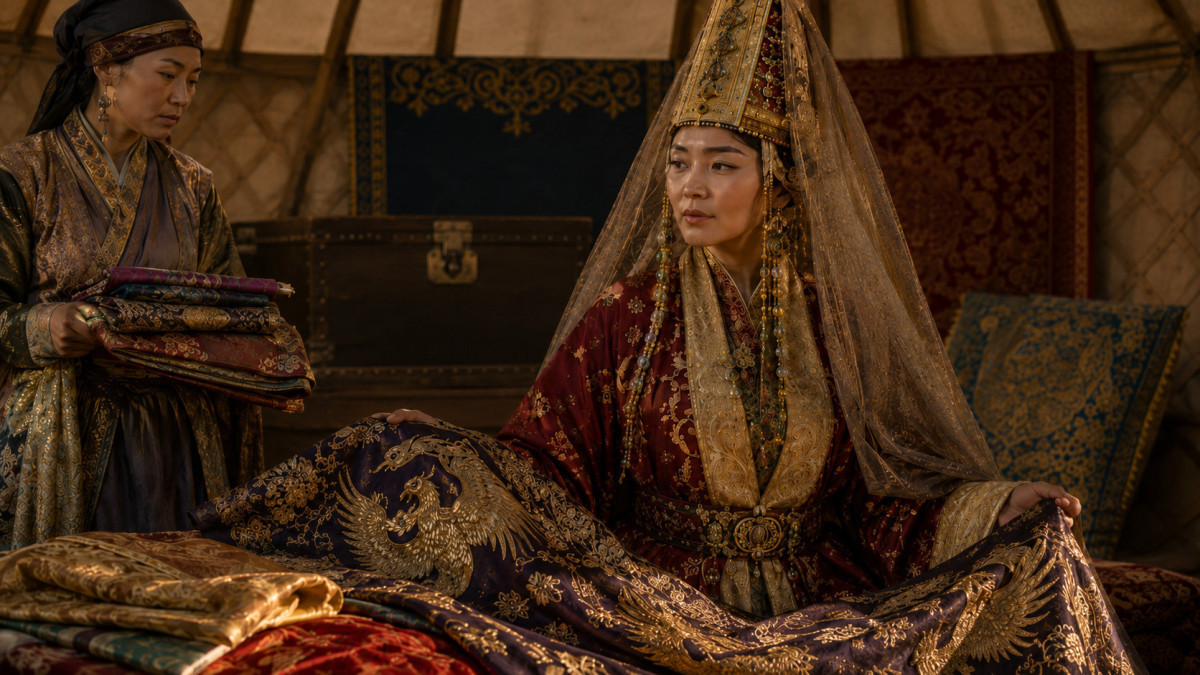
A unique female robe from the Golden Horde era, discovered in the Bolgan Anammausoleum, has been transferred to the National Museum of Kazakhstan, El.kz reports.
The find was uncovered during research at the Bolgan Ana mausoleum in Ulytau. For several years, specialists studied the fabric, cut, material condition, and manufacturing technology to preserve the original and create a scientific reconstruction.
This robe is associated with the elite culture of the Ulus of Jochi. For historians, it is a precious and rare textile artifact, as fabric survives far less often in archaeology than metal, ceramics, or stone.
Women's fashion as a sign of status
In the medieval steppe, clothing spoke about a person faster than a long introduction. By the fabric, headgear, jewelry, and trim, one could discern a woman's marital status, the wealth of her clan, and her proximity to the ruling circles.
Researcher Regina Karimova, in her work on the accessories of nomadic Golden Horde costumes, views the costume as an entire "complex." This included clothing, headgear, footwear, jewelry, belts, amulets, cosmetics, hairstyles, handbags, and toiletry items.
This approach is vital for the study of women's fashion. It demonstrates that the image of a noblewoman was not formed by a single beautiful item, but by a set of objects where every detail carried social meaning.
The bokka on the head
One of the primary symbols of female status in the Mongol and Golden Horde environment was the bokka (or boktag). Researchers Elena Korzh and Sofya Shashunova write that the bokka was a high-status headgear for married women throughout the Mongol Empire.
In their article regarding silk bokka caps from the Volgograd and Astrakhan museum collections, they note that such headgear could be sewn from expensive patterned fabrics. Researchers have identified several variations of the cut and refined previous reconstruction models.
The bokka was a prominent part of a ceremonial look. Its high silhouette, silk base, veil, ties, and decorative elements immediately distinguished a woman within the space of a headquarters, a city, or a formal gathering.
What new research reveals
The subject of the boktag is currently being actively studied independently of general costume history. In Liliya Maklasova’s dissertation abstract, it is emphasized that this headgear was a complex and expensive item associated with the high social standing of married women in the Mongol Empire and the Golden Horde.
Maklasova gathered materials from dozens of archaeological sites where headgear or its elements were found. The researcher writes that while early descriptions often relied on written and pictorial sources, archaeology is what helps verify the actual shape, construction, and decoration.
An important detail for the article: proving a direct transition from the boktag to later national headgear is risky. Maklasova specifically points out that the hypothesis of the boktag as a predecessor to the saukele (a traditional Kazakh bridal headress) requires further clarification, as there is currently no archaeological evidence for such a transition.
Written sources and caution
European travelers, including Plano Carpini and William of Rubruck, wrote about the women's clothing of the Mongol era. Their accounts are important because they saw the world of the Mongol Empire through the eyes of contemporaries.
However, these travelers described a foreign culture through the lens of their own habits, fears, and religious beliefs. Therefore, modern researchers cross-reference their words with archaeology, visual sources, and museum artifacts.
This is how the study of women’s costume becomes more reliable. When a written description matches finds of fabrics, frames, jewelry, and caps, historians gain a much firmer reconstruction of the image.
Bolgan ana and the courtly image
One of the most expressive female images of the Golden Horde era in Kazakhstan is associated with the Bolgan Ana mausoleum. In reconstructions, researchers have depicted a noblewoman in a ceremonial robe, leather shoes, and a tall headpiece.
The robe was found in 2019 and subsequently entered the collection of the Alkei Margulan Pavlodar Pedagogical University. Specialists from the International Laboratory for the Conservation and Restoration of Cultural Heritage "UMAI" handled its study and conservation.
A reconstruction of the robe is displayed in the Ulytau Museum. The original was transferred to the National Museum because such textiles require specific storage conditions. For Kazakhstan, this is a rare case where Golden Horde women's fashion can be discussed through a specific, tangible object.
Silk, Dragons, and Phoenixes
Expensive fabric was its own language of status. Materials regarding Golden Horde finds mention silk fabrics featuring images of dragons and phoenixes from the Shengheldy site in the Almaty region. These materials date back to the 13th and early 14th centuries.
Such motifs indicate links with China and Iran. For a noblewoman, the fabric could be more valuable than jewelry because it demonstrated her family’s access to distant trade routes and prestigious workshops.
Silk, brocade, and gold threads in Horde costumes were part of the courtly style of a great empire. Power was expressed through ceremonies, gifts, clothing, and physical appearance. In such an environment, fabric revealed one's rank as clearly as a genealogy at the Khan's table.
Women's Headgear Beyond Kazakhstan
Golden Horde-era finds are known not only in Kazakhstan and the Lower Volga region. In the Tomsk Ob region, archaeologists described a woman's headgear from the burial of a young woman at the Shaitan-II cemetery. It is reconstructed as a cap with a bronze disk at the front, with beaded ribbons and beads on the sides.
The study's authors link the ornament to the tradition of prestigious Golden Horde headgear. This is important for understanding the scale of fashion: individual elements of the imperial style reached far beyond the major cities of the Ulus of Jochi.
Another example is provided by the study of a noblewoman's costume from the Nogoon Gozgor burial in Mongolia. It describes a complex featuring a boktag, silk coverings for a birch-bark frame, several caps, and clothing made from fabrics featuring dragons, phoenixes, and peonies. Such materials help us see the Golden Horde within the broader world of the Mongol Empire.
Jewelry and Metal
A woman's look was complemented by bracelets, plaques, pendants, beads, and headgear details. Kazakhstani materials on the Golden Horde mention silver bracelets with lion faces from the Bozok necropolis and gold headgear ornaments from the Syganak mausoleum.
These finds demonstrate a high level of jewelry craftsmanship. Metal is preserved better in the ground, which is why jewelry often helps archaeologists reconstruct the details of a costume. They reveal which shapes, ornaments, and symbols were valued by the Horde elite.
For a woman, jewelry was part of her social portrait. It emphasized family status, wealth, and belonging to a specific cultural environment. Elements of the headgear were particularly expressive, as the face and head were the immediate focus of attention.
The Beauty in the Details
The costume of a noblewoman cannot be reduced solely to a robe and headgear. Archaeological research also examines belts, handbags, amulets, mirrors, and toiletry items.
Such items reveal the everyday side of fashion. A woman might have a ceremonial costume for special occasions and separate items for daily life. The higher the family’s status, the more expensive the fabrics, metal, trim, and small accessories became.
In this sense, Golden Horde fashion was not a storefront, but a practice of daily distinction. Some women wore simple caps and functional clothing, while others appeared in complex headgear, silk, gold, and jewelry visible from afar.
Did Golden Horde Fashion Have a Scent?
One must be cautious with fragrances. There is currently no direct evidence that Golden Horde women mass-sewed fragrant herbs into their clothing or headgear. Organic materials are poorly preserved, and scent leaves almost no trace in the archaeological layer.
However, aromatic culture was familiar to the cities of the Horde. Rose water, incense, oils, and Eastern-style bath practices were used in daily life. Vessels for rose water, the presence of bathhouses, and trade with the Islamic East suggest a culture of cleanliness and pleasant scents.
Therefore, the scent of a noblewoman's costume can only be described as a "cautious reconstruction." Clothing might have been fumigated with incense or treated with rose water or aromatic oils. However, the claim of "sewn-in herbs" should not be presented as an established fact without a direct source.
Fashion Without the Museum Dust
If we view Golden Horde women's costume only as "pretty clothes," the main meaning is lost. What we see is a system of signs, where fabric, headgear, jewelry, and footwear spoke of lineage, marriage, status, and family wealth.
Modern research returns these items to their context. The ceremonial robe from Bolgan Ana, the silk bokkas, fabrics with dragons and phoenixes, bracelets from Bozok, jewelry from Syganak, and finds from other regions show that the fashion of the Ulus of Jochi was part of a grand imperial culture.
Through such finds, the Golden Horde ceases to be only a history of campaigns, khans, and steppe politics. A feminine silhouette emerges: a tall bokka, an expensive robe, fine fabric, metal at the temples, and the scent of rose water after a bath.
