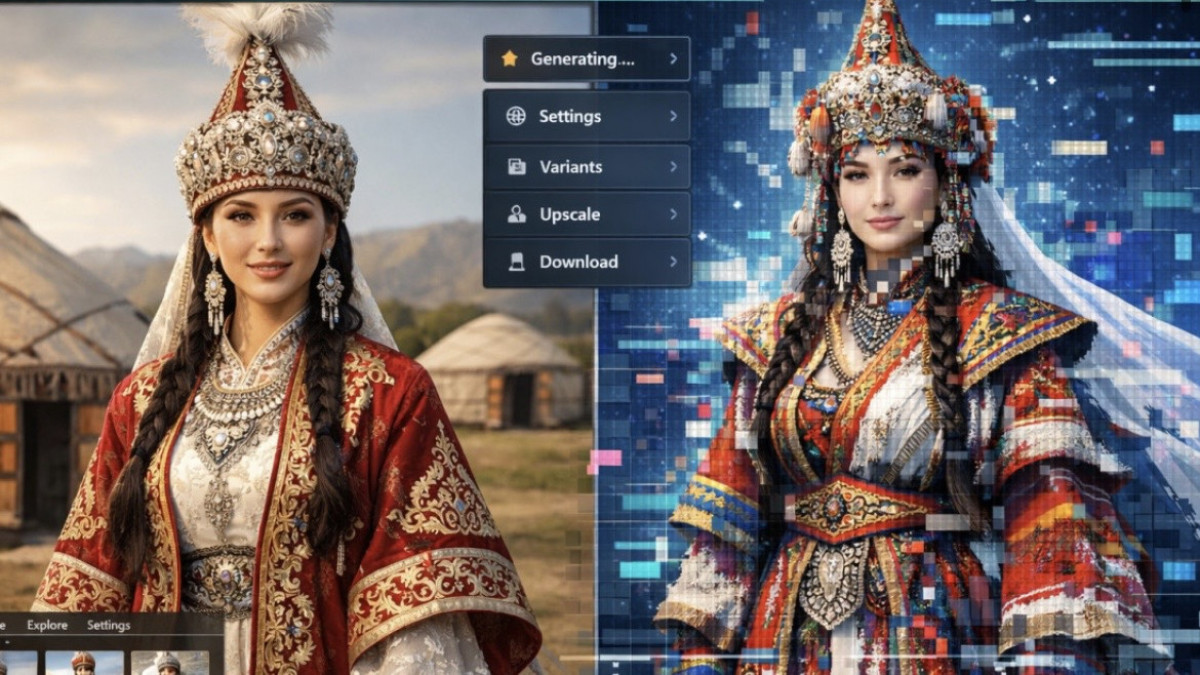
Artificial intelligence is increasingly used to generate images of national clothing, but these technologies do not always cultural specifics. In this article El.kz explores what role AI plays in preserving cultural heritage.
Digital interpretation of traditions
With the development of generative technologies, neural networks have learned to create images that are highly realistic. A user only needs to input a prompt, and the system generates a visual image, including elements of national costume - ornaments, fabrics, accessories.
However, a closer look reveals that such images do not always correspond to authentic traditions. Algorithms may combine elements from different cultures, alter clothing proportions, or use ornaments outside their historical context. As a result, a generalized visual style emerges that only partially reflects the original national identity.
Data limitations and accuracy
This is especially noticeable in cultures that are less represented in the digital space. In such cases, neural networks rely on a limited number of images, which directly affects the accuracy and depth of detail reproduction.
This is not only about appearance but also about symbolism: ornaments and elements of national clothing often carry cultural meaning that can be lost in digital interpretation.
What can be changed
The solution lies in data and that’s good news, because data can be created intentionally. Kazakh museums, universities, and cultural institutions hold extensive archives on national clothing, ornamentation, and traditional lifestyles. Digitizing these materials with proper labeling and making them publicly available is a direct contribution to how global AI models will “see” Kazakh culture in the next generation of systems.
International experience shows that without the participation of cultural communities themselves, technical solutions do not work. The DE-BIAS project, launched by European museums, involves collaboration between archive curators and representatives of cultural communities to relabel data taking into account the meanings that cultural bearers themselves assign to artifacts, rather than external observers.
A neural network does not know what a saukele or a chapan is, it only knows what it has seen in data. If Kazakh culture is poorly represented or distorted in that data, that is exactly how it will be reproduced in design, education, media, and marketing. This is not a flaw of the technology, but a task for cultural institutions: to actively shape the digital representation of their culture before someone else does and does it incorrectly.

El recommends 
