
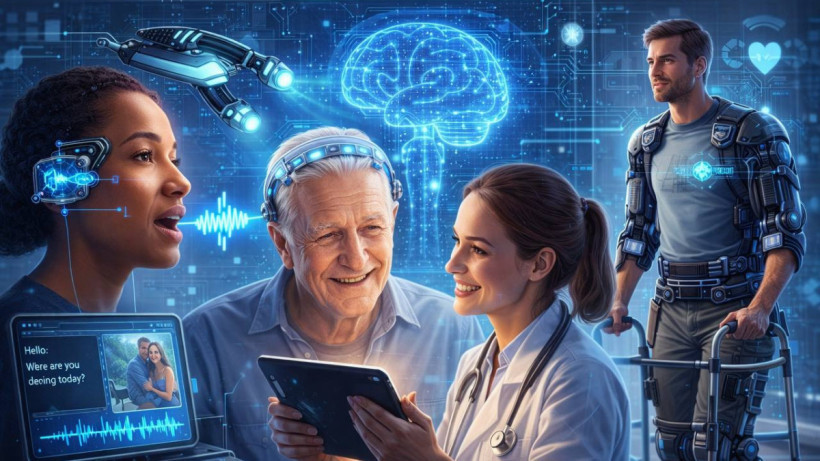
On World Health Day, the world celebrates not only the achievements of traditional medicine but also the breakthroughs of artificial intelligence, which is giving a second life to people with severe illnesses. Smart glasses for dementia patients, a brain implant that restores speech for those with ALS, a neural interface that allows a robotic arm to be controlled by thought, and an autonomous robot nurse - these are vivid examples of how AI is reshaping medical reality today, El.kz reports.
CrossSense smart glasses: A "second brain" for people with dementia
The British company CrossSense has introduced AI glasses designed specifically for patients in the early and middle stages of dementia. The lightweight frame features a built-in camera, microphone, and speakers. In real-time, the AI recognizes objects in the user's field of vision, names them, explains how to use them and even reads labels and handwritten notes.
Furthermore, the assistant gradually adapts to the individual: it helps find the right words and asks questions to spark memories. Relatives and social workers can connect to the system via a dedicated app.
The results of internal tests are impressive: without the glasses, volunteers with dementia correctly named only about half of the objects around them; with the glasses, that number rose to 82%. Even an hour after removing the device, accuracy remained at 78%. The glasses are currently undergoing expanded clinical trials. In the future, the developers hope to make the device available to everyone in need through the UK’s National Health Service (NHS).
Neuralink restores voice to patient with ALS
Kenneth was diagnosed with ALS (Amyotrophic Lateral Sclerosis) in January 2024. Over several years, this condition causes a person to completely lose the ability to speak as the brain loses control over the muscles of the speech apparatus. After learning about the recruitment of volunteers for the Neuralink N1 brain implant trials, Kenneth applied. In early 2026, the chip was implanted directly into the speech cortex of his brain. Now, the patient simply needs to think about words and the AI instantly synthesizes his actual voice based on old audio recordings.
"It was the same old him," Kenneth’s wife, Cheryl, says with tears in her eyes.
Today, the patient can comfortably hold full conversations and even play board games with his family.
AI brain interface
Scientists at the University of California, San Francisco (UCSF) have created an adaptive AI-powered brain-computer interface (BCI) that has allowed a patient, confined to a wheelchair for many years, to confidently control a robotic arm. Conventional systems of this type require constant recalibration because the brain rapidly changes its activity patterns.
The new algorithm automatically accounts for these changes. As a result, the interface operated stably for seven consecutive months. even after a break of several months, the patient needed only 15 minutes to regain control of the robotic arm. The experiment was conducted in several stages: from mental training to real-world actions the patient independently reached for a cup and filled it with water from a cooler. The study's authors call the technology "the next stage in the evolution of brain-computer interfaces."
Nurabot Robot Nurse Already Working in a Taiwanese Hospital
The Taichung Veterans General Hospital in Taiwan is testing the autonomous robot "Nurabot." The robot is equipped with powerful NVIDIA chips and an "AI brain" trained on thousands of virtual simulations. Nurabot independently maneuvers through narrow corridors, recognizes speech, answers patient questions, delivers medications, transports lab samples, and monitors wards. It is estimated to reduce the workload on nurses by 30%, giving staff more time for direct patient care.
"AI allows the robot to perceive, reason, and act more like a human," notes David Nevolny, NVIDIA’s Director of Healthcare Business Development.
According to WHO forecasts, by 2030, the world will face a shortage of 4.5 million nurses, while the number of people over the age of 60 will grow by 40%. In such conditions, robot assistants could become a true lifesaver for the healthcare industry.
