

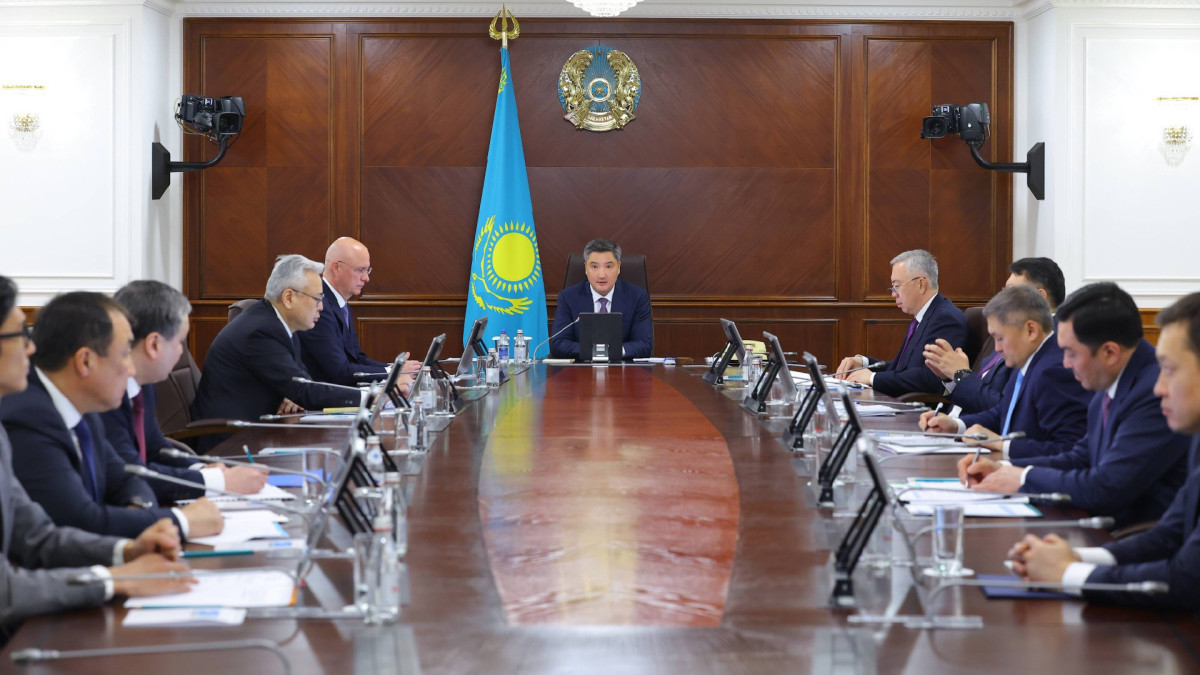
At the Government session chaired by Prime Minister of the Republic of Kazakhstan Olzhas Bektenov, the issue of implementing artificial intelligence across all sectors of the economy was discussed. Reports were delivered by Deputy Prime Minister – Minister of Artificial Intelligence and Digital Development Zhaslan Madiyev, Ministers of Industry and Construction Yersaiyn Nagaspayev, Transport Nurlan Sauranbayev, Energy Yerlan Akkenzhenov, Science and Higher Education Sayasat Nurbek, as well as the management of JSC Kazakhtelecom, the Grain Consortium, and the IT startup Ascle, El.kz reports citingprimeminister.kz.
The Prime Minister emphasized that President Kassym-Jomart Tokayev pays special attention to digitalization and the widespread introduction of digital technologies and artificial intelligence, which is one of the key factors in the comprehensive modernization of the country.
“On the instruction of President Kassym-Jomart Tokayev, a draft of the National Strategy for Large-Scale Digitalization and Total Implementation of Artificial Intelligence Technologies ‘Digital Qazaqstan’ has been prepared. This document will define the conceptual vision for the development of the sector in the long term and will allow for coordinated implementation of the tasks set in this area. In the Year of Digitalization and Artificial Intelligence declared by the Head of State, we must give a significant impetus to the digital transformation of the economy,” Olzhas Bektenov stressed.
Last year, Kazakhstan’s IT services exports exceeded $1 billion. The need to maintain the current pace was emphasized. At the same time, according to international experts, by 2030 the contribution of artificial intelligence to the global economy will exceed $22 trillion, which requires accelerated development of digital infrastructure and increased global competitiveness of the country. It was noted that the introduction of digital technologies at domestic enterprises contributes to improving product quality, industrial safety, and labor productivity.
Attention was paid to the development of computing power. The country already operates the Alem.Cloud and AL Farabium supercomputer clusters, which are included in the global TOP-500 ranking. In connection with the growing number of requests from state bodies and businesses for computing resources, the Prime Minister instructed the Ministry of Artificial Intelligence and Digital Development to take measures to increase current computing capacity and form a flexible resource allocation policy so that limited capacity does not become a constraining factor.
The need to intensify work on attracting investors to implement the “Data Center Valley” project in Pavlodar Region was noted. Kazakhstan must create favorable conditions for attracting investments and IT specialists, including foreign ones. The relevant ministry was instructed to submit proposals to improve legislation for the regulation and stimulation of cloud service providers.
The Head of Government emphasized that the availability of high-quality and accessible data is a key condition for the large-scale implementation of AI. Tasks were set to eliminate data fragmentation, ensure business access to state datasets, and introduce uniform standards for their use. The Ministry of Artificial Intelligence and Digital Development was instructed to complete the formation of the methodological framework and focus on creating sectoral “data lakes”, as well as to intensify work on digitization and regular data population.
The private sector plays an important role in AI development. Emphasis was placed on the need to create economic incentives for business and ensure support for high-digitalization projects from financial institutions. It was instructed to form a single pool of AI projects to improve coordination efficiency and avoid duplication and dispersion of resources. As a result, AI should become a real driver of the economy.
The Prime Minister noted that modern challenges require a transition to more accurate tools for socio-economic planning. Artificial intelligence can process large data arrays, identify patterns, and form more accurate forecasts. This will improve the effectiveness of state economic policy.
In this regard, the Ministry of National Economy, together with the Ministry of Artificial Intelligence, must introduce a specific mechanism for using artificial intelligence to forecast the development of economic processes.
For most enterprises, especially small and medium-sized businesses, AI remains a complex and inaccessible tool. The main reasons are the lack of competencies, resources, and understandable implementation mechanisms. Therefore, the Ministry of Artificial Intelligence, together with interested state bodies, needs to develop approaches to stimulate the introduction of artificial intelligence by small and medium-sized businesses.
The Ministry of Science and Higher Education must build a systematic approach not only to training new specialists in this field, but also to retraining existing personnel from various sectors.
“The new Constitution for the first time enshrines the rights of citizens to the protection of personal data. This gives impetus to the further development of the industry and reflects the strategic priorities of the state. Current legislation provides for the need to protect personal data when operating artificial intelligence systems,” Olzhas Bektenov emphasized.
The Ministry of Artificial Intelligence was instructed to ensure proper control to prevent unauthorized access by third parties and systems to personal data, as well as to protect rights to intellectual property objects.
It was noted that the “Digital Qazaqstan” strategy is aimed at the comprehensive digital transformation of the country and the transition from pilot initiatives to the systemic implementation of artificial intelligence in the economy.
Control and coordination of the implementation of the instructions were assigned to Deputy Prime Minister – Minister of Artificial Intelligence and Digital Development Zhaslan Madiyev.
