

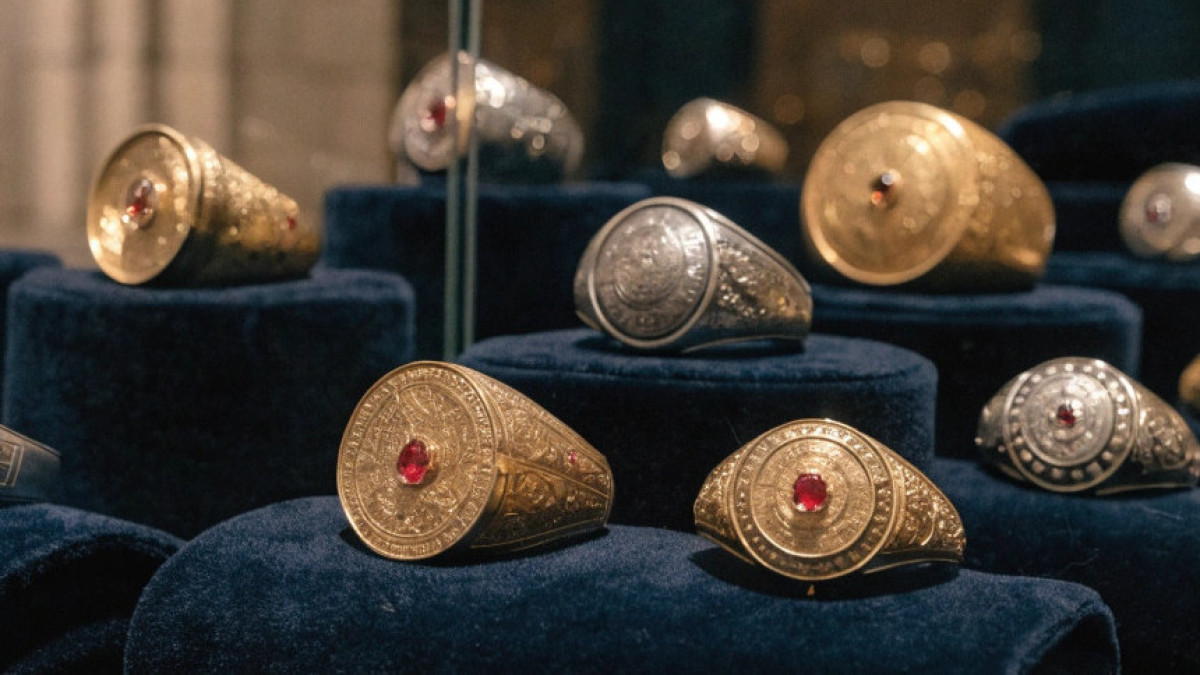
The gold and silver signet rings of rulers were far more than items of personal adornment. They functioned as official state seals, authenticating decrees, intl treaties, diplomatic correspondence, and other instruments of governance. Today, these artifacts provide historians with valuable evidence for reconstructing the historical events of the eras of Genghis Khan, Ögedei Khan, and Ablai Khan, El.kz reports.
Ögedei Khan’s signet ring as a symbol of the Mongol Empire’s sovereign authority
Among the most significant artifacts is a gold signet ring bearing the tamga of Ögedei Khan, the son of Genghis Khan and the second Great Khan of the Mongol Empire. The ruler’s dynastic emblem is engraved on the diamond-shaped bezel and was used to authenticate the Empire’s most important official documents.
Such rings were not ornaments in the conventional sense. They fulfilled a formal legal and administrative function by certifying the authenticity of yarlyks (official charters), diplomatic communications, and khans’ decrees. The production of these signet rings required exceptional craftsmanship from court goldsmiths proficient in casting, repoussé, chasing, and engraving techniques.
According to researchers, the ring may have belonged either to Ögedei Khan himself or to one of his closest governors or diplomatic envoys vested with the authority to act on behalf of the Great Khan.
The Enigma of the Otrar Oasis Signet Ring
Another remarkable artifact is a massive gold signet ring bearing the name Ahmad Ali al-Fadl. It was discovered in the Otrar Oasis together with Khwarazmian and early Mongol coins. Archaeologists associate the hoard with the dramatic events of the early thirteenth century, when Otrar became the focal point of the confrontation between the Khwarazmian Empire and the Mongol Empire.
According to one interpretation, the ring belonged to an influential Arab merchant or diplomat who had travelled to Central Asia along the Great Silk Road. An alternative hypothesis suggests that it became part of the treasure following the plundering of Genghis Khan’s famous trade caravan in Otrar.
Historians believe that the hoard was concealed during the siege of the city by the forces of Chagatai and Ögedei. Its owner never returned to recover the valuables, allowing this unique artifact to remain buried for approximately eight centuries.
Ablai Khan’s signet ring
A third well-known artifact is the signet ring of Ablai Khan. The original has not survived; however, a reconstruction based on an extant seal impression has been produced for exhibition at the Akmola Museum of History and Local Lore.
Historians note that metal signet rings constituted the principal symbol of authority of Kazakh khans and sultans. The shape of the seal reflected the owner’s social and political status. Members of the ruling elite used large teardrop-shaped signet rings, while representatives of other social strata employed round, oval, square, or pear-shaped seals.
The seal of Ablai Khan bears the Arabic inscription: “Abulmansur bin Bahadur Wali Sultan.” Signet rings of this type were used to authenticate official state documents, diplomatic correspondence, and international agreements.
