

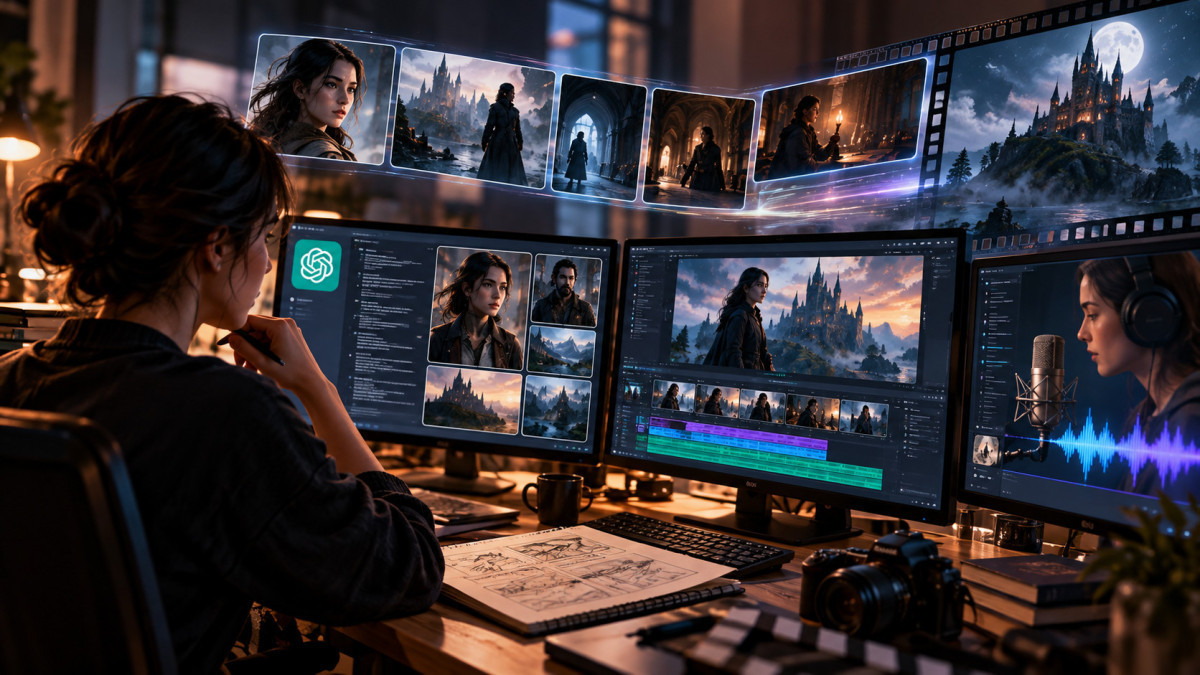
Until recently, producing a television series required a film crew, actors, cameras, sets and a substantial budget. Today, some of these tasks can be carried out using
AI. AI tools can assist with scriptwriting, character development, video scene generation and voice-over production. In this article El.kz reviews how to produce a mini-series, which tools to choose and what costs to expect.
A good starting point is to create a short episode lasting two to three minutes. This could be a science fiction story set in the future, a detective story, a romantic drama or a supernatural series. However, fully automating the production process remains challenging: the creator will still need to oversee plot continuity, character appearance, editing and dialogue quality.
This overview examines four tools: ChatGPT, Midjourney, Seedance and ElevenLabs. Each serves a specific stage of production. Paid subscriptions are particularly useful for video production, where dozens of frames may be required and the ability to revise generated content repeatedly is essential.
ChatGPT: From an initial idea to a completed scrip
The first stage of producing a series is scriptwriting. ChatGPT can help develop a storyline, determine the genre, create character profiles, write dialogue and divide the narrative into episodes.
For example, users can ask the AI tool to develop a supernatural mini-series about a journalist who discovers a collection of old letters and gradually uncovers the mystery surrounding the disappearance of an entire family. The AI can suggest plot twists, character biographies and a sequence of scenes.
The free version of ChatGPT is sufficient for getting started. It supports text-based tasks and image generation, although certain features are subject to usage limits. A paid subscription is more convenient for sustained work on a project.
Sample prompt for ChatGPT
“Develop a script for a supernatural mini-series consisting of five three-minute episodes. The story is set in contemporary Kazakhstan. The main character is investigating the disappearance of a girl that occurred many years ago. Create character profiles, dialogue, a sequence of scenes, camera directions and an unexpected ending for each episode.”
Midjourney: Creating Characters and the Visual World
Once the script is ready, the next step is to establish the appearance of the characters and the world around them. Midjourney is suitable for this purpose, as it generates images based on textual descriptions.
Users can develop the appearance of the main characters, their costumes, apartment interiors, futuristic cities or ancient castles. The resulting images can serve as visual references for subsequent stages of production.
Particular attention should be paid to maintaining character consistency. If the main character appears in several episodes, her distinctive facial features, clothing and hairstyle should remain recognisable throughout the series. Reference images can be used to help achieve this.
Midjourney operates on a subscription basis. The Basic plan costs 10 dollars per month, the Standard plan costs 30 dollars and the Pro plan costs 60 dollars. The higher-tier plans provide greater image-generation capacity, while the Pro plan also allows users to keep their work private rather than making it publicly accessible.
Midjourney also offers its own video-generation functionality. However, producing a full mini-series may require a more specialised AI video-generation tool.
Seedance 2.5: Turning Images into Video Scenes
The next stage is the most challenging and potentially the most expensive. Static images must be transformed into moving scenes in which characters speak, walk, interact with objects and respond to events.
In July 2026, ByteDance introduced Seedance 2.5. The model can generate video clips of up to 30 seconds per generation, supports scene extension and allows users to work with visual references.
For example, a user can upload an image of a female character in an old house and instruct the system to show her slowly opening a door, noticing movement in the darkness and turning around in alarm. The creator can also specify camera movements, lighting and character behaviour.
Usage terms and costs depend on the service selected, the user’s region and the available credits. Producing several episodes will require generating numerous individual clips. Even if the final running time is 15 minutes, the total volume of generated footage may be considerably greater due to repeated attempts, error correction and the selection of suitable takes.
ElevenLabs: Character Voices, Music and Sound Effects
Even high-quality AI-generated footage may appear unconvincing without appropriate audio. ElevenLabs can be used to create character voices, ambient sounds and individual musical elements.
The service enables users to convert text into speech, create voices with specific characteristics, generate sound effects and work with dubbing. Each character can be assigned a distinct voice, speaking pace and emotional delivery.
For example, in a supernatural series, the main character might speak calmly and confidently, while a mysterious stranger could have a deep, unsettling voice. Individual scenes can also be enhanced with the sounds of footsteps, a creaking door, rain or wind.
ElevenLabs offers a free plan with 10,000 credits per month. However, this plan is intended for non-commercial use and requires attribution. Commercial publication requires a paid plan with the appropriate licence. The Starter plan includes 30,000 credits, while the Creator plan provides 121,000 credits per month.
How much does it cost to produce a mini-series using AI?
To estimate the minimum project budget, consider a production consisting of five short episodes, each three minutes long. The creator independently writes the script, develops the characters, generates the video footage, produces the dialogue voice-overs and edits the final material.
Project Budget Calculator
This estimate does not include potential expenses for video-editing software, additional generations beyond the selected budget, separately licensed music or professional services.
Assembling the Final Episodes
Once the video clips have been generated, they need to be combined into a complete episode. Free software such as DaVinci Resolve or other video-editing applications can be used for post-production. At this stage, the creator arranges the scenes in the required sequence, adds dialogue, music and titles, and adjusts the audio.
Maintaining visual consistency remains one of the most challenging aspects of the process. An AI model may alter a character’s face, clothing details or surroundings when generating successive frames. It is therefore advisable to prepare character reference images from different angles in advance, together with detailed descriptions of each location.
The completed mini-series can be published on YouTube, TikTok or other video-sharing platforms, provided that all applicable rules governing AI-generated content, music licensing, and rights to images and voices are observed. For commercial projects, the terms and conditions of each service should be reviewed separately.
