

Over 400 companies from 23 countries have gathered in Astana for Automechanika Astana 2026. The 10th anniversary edition has become the largest in the project’s history. The exhibition brings together automotive components, service equipment, lubricants, car care products, tires, diagnostic solutions, and technological innovations for the automotive market. El.kz reports.
This year, Automechanika Astana celebrates its 10th anniversary. Over the past decade, the exhibition has evolved from a regional industry platform into one of the key events for the automotive aftermarket in Central Asia, where business partnerships are formed and technological developments are discussed.
The project is held under the official license of Messe Frankfurt GmbH and is part of the international Automechanika network, which unites industry exhibitions worldwide and sets standards for automotive components, service solutions, and aftermarket operations.
This year, companies from Kazakhstan, Germany, China, Russia, the UAE, South Korea, India, and other countries have arrived in Astana. National pavilions from China, Uzbekistan, and Iran stand out in particular, showcasing comprehensive solutions ranging from spare parts to service equipment.
The exhibition halls demonstrate different approaches to the same market. Some exhibitors focus on live equipment demonstrations, others highlight digital diagnostic solutions.
Kazakhstan’s Vice Minister of Trade and Integration, Asset Nussupov, noted that such platforms serve as a bridge between the government and businesses.
“International industry exhibitions are a practical tool for achieving this goal: direct dialogue between the state, businesses, and international partners, technology transfer, and concrete contracts,” he said.
Central Asia as an Automotive Industry Hub
Over the years, Automechanika Astana has become a meeting point for manufacturers, distributors, dealers, service centers, and procurement specialists. Contracts are discussed, new technologies are presented, and supply chains that later operate across the region are established here.
The business program includes B2B meetings, equipment presentations, technology demonstrations, educational sessions within the Automechanika Academy, and expert discussions featuring industry specialists. At times, the exhibition halls transform into active negotiation zones where business talks take place directly beside product displays.
Anuar Malik, Director of Business Media Central Asia, emphasized that the exhibition has long surpassed the role of a simple showcase.
“Over the past ten years, we have created not just an exhibition, but an environment where deals and partnerships are born,” he said.
Jörg Seifart, Director of Finance and Strategy at Messe Frankfurt GmbH, highlighted growing international interest in the region.
“We are pleased to celebrate the 10th anniversary of Automechanika Astana and see potential for further growth in the region,” he said.
Negotiation areas clearly demonstrate how quickly participants move from introductions to discussing business terms. Companies present component samples, discuss supply arrangements, compare equipment specifications, and immediately exchange contacts.
Kazakhstan’s Manufacturing Sector and Export Ambitions
Among the participants is Tengri Tyres, which is showcasing a range of tires manufactured in Kazakhstan using international technologies and quality standards.
Ilyas Arystan, Executive Director of Aiken Tires Kazakhstan and Head of Legal Affairs at Tengri Tyres, noted that participation in the exhibition helps strengthen confidence in local products both domestically and internationally.
“We represent the only tire manufacturing plant in Kazakhstan. We are proud to showcase domestic products and demonstrate that our country produces tires that meet European standards,” he said.
Company representatives also noted that the exhibition provides an opportunity to observe market reactions directly and compare their products with foreign competitors displayed at neighboring stands.
“Kazakhstan is capable of manufacturing automotive components and competing successfully in the market,” he added.
Cars, Tuning, and Private Projects
A separate section of the exhibition is dedicated to automotive culture, tuning, and private enthusiast projects. Classic vehicles stand alongside modern sports cars, motorcycles, and custom-built machines.
One of the most talked-about displays belongs to the owner of two projects: a 2023 Harley-Davidson Revolution Max motorcycle and a BMW M4. The combined value of the vehicles is approximately 52 million tenge. Both represent different approaches to automobiles and motorcycles as both machines and personal projects.
The motorcycle is powered by a 142-horsepower Revolution Max engine. According to the owner, it performs best in urban environments and on shorter routes.
“Harley-Davidson also used this engine in the Pan America model, which is designed for long-distance travel. You can cover great distances comfortably,” the participant explained.
The BMW M4 is currently in factory configuration, but its owner plans a major performance upgrade to approximately 900 horsepower through ECU reprogramming. The vehicle continuously attracts crowds interested in the technical details and cost of such modifications.
“I plan to widen it and increase output to around 900 horsepower. The system needs to be unlocked and reprogrammed so new engine maps can be installed,” he said.
Classic and Rare Automobiles
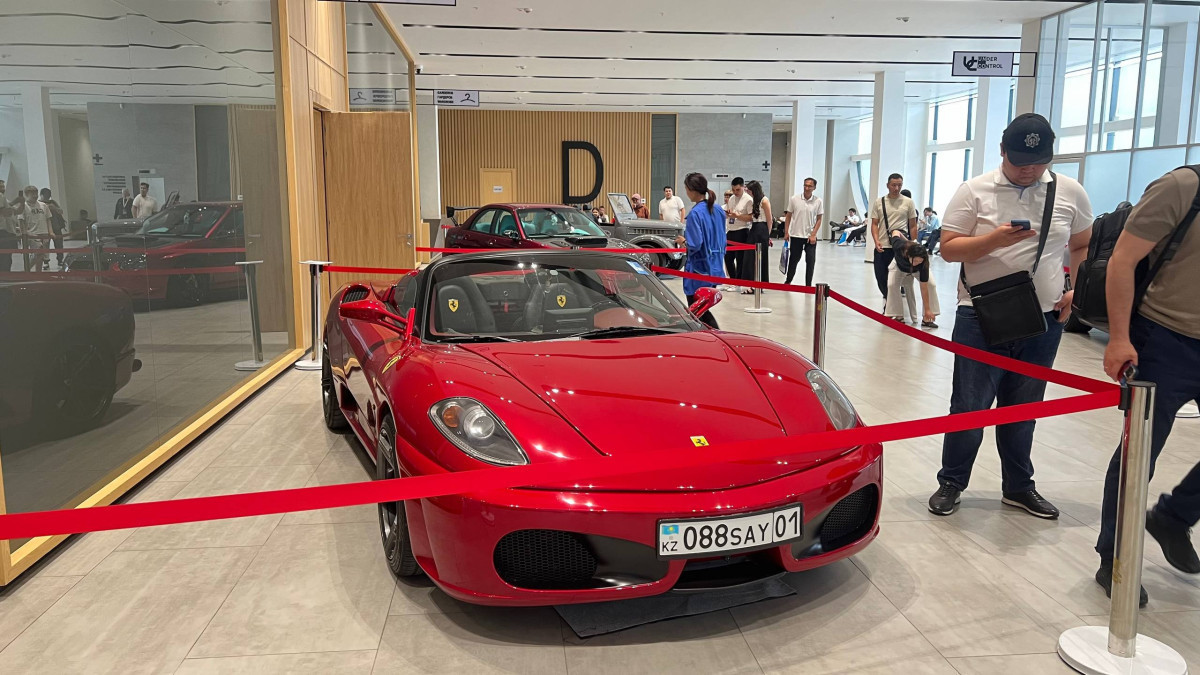
The exhibition also features rare and collectible vehicles that attract significant attention from visitors. Among them are the Ferrari 360 Spider, Rolls-Royce Cullinan, and BMW E21.
The value of the exhibits ranges from tens of thousands of dollars for classic models to several hundred thousand dollars for luxury SUVs and custom-built vehicles. Each automobile tells its own story, combining engineering, design, and the spirit of different eras.
Driving Simulators and Digital Technologies
One of the exhibition halls features a driving simulator where visitors can test vehicle behavior in a virtual environment. The simulator attracts students, aspiring engineers, and visitors trying digital driving experiences for the first time.
Nearby displays feature diagnostic systems, digital platforms for service centers, and maintenance equipment. These technologies demonstrate how the automotive industry is evolving and what skills are becoming essential for industry professionals.
A dedicated segment of the program focuses on electric vehicles and the development of charging infrastructure, with participation from representatives of the energy sector.
Kazakhstan’s Vice Minister of Energy, Erlan Akbarov, emphasized the growing interconnection between transportation and energy systems.
“The automotive industry presents new strategic challenges for our energy sector every day. The growth of the electric vehicle market is driving the rapid expansion of urban charging infrastructure. Today, transportation and energy operate as a single integrated system,” he said.
The exhibition features charging stations, software solutions, and service technologies that are helping build the infrastructure for electric mobility and future urban systems.
Automechanika Astana 2026 continues in Kazakhstan’s capital, bringing together manufacturers, distributors, service companies, and international business representatives in one space for negotiations, networking, and technology showcases.
The exhibition runs from June 10 to June 12, turning Astana into a focal point for the region’s automotive industry, where new partnerships are forged and solutions for the future market are discussed.
