

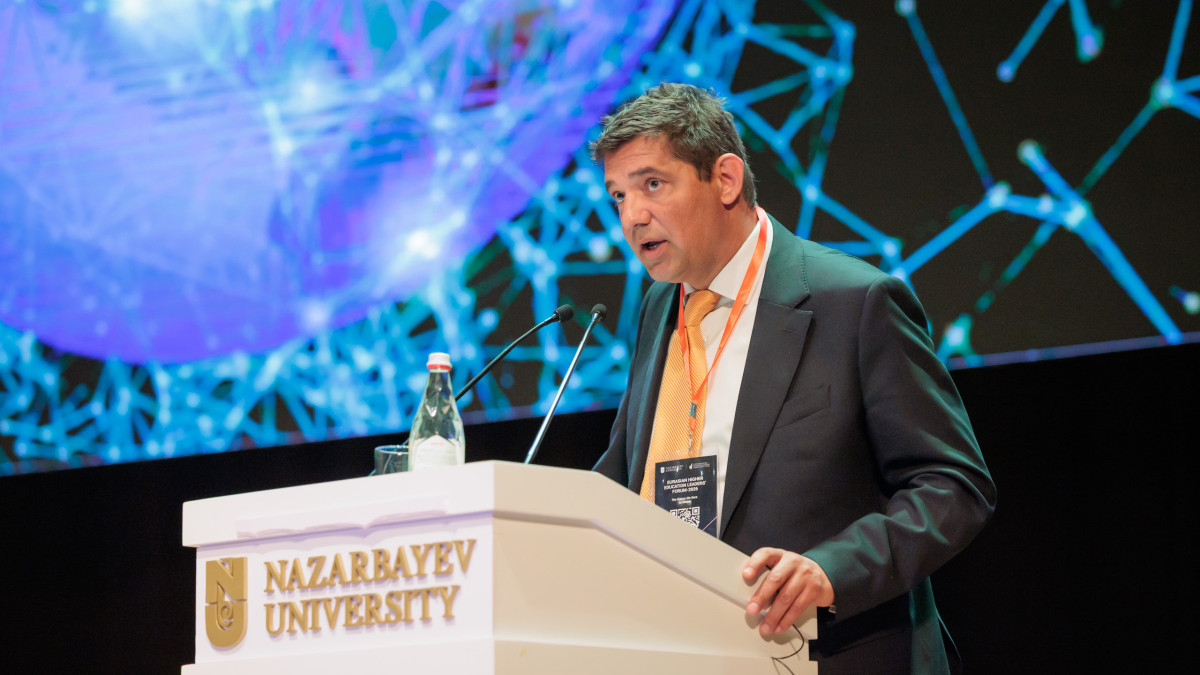
The Eurasian Higher Education Leaders’ Forum was held in Astana, bringing together higher education experts from various countries. Dr. Norbert Csizmadia, internationally recognized expert in geoeconomics, geostrategy, and global economic transformation shared his vision for the future of education, cities, and society through the concept of the "Turquoise Zone" - a space where knowledge, innovation, security, culture, and high quality of life intersect. El.kz reports.
A journey through maps of the future
Dr. Norbert Csizmadia’s presentation was structured as a visual journey. The economic geographer invited the audience to view the world not just through traditional political maps, but through transit routes, scientific collaborations, flight networks, infrastructure, digital systems, and cultural corridors.
According to him, a map is more than just an image of a territory; it is a way of thinking. The same world looks different when viewed from Europe, Asia, or China.
"I am a geographer, an economic geographer, and my job is to think. Geography is not just about memorizing places on a map. Through geography, we can understand the processes of the coming decades. Every map is a pair of glasses. But today, we need more and more of these glasses because the world is becoming increasingly complex."
Connectivity, complexity, and sustainability
One of the central themes of the speech was connectivity. Csizmadia presented the modern world as a system of lines: state borders, railways, highways, flight paths, scientific publications, and internet networks. These connections form the new architecture of global development.
For higher education, this means that universities can no longer be viewed in isolation from global knowledge flows.
Scientific collaborations, academic mobility, joint research, and digital platforms make universities part of a vast map of connectivity. On this map, Asia including Central Asia is becoming increasingly prominent.
"If we want to understand what is happening today in geopolitics, sustainable development, and technology, we need to know three key words: connectivity, complexity, and sustainability. For higher education, connectivity means that universities are increasingly linked through research, publications, knowledge exchange, and joint projects."
Eurasia as a space of new routes
Eurasia occupied a special place in the presentation. According to the speaker, new routes between Asia and Europe involve more than just roads, ports, and logistics. They encompass green development, digital infrastructure, education, culture, and political cooperation. In this vision, Central Asia is a key section where mainland Eurasia is regaining its connectivity.
"Belt and Road is a key theme for discussing the connection between Asia and Europe. It shifts the axis of development from the ocean back to the mainland and unites Eurasia. This is not just about infrastructure, green development, or digital networks it is also about education, culture, and political cooperation."
Megatrends reshaping universities
Csizmadia described the future as a system of overlapping megatrends. These include the rise of Asia, automation, robotization, AI, urbanization, climate change, and transformations in labor, economy, education, transport, media, security, and values. This landscape is vital for universities because higher education can no longer exist as an "isolated academic tower."
Universities must be able to see the interconnectedness between technology and society, climate and economy, the city and quality of life, and local culture and global competition.
"Megatrends are the rules, patterns, and laws of the future. If we look at the map of the future, we see different directions: society, work, economy, money, food, technology, environment, media, transport, education, security, and values. But at the center lie three main points: connectivity, complexity, and climate change."
The Anthropocene and the point of choice
Speaking on sustainable development, Csizmadia reminded the audience that humanity lives in the era of the Anthropocene, where human activity has become a force of planetary scale. Population growth, urbanization, water usage, economic production, pressure on ecosystems, and loss of biodiversity have already altered the Earth. He stated that the world is at a crossroads. One path leads to destruction and exhaustion, while the other leads to restoration and a new type of development. For Kazakhstan and Central Asia, however, Csizmadia sees another image of the future: not just "red" as a warning or "green" as an environmental standard, but "turquoise" associated with protection, healing, security, creativity, and knowledge.
"We are at a breaking point. The main question is which path humanity and the Earth will choose. One path leads to damage and destruction. The other leads to the rebirth of the future. But Kazakhstan’s answer, as I see it, is not to go right or left. Kazakhstan’s answer is to go up."
What is the “Turquoise Zone”?
The core imagery of the presentation was the "Turquoise Zone." Csizmadia explained that he arrived at this idea by studying the cultural history of the gemstone. In various civilizations from Iran and China to Egypt, the Americas, and Kazakhstan turquoise has been perceived as a symbol of protection, healing, security, creativity, innovation, and luck. In his concept, a Turquoise Zone is not just a place with beautiful nature or a developed economy. It is a space where the green economy, longevity, culture, ancient knowledge, gastronomy, local identity, peace, happiness, sustainability, creativity, and innovation converge. It is a place that manages to be both ancient and modern simultaneously.
"When I began studying the history of turquoise, I saw that in different cultures it signifies protection, healing, innovation, creativity, and security. It is a kind of amulet. And then I began to think about turquoise through the lens of sustainability. If the future is not red and not green, then the future can be turquoise."
One Hundred and One Places on the Map of the Future
Csizmadia shared that he has completed a book on the world's "Turquoise Zones," identifying 101 locations. He emphasized that these places cannot be compared directly. Every city, region, or cultural landscape has its own genius loci the spirit of the place its own history and its own formula for development. This is why Astana cannot be compared to Sardinia, nor Samarkand to Singapore. However, one can identify different types of spaces where sustainability, knowledge, creativity, and quality of life are born. For Csizmadia, these places are important not as tourist spots, but as nodes of the future where new development models can be studied.
Geo-cultural Corridors: From the Mediterranean to the Silk Road
In his model, Csizmadia identifies several geo-cultural corridors. These include the Mediterranean Basin (Apulia, Naples, Rome, Sardinia, Sicily, Northern Tunisia, Marrakech, and Spain); the Alpine-Nordic space with its emphasis on innovation, happiness, and quality of life; and East Asia with knowledge and technology hubs in Japan, China, South Korea, Shanghai, Shenzhen, and Chengdu. He placed particular emphasis on the ancient Silk Road, which he believes is experiencing a rebirth. This corridor passes through Azerbaijan, Turkey, Iran, Central Asia, Uzbekistan, Kyrgyzstan, and Kazakhstan. In Kazakhstan, he highlighted two vital points: Astana and Almaty.
Astana as a regional knowledge center
In his typology of "Turquoise Zones," Csizmadia speaks of different types of cities: ancient centers, new global hubs, creative cities, lifestyle cities, knowledge and talent centers, tourist destinations, and unique regions. In this system, Astana is labeled as a "new regional and knowledge center of Central Asia." This is a significant classification in the context of the higher education forum: the city is viewed not just as an administrative capital, but as a place where new educational, research, and institutional links are formed.
"There are ancient centers like Isfahan, Samarkand, Bukhara, Almaty, and Cusco. There are new global hubs New York, Istanbul, London, Singapore, Dubai, Seoul. Astana, on this map, is the new regional and knowledge center of Central Asia."
The DNA of a Place: History, Culture, Education, and Innovation
One of Csizmadia’s most striking theses was: "Geography is not just destiny, it is DNA." Every city, university, and state has its own structure, which includes history, education, innovation, quality of life, sustainability, culture, food, health, energy, and synergy. This approach is vital for universities because they are part of the "DNA of a place." They are not merely located in a city or country; they participate in shaping its future. A university can strengthen local identity, create new knowledge, retain talent, connect a region to global networks, and help society understand its own strengths.
"Geography is destiny, but I want to go further: geography is the DNA of destiny. Every person has a DNA structure. But what is the DNA of your city, your university, your nation? It includes geography and history, education and innovation, quality of life and well-being, sustainability, culture, food, health, energy, and synergy."
The Turquoise Zone and the Sustainable Development Goals (SDGs)
Csizmadia linked his concept to the Sustainable Development Goals. "Turquoise Zones," he argued, correspond to quality education, good health and well-being, clean water, sustainable cities, innovation and infrastructure, decent work, economic growth, clean energy, climate action, life below water and on land, peace, justice, and partnership. Thus, the Turquoise Zone becomes an attempt to gather various elements of sustainable development into a more cohesive picture. It is not just an isolated environmental project or an economic strategy; it is a model for a place where nature, culture, knowledge, technology, and human well-being must work together.
"If we look at Turquoise Zones through the Sustainable Development Goals, we see health and well-being, quality education, clean water, sustainable cities, industry, innovation and infrastructure, decent work and economic growth, clean energy, climate action, life below water and on land, peace, justice, and strong partnerships."
Universities as Navigators of a Complex World
Although Csizmadia’s presentation was filled with maps, imagery, and geographical metaphors, his primary audience remained the universities. According to his logic, it is the universities that must help societies navigate the complexity of the world. This requires interdisciplinary thinking: merging economics, ecology, technology, demography, urbanism, biology, culture, and the humanities. In this vision, the university of the future becomes more than an educational organization; it becomes a "navigator" that helps society understand which development routes lead to destruction and which lead to sustainability, creativity, and the long-term vitality of a place.
The Future as a Turquoise Route
The core message of Csizmadia’s speech was the need to change the language we use to talk about the future. Old maps no longer explain the modern world, and old polarities are insufficient. Between destruction and restoration, globalization and locality, technology and culture, nature and the city, a third route emerges - the Turquoise Route.
For Kazakhstan and Central Asia, this idea is particularly symbolic. The region sits at the intersection of historical paths, new infrastructure projects, cultural layers, and educational ambitions. Therefore, the "Turquoise Zone" served not as a decorative metaphor, but as a proposal to see Eurasia as a space where the new geography of the future can be formed.
