

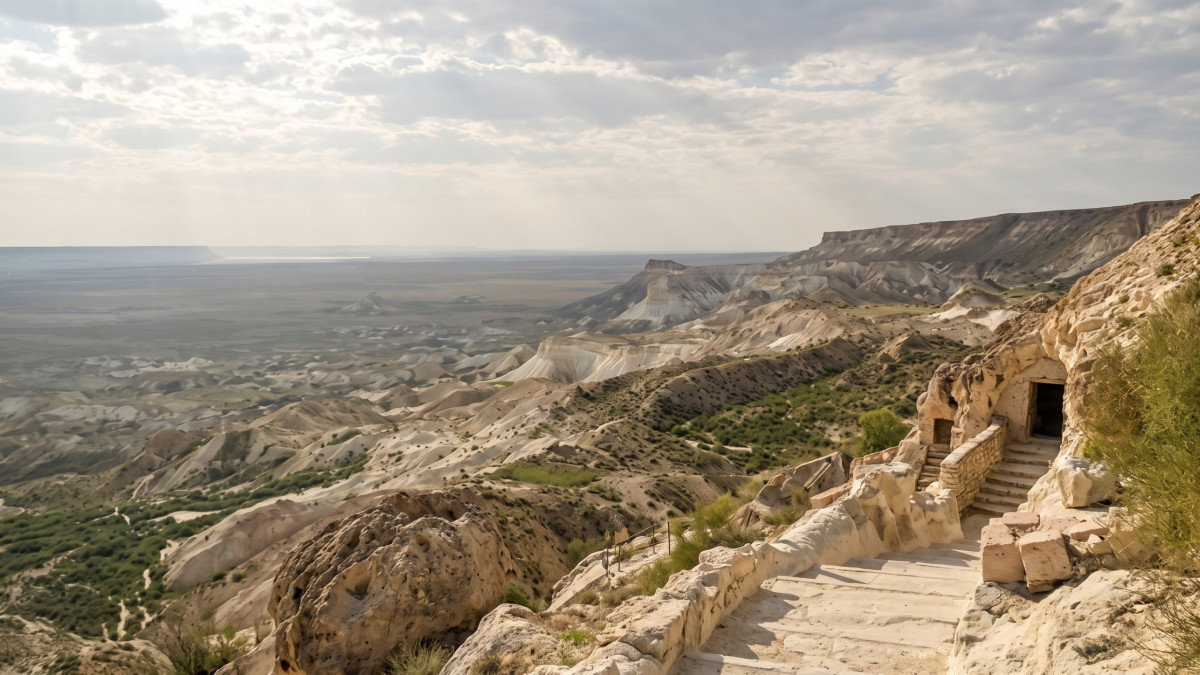
Five rock-hewn mosques and associated sacred sites in Mangystau, dating from the 12th to the 18th centuries, have been inscribed on the UNESCO World Heritage List. The World Heritage Committee adopted the decision at its 48th session on 25 July in Busan, South Korea. This follows President Kassym-Jomart Tokayev’s 2024 instructions to pursue the inscription of these rock-hewn mosques on the World Heritage List, El.kz cites Euronews.
The sites are Beket-Ata, Shopan-Ata, Karaman-Ata, Shakpak-Ata and Sultan-Epe.
In Central Asian Sufism, ‘Ata’, meaning ‘father’ or ‘ancestor’, is used as an honorific for a revered spiritual figure.
Their spiritual lineage traces back to the 12th-century Sufi master Khoja Ahmed Yasawi. His teachings helped spread Islam among the Turkic-speaking peoples of Central Asia, connecting Islamic practices with older Tengri beliefs and local shamanistic traditions.
Mangystau – the cradle of nomadic spirituality
According to UNESCO, the sacred complexes reflect the evolution of a distinctive spiritual culture, combining Sufi Islam with older traditions of ancestor worship, reverence for the landscape and spiritual leadership.
Erlan Karin, Chairman of Kazakhstan’s National Commission for UNESCO and ICESCO, described the inscription as recognition of the sites’ global significance and a tribute to the history, spiritual heritage and cultural identity of the Kazakh people.
Local resident Almagul Zhaiman noted that the sacred sites have been preserved through faith and traditions passed down through generations.
The Sufi masters of the mosques
Karaman-Ata was a Sufi missionary who came to spread Islam in the region. His mosque is believed to date back to the 12th or 13th century, while its associated necropolis is one of the largest and oldest in Mangystau.
For the Kazakhs and Turkmens who lived on the Mangyshlak Peninsula, the necropolis was considered a sacred place.
According to tradition, Karaman-Ata was the grandson of Shopan-Ata, a 12th-century mystic revered as the protector of shepherds and livestock. Shopan-Ata was a disciple of Khoja Ahmed Yasawi, and his sanctuary remains an important destination for Sufi pilgrims.
Beket-Ata is said to have regarded Shopan-Ata, who lived centuries earlier, as a spiritual mentor.
Local traditions attribute extraordinary abilities to the 18th-century scholar, healer and architect, including teleportation and levitation.
“He was also regarded as the last and highest-ranking spiritual master among other holy men, which is why he became known as Pir Beket,” said Bakhtiyar Esimbetov, caretaker of Beket-Ata’s mosque.
The Shakpak-Ata complex was an important regional Sufi centre for centuries. Carved into a chalk and limestone cliff, its sanctuary features a central domed hall with a cross-shaped layout. Local traditions associate Shakpak-Ata with the study of astronomy and astrology.
Inside the mosques’ architectural layout
Located across western Kazakhstan, Mangystau’s underground mosques were built in natural caves, carved into cliffs or excavated underground. Their structures include prayer halls, mihrabs, meditation cells and tombs, while the surrounding complexes feature courtyards, wells, sacred trees and necropolises dating from different historical periods.
According to local sacred sites guide Yersultan Islam, the underground chambers provided places of retreat where people could withdraw from everyday life and focus on spiritual purification.
Pilgrims
Mangystau’s sacred sites have attracted pilgrims for centuries and continue to welcome visitors from Kazakhstan and abroad.
The programme features pilgrims from Russia, Türkiye and Italy. Dinara Farvazova’s family travels from Bashkortostan to visit the sanctuaries, while Rinat Aubekerov and his wife, ethnic Kazakhs from Russia, visited Shopan-Ata in the hope of having children.
Turkish traveller Kaahn Ozturk visited Karaman-Ata while travelling across Kazakhstan by motorcycle, seeking a deeper understanding of Islam. Italian visitor Davide Passanante spoke of the strong role faith plays in local communities.
Almagul Zhaiman emphasised that the sanctuaries’ preservation reflects the transmission of faith across generations. Basic accommodation and meals are available to pilgrims free of charge.
Easing travel for visitors to sacred sites
Kazakhstan is now planning to improve access to the newly listed sites while preserving them for future generations.
A five-year comprehensive development plan, due to begin in 2027, is expected to support tourism at the sites, including restoration work and the development of new visitor infrastructure.
Visitor centres are planned for Shopan-Ata, Beket-Ata and Karaman-Ata, complementing the existing centre serving Sultan-Epe and Shakpak-Ata. According to Baltabai Balapan, director of the Mangystau State Historical and Cultural Reserve, the plans also include construction of an asphalt road and efforts to improve internet connectivity.
The inscription brings international recognition to Mangystau’s spiritual and cultural heritage and supports efforts to preserve these sacred sites for future generations.
