

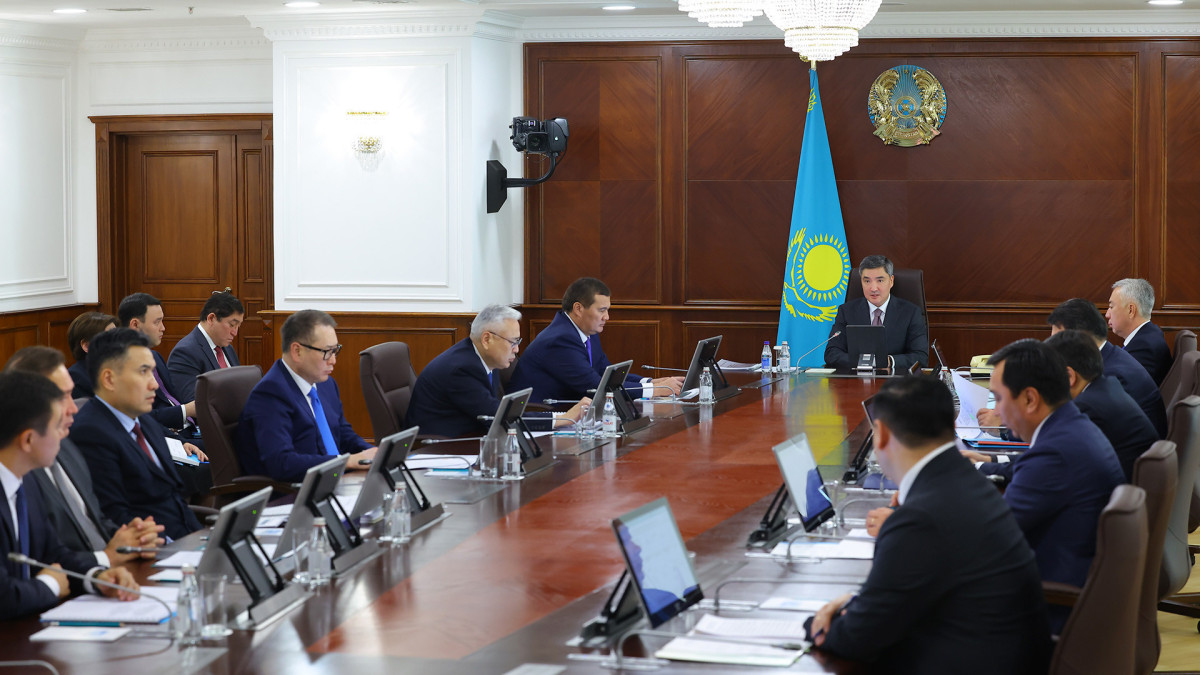
At the Government session chaired by Prime Minister Olzhas Bektenov, the results of socio-economic development and the execution of the republican budget for the nine months of 2026 were reviewed, El.kz cites primeminister.kz.
Reports were presented by the heads of the Ministries of National Economy, Finance, Agriculture, Trade and Integration, Industry and Construction, Energy, and Transport.
“The Head of State instructed the Government to step up efforts to ensure sustainable and high-quality economic development. There are 2.5 months left until the end of the current year. Despite the decline in the oil sector this year, the country's economy has entered a growth trajectory and stands at 4.2%. It should be noted that the non-resource sector continues to be the main driver of growth in the domestic economy,” Olzhas Bektenov emphasized.
Positive dynamics were recorded in construction (growth of 11.5%), manufacturing (8.6%), transport (7.2%), trade (6.2%), and agriculture (5.8%). The combined contribution of these sectors to GDP growth is about 80.5%. The Prime Minister noted the huge potential of these sectors and the need to utilize all available reserves. This is evidenced by their high investment activity, as well as the dynamics of non-resource exports.
Thanks to outstripping export growth in the first half of 2026, the current account of the balance of payments registered a surplus of $2.4 billion, whereas during the same period last year a deficit of $3.6 billion was observed. Economic growth is taking on a more balanced and quality-driven character, forming the foundation for further expansion of the country’s production potential.
In addition, as a result of coordinated work between the Government and the National Bank, reduced inflationary pressure has been ensured: following the results of 9 months, annual inflation slowed down to 9.3%, and the main task for the current year remains keeping it below 10%.
Overall, to ensure stable economic growth, the head of the Government set a number of tasks for government agencies and akimats to take the necessary measures.
First. Special emphasis is placed on the manufacturing industry, in particular metallurgy.
“As part of the further development of the real sector, it is important not to reduce production volumes in the manufacturing industry. The metallurgical industry forms the basis for many sectors of the economy. Therefore, measures must be taken to ensure its sustainable development and the realization of its existing potential. To fully load metallurgical enterprises with raw materials, it is necessary to complete all negotiations with foreign partners and proceed with the practical implementation of agreements. Among other things, the geography of supplies needs to be expanded,”Olzhas Bektenov stressed.
- The Samruk-Kazyna Fund and the Ministry of Industry were instructed to work out mechanisms for long-term supply of raw materials to domestic metallurgy enterprises.
- The Ministry of Trade needs to take additional measures to reduce barriers to the supply of domestic products to foreign markets.
- The Ministry of Finance is to step up control to eliminate the import of "gray" products.
Attention was paid to maximizing the capacity utilization of existing production facilities and the timely launch of new projects: out of 200 planned for this year, 106 have already been commissioned.
- The Ministry of Transport, together with the company “Qazaqstan Temir Zholy”, was instructed to ensure the uninterrupted delivery of containers and wagons carrying raw materials and components.
- Regarding the geological study of territories, the Ministry of Industry was tasked with completing key stages and presenting concrete results by the end of the year.
In the construction sector, the key task remains ensuring the actual commissioning of the planned volume of housing in the amount of 20.4 million m², without formal accounting, fully equipped with ready infrastructure and landscaping.
- Regional akimats were instructed to prepare land plots in advance and accelerate the provision of engineering networks to them.
- Instructions were given to improve housing financing mechanisms and increase the availability of housing programs for citizens. To increase the availability of housing programs, the Agency for Regulation and Development of the Financial Market, together with the Ministry of Industry, needs to draft proposals to reduce the amount of down payment.
Second.
“The Head of State instructed that gasification levels be brought to 80% by 2035. By the end of the current year, this figure should reach 64.5%. I instruct the Ministry of Energy, together with QazaqGaz and regional akimats, to take measures to modernize existing infrastructure, construct trunk gas pipelines in a timely manner, and implement major projects in the gas industry,”the Prime Minister noted.
Third. Tasks were set before the Ministry of Transport and the Ministry of Finance, together with interested government agencies, for the timely completion of infrastructure projects, increasing cargo and transit traffic volumes, shortening cargo border-crossing times, eliminating administrative barriers, and introducing unified digital accompanying documents.
Special attention must be paid to attracting additional cargo flows, developing logistics centers, and increasing the capacity utilization of existing transport corridors.
Fourth.
“This year, a high-quality grain harvest is expected. To meet the needs of the domestic and external grain markets, it is important to complete the harvesting campaign on time. Regional akimats, together with the Ministry of Agriculture, must engage all available elevator and warehouse capacities,” Olzhas Bektenov emphasized.
In the livestock sector, it was noted that by the end of the current year, milk production at newly commissioned dairy farms should reach at least 70% of their design capacity. Akimats were instructed to ensure the targeted and effective utilization of funds allocated for the implementation of preferential lending programs within the framework of the Comprehensive Plan for Livestock Development. The Ministry of Agriculture is also required to take measures to stabilize the situation in the beverage production sector.
Fifth. In the field of trade, the implementation of regional Roadmaps continues. Akimats were set the task of executing them thoroughly and achieving the established indicators for increasing trade turnover.
“The issue of digitalizing trade markets requires special attention. Today, there are around 600 markets operating in the country. This is key infrastructure for micro and small businesses. Digitalization will allow us to see the actual operations of trade markets to legalize entrepreneurial activity and replenish the tax base,” the head of the Government emphasized.
The Ministry of Trade, together with the Ministry of Artificial Intelligence and the Atameken Chamber, was instructed to accelerate the process of digitalization and the creation of a corresponding information system.
Sixth. A crucial direction of the Government's work remains the full-scale launch of a new investment cycle.
“The Head of State instructed that active measures be taken to fully launch a new investment cycle. The emphasis in this direction must be placed on attracting long-term and high-tech investments, developing the manufacturing industry, and deep processing of products. Priority should be given to breakthrough projects that multiply gross value added,” Olzhas Bektenov emphasized.
According to the Concept of Investment Policy, over the next 5 years, fixed capital investments should increase 3-fold — from 23.5 trillion tenge in 2025 to 67.8 trillion tenge by 2030. In this regard, it is necessary to intensify efforts to search for and attract major investors to the country who can bring technology, expertise, and access to new markets. At the same time, the importance of refining the "investment order" mechanism was noted so that it becomes a driver of new-generation technology-intensive industries reflecting Kazakhstan's long-term strategic interests.
-
The Ministry of Foreign Affairs and the Ministry of National Economy were instructed to prepare an action plan within ten days for a fundamental overhaul of the "investment order" mechanism.
-
The Ministry of National Economy was instructed to work out additional measures within two weeks to stimulate investment in projects with high added value.
Seventh. Administrators of budget programs must strengthen financial discipline by ensuring the targeted and effective use of budget funds. Akimats were tasked with ensuring the mobilization of additional revenues and making maximum use of internal reserves, which will reduce regional dependence on unplanned funding from the republican budget.
Eighth. Regarding regional development, positive dynamics in key macro-indicators were noted in Turkestan, Almaty, Zhambyl, Kyzylorda, Pavlodar, Mangystau, and Kostanay regions, as well as in the Ulytau and Abai regions, and the cities of Astana, Almaty, and Shymkent. Heads of Atyrau, Akmola, Aktobe, Karaganda, and Zhetysu regions, where lagging behind on several indicators was recorded, were instructed to take operational measures to correct the situation.
“We face the task of ensuring high-quality economic growth. To achieve the planned targets, coordinated action, maximum efficiency, and personal responsibility from every minister and akim are required,” the Prime Minister noted.
Coordination has been assigned to Deputy Prime Minister – Minister of National Economy Serik Zhumangarin.
