

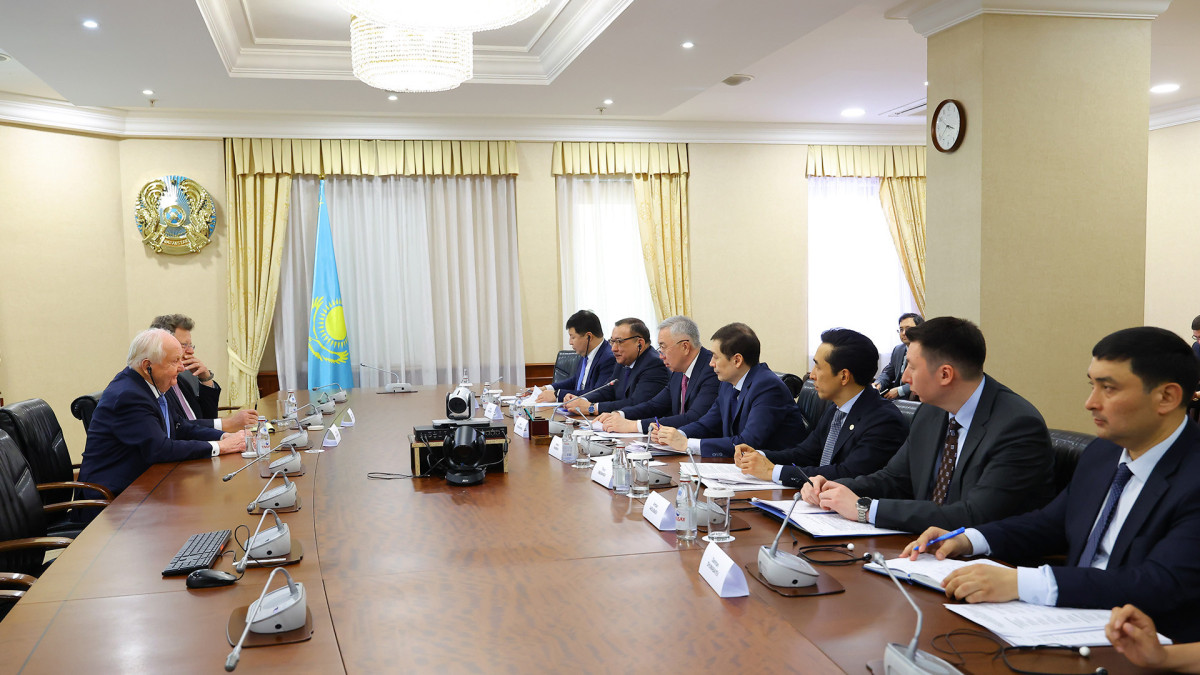
Deputy Prime Minister – Minister of National Economy Serik Zhumangarin held a meeting with Karl Günter Papenburg, Head of the German industrial holding GP Günter Papenburg AG. The parties discussed plans for the development of Kazakhstan’s copper industry and possible areas of cooperation, El.kz reports citing primeminister.kz.
The meeting continued the country’s policy of proactive economic growth, under which the Government is deliberately attracting leading international companies and investors, offering them participation in the development of priority manufacturing sectors. During the negotiations, the Kazakhstan side presented its vision for the development of the copper industry and proposed specific formats for cooperation.
The development and technological upgrading of the copper industry is one of the key directions of Kazakhstan’s new proactive economic policy. Within the new growth model, priority sectors have been identified with an emphasis on producing higher value-added products that are in demand both in the domestic and international markets.
Kazakhstan has approximately 130 copper deposits. Around 170 million tons of ore are mined annually, accounting for about 4% of global volume. However, up to 97% of the products are exported in the form of cathodes, concentrates, and ore. The bulk of the mined ore — approximately 750–800 thousand tons of copper per year — is enriched into concentrate (second-stage processing). Of this volume, about 470 thousand tons are used to produce cathodes (third-stage processing), while the remaining concentrate is exported without further processing. Production of higher value-added products — such as wire, foil, cables, and other items — accounts for less than 5%. The potential for increasing gross value added in the copper industry is estimated to be more than 20-fold. For these reasons, the development of higher-stage copper processing is considered a key direction for increasing value added within the country.
The German side expressed interest in a detailed study of the issue. It was noted that supplies of copper concentrate from Kazakhstan to Germany could also be considered, though they require additional logistics analysis. Furthermore, the company is ready to explore the possibility of establishing higher-stage processing facilities in Kazakhstan, emphasizing that the most efficient production should be located close to raw material sources.
The parties agreed to work out possible formats of cooperation with the involvement of the Baiterek Holding and with the support of the Kazakhstan Embassy in Germany.
