

The 10th edition of Astana Media Week has opened at the Palace of Peace and Reconciliation in Astana. Taking place from October, 14 to 16 , the event brings together representatives of the media, government authorities and technology companies. On the first day, participants discussed how artificial intelligence is transforming journalism, while interactive exhibits offered visitors the opportunity to test their ability to identify manipulated content and turn archival newspaper pages into videos using AI, El.kz reports.
Two video clips are displayed on a screen. One is authentic, while the other has been generated using artificial intelligence. Participants must determine which is the original and which is fake. The test consists of several rounds, with participants choosing between two videos each time. This interactive exhibit at Astana Media Week allows visitors to assess their ability to recognise deepfakes. An issue frequently discussed in the context of information security becomes a practical challenge: viewers are presented with two clips and must decide which one to trust.
Another interactive exhibit focuses on working with newspaper archives. Scanned pages from old newspaper issues can be converted into videos using AI. Participants have the opportunity to try the tool on site and see how printed material can be transformed into a new visual format.
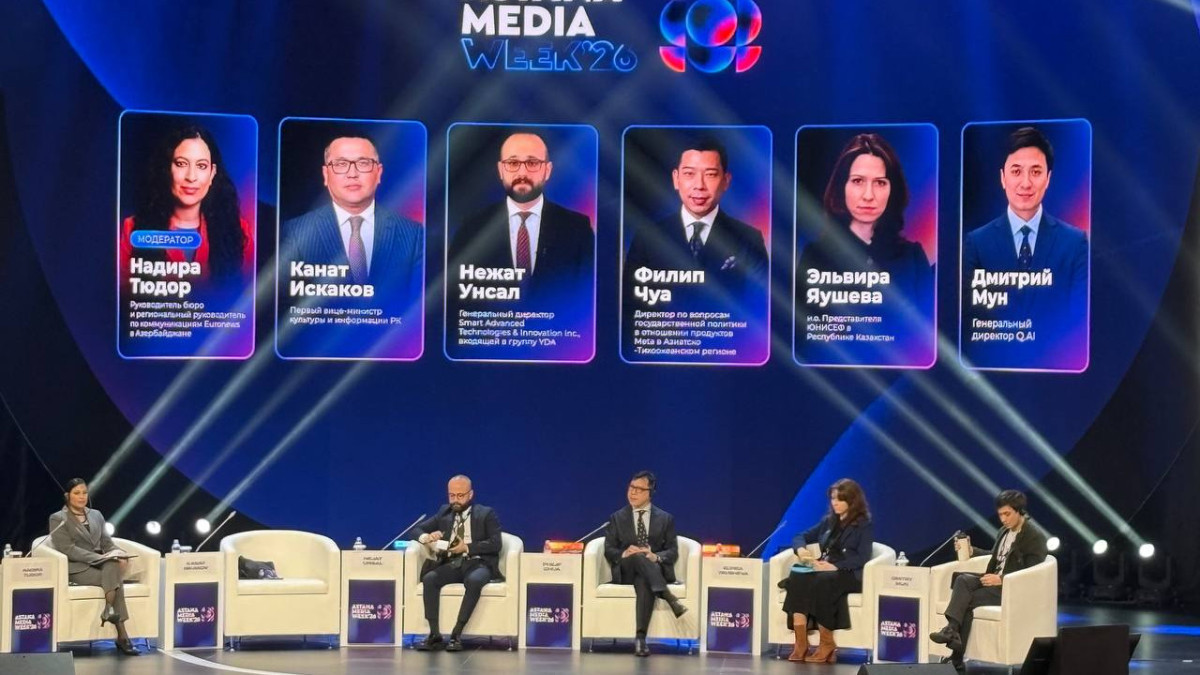
The two interactive exhibits demonstrate different aspects of the same technology. AI facilitates content creation and the use of archival materials, but it also requires audiences to understand the origins of images and verify what they see. These issues were also discussed during the plenary session entitled “MEDIA. HUMAN. AI: 10 Years of Transformation. A New Architecture of Trust.”
Who is accountable for AI-generated text?
First Vice Minister of Culture and Information of the Republic of Kazakhstan Kanat Iskakov identified the transition of the media sector to the digital environment and the proliferation of artificial intelligence as two of the industry’s most significant developments over the past decade. Alongside changes in content production tools, patterns of media consumption are also evolving, with audiences increasingly turning to social media, messaging platforms and chatbots. However, he stressed that technological capabilities do not absolve editorial teams of responsibility.
“An algorithm can write text, as we all understand, but it cannot be held accountable for its words. Responsibility always rests with the journalist and the editorial team as a whole,” Kanat Iskakov noted.
He emphasised the need to inform readers and viewers whenever AI is used in content production. He also proposed working with the media community to develop common principles for the responsible use of AI, including ethical standards. According to him, these principles should become professional standards adopted by editorial teams themselves.
Iskakov also addressed deepfakes that use the likenesses of well-known individuals. He underscored the importance of media literacy and digital security, including the protection of information sources and the personal data of individuals featured in publications.
The issue of transparency was further addressed by Philip Chua, Meta’s Director of Public Policy for Products in the Asia-Pacific region. He spoke about industry efforts to develop standards that enable information about the provenance of AI-generated content to be embedded in such materials. This information can be used to label content, allowing users to learn more about how it was created if they wish.
Chua stressed that labelling should serve to inform audiences. It should not automatically create the impression that all AI-generated material is inaccurate or unworthy of attention. In his view, the development of technical transparency tools must go hand in hand with improvements in media literacy.
Nejat Unsal, Chief Executive Officer of Smart Advanced Technologies & Innovation Inc., linked trust in technology to its practical value. He cited tracking solutions that, according to him, operate entirely offline and identified transparency, security and accountability as essential prerequisites for the deployment of new tools.
“Technology creates opportunities, while trust ensures their acceptance,” Unsal said.
How media content becomes part of AI systems
Dmitry Moon, Chief Executive Officer of Q.ai, discussed another connection between journalism and artificial intelligence: editorial content can become part of the datasets used to train language models.
According to Moon, the initial collection of archives, books and educational materials proved insufficient for developing a Kazakh-language model. As a result, the team also collected information from media outlets in cooperation with Nazarbayev University and the relevant ministry. Moon noted that the pilot model’s communication style even resembled that of a television presenter.
He believes that over the next two years, the use of AI in the media sector will expand rapidly across practical applications, including translation, scriptwriting, and image and video generation. At the same time, he believes that people who understand the media industry and know how to use new tools will remain central to its transformation.
Discussions on emerging technologies will continue during other sessions of the media week. The first day’s programme includes a panel discussion on the boundaries of accountability in AI, IT and the media; an editorial workshop on English-language journalism in Central Asia; and a masterclass on multilingual broadcasting using AI.
On the second day, participants will examine information policy, the development of Kazakhstani content and the economics of the advertising market.
Astana Media Week will conclude on October,16 with the QAZAQSTAN MEDIA AWARDS ceremony.
