

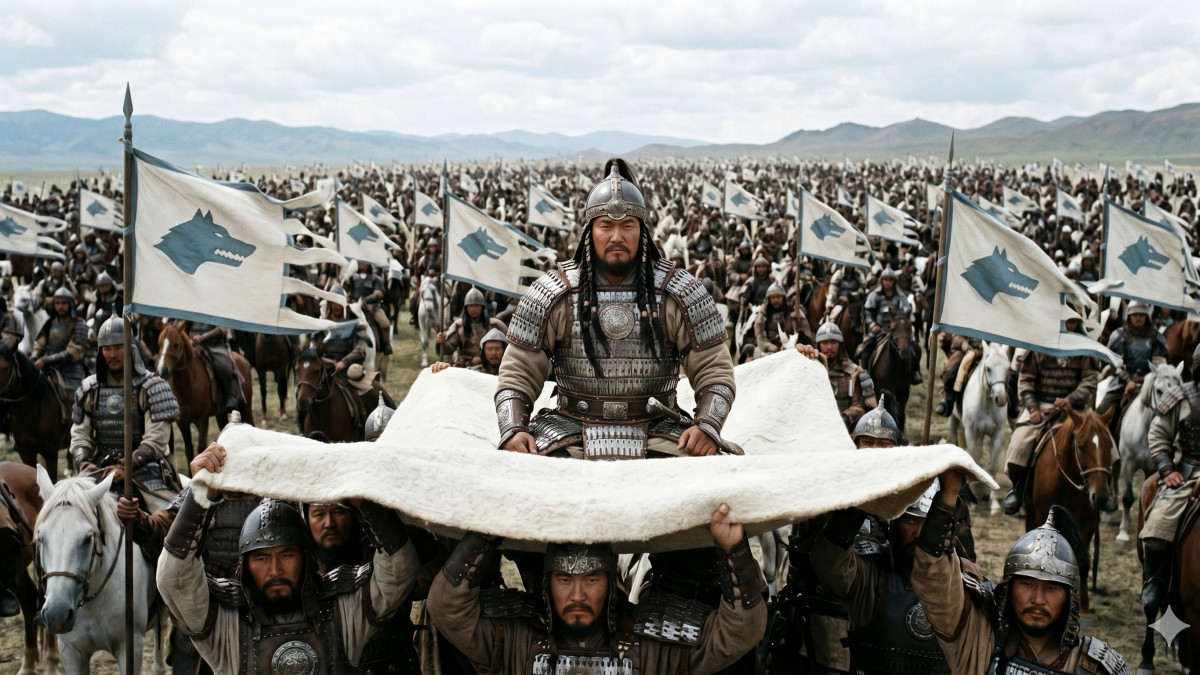
During the Great Migration of Peoples, a portion of the Xiongnu (Huns) remained in the foothills of the Altai. They lived under the leadership of the Ashina clan but soon fell under the rule of the Rouran Khaganate and were forced to pay tribute in iron.
Masters of the Steppe: Who were the Rourans?
The Rouran Khaganate was an early Mongol state that dominated the steppes of Northern China between the disappearance of the Xiongnu in the 4th century and the rise of the Turkic Khaganate in the 6th century. They filled the vacuum left by the Xiongnu and they did so ruthlessly.
The mechanism of their power was simple: conquered tribes were not destroyed but were incorporated into a tributary system. One of the Altai tribes - the Ashina supplied iron for the Rouran Empire. The Turks were not alone in this position. The Tiele tribes revolted against the Rourans in 482 and created their own state, but they fell back into dependency in 516. The system renewed itself time and again: rebellion, suppression, new tribute.
Why did the Rourans oppress others? It followed the same logic as any steppe empire: resources in the steppe are scarce, and control over crafts and trade routes determines everything. The iron forged by the Turks was a strategic material used for weapons, armor, and arrowheads. Keeping the blacksmiths in dependency meant controlling the production of all the military technology in the steppe. According to Rouran law, whoever attacked first in battle was rewarded with captives and a larger share of the spoils, while an arrow was thrown at anyone who retreated out of cowardice. It was an army engineered for aggression.
Blacksmiths who forged more than just iron
The first mention of the ethnonym "Turk" in Chinese chronicles dates back to 542. It was then that Bumin became the leader of the Ashina clan - a small Altai tribe that the Rourans kept as a useful tool: let them forge iron, let them make weapons for their masters. This humiliating position lasted for generations.
Bumin understood what his predecessors did not: the primary resource was not iron, but people. In 546, thanks to the incorporation of a defeated large union of Tiele tribes, the size of the Turkic army grew sharply. He suppressed a Tiele rebellion against the Rourans and immediately claimed the defeated for himself, offering them an alliance instead of captivity. The Rourans thought he was a loyal vassal. In reality, he was building an army.
An imsult that became a Casus Belli
Bumin’s diplomacy was straightforward: first, find an outside ally, then create a pretext. In 551, he renewed negotiations with the Chinese state of Western Wei and received the Chinese Princess Changle in marriage - this finally cemented his authority among the nomads. Later, she would bear him a son, Taspar Qaghan. Now, China stood behind him. All that remained was to provoke the Rourans.
Bumin sent his men to the Rouran Khagan, Anagui, with a proposal to marry his daughter. Anagui refused, calling him a "blacksmith slave." This was exactly what Bumin wanted. He ordered the execution of the Rouran envoy cutting off all paths to reconciliation. War was now inevitable, and the moral right to revolt was obvious to all tribes tired of Rouran dominance.
One Hundred Thousand Against an Empire
Sources do not provide exact data on the size of the armies on either side 6th-century steppe wars were not accompanied by military archives. However, there are indirect figures. According to historical accounts, Bumin defeated the Rourans with an army of one hundred thousand. This was an army gathered in stages: a core from the Ashina clan, followed by the Tiele tribes, whom Bumin had claimed in 546 after their suppressed revolt - 50,000 Oghuz families joined the Turks before the decisive campaign.
At the peak of their power, the Rourans could field many more. But by 552, the Khaganate had been shaken for decades by internal strife and vassal uprisings. Anagui was fighting wars on several fronts simultaneously and lacked a single, concentrated army. Bumin did not strike a strong opponent; he struck an opponent who did not yet realize they were weak.
The Winter Strike That Changed Eurasia
Seeking to utilize the element of surprise, Bumin set out on his campaign in the winter of 552. This was a conscious choice, not a desperate measure. Traditionally, steppe warfare was not conducted in winter that was the logic of nomadic armies. Horses lose strength in the cold, forage is scarce, and men freeze. The Rourans knew this rule as well as anyone else. That is precisely why they did not expect him.
The Turks came from the west, from the Altai region. The Rouran cavalry could not withstand the blow of the heavy Turkic cavalry. Riders in iron lamellar
armor with long spears broke the formation and created chaos, after which light horse archers finished off the scattered enemy units. The very iron that the Turks had forged for their masters for decades was now turned against them.
Anagui suffered a total defeat. Disgraced by the loss, he committed suicide. His final words, passed down through Chinese chronicles, were addressed to the victor: "You were my blacksmith." After the victory, Bumin took the title Il-Khan - "Ruler of Nations." Not just a tribal chief - a ruler of all.
After the Defeat: Avars and Tatars
Following the collapse of the Rouran state, some Rourans moved west, while others remained in the territory of modern Mongolia. To control those who stayed, Turkic rulers installed representatives from ethnic Turkic tribes.
The fate of those who fled west was unexpected. A portion of the Rourans (known as Juan-juan) migrated to Europe, where, under the name of Avars, they occupied lands in Pannonia. The people who lost in Mongolia reached Hungary and created the Avar Khaganate, which fought against the Franks and Byzantium. Charlemagne only defeated them in 796 - 250 years after Bumin destroyed their homeland in the steppe.
There is another trace of the Rourans in history. One of their names - "Datan" is traced by researchers to the name of Khagan Yujiulü Shelun (Datan). From this comes the name of the Tatar tribe, which would later spread across Eurasia and designate many different peoples over the centuries.
The White Felt: How Steppe Power Was Born
Among nomads, there was a belief that power is not transmitted automatically by blood it must be received publicly, in front of everyone. A Khan's title could only be acquired through an official act of election at a crowded assembly of the nobility, via the solemn ritual of being raised on a white felt rug. In steppe tradition, the color white signified purity, and felt was the primary material of nomadic life: it was used to build yurts, sew clothes, and wrap children.
The first sufficiently detailed written mention of this ritual regarding themTurks is the proclamation of Bumin in 551–552. Bumin was raised on a white felt and proclaimed the Qaghan of the Turkic El (State). This does not mean the ritual did not exist before him; it simply means that up to that point, the Turks did not have their own state texts, and Chinese chronicles recorded steppe rituals selectively. The tradition proved remarkably resilient: a thousand years after Bumin, it was used by Kazakh Khans, and in the 18th century, it was even adopted by the ruler of Bukhara, who had neither Turkic nor Genghisid roots he understood that this specific ritual made power legitimate in the eyes of the steppe peoples.
