

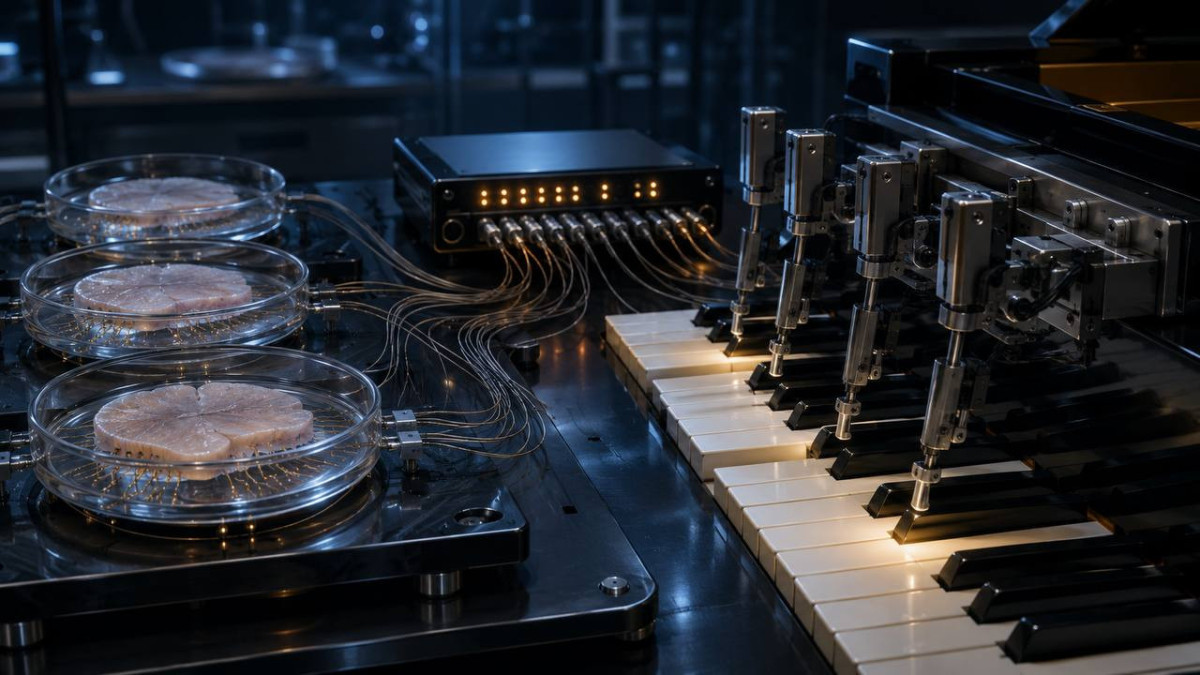
Scientists in Montpellier have conducted an experiment in which viable slices of human cerebral cortex obtained from deceased donors were able to learn to reproduce musical notes on an electronic piano, El.kz reports.
For the experiment, the researchers used brain tissue obtained from donors who had died no more than 12 hours before the samples were collected. Approximately 300-micrometre-thick slices of the human cerebral cortex were placed in a specialised nutrient medium on an array of 60 electrodes. Six electrodes were selected at random: three were designated as “motor” electrodes and three as “sensory” electrodes.
During the first three days, the system operated in a training mode. The researchers applied a weak electrical impulse to one of the motor electrodes. A robotic arm then bent the finger assigned to that electrode, causing the finger to press a piano key, while a microphone recorded the resulting sound. A computer identified the note and transmitted the corresponding signal to one of the sensory electrodes. In this way, the neural tissue was gradually exposed to a repeated association between an electrical signal and a specific sound. The system was not provided with information about errors; the training was based exclusively on the temporal coincidence of events.
On the 4th day, the experimental protocol was modified. A human operator played a note on the piano, and the software transmitted the corresponding signal to a sensory electrode. The researchers then monitored which of the motor electrodes exhibited the strongest response. Depending on the response, the robotic arm bent the corresponding finger and pressed the relevant piano key.
According to the authors, during the training period, note-recognition accuracy increased from 31% to 58.5%. With random selection, the expected accuracy would have been approximately 33%. At the same time, there were substantial differences between individual tissue samples. Three of the 16 slices made no errors, while a further seven were able to learn two out of the three notes. Six samples were unable to reliably learn even two notes.
The researchers also conducted additional tests. When the relevant receptors were blocked, or when the same tissue slice was connected to a different set of previously untrained electrodes, performance declined to as low as the level expected from random guessing. According to the authors, this suggests that the improvement was attributable specifically to changes in the functioning of the neural tissue, rather than solely to characteristics of the equipment.
The scientists emphasise that the experiment did not involve a fully autonomous “brain in a dish” capable of playing music independently. The study used a small, isolated fragment of the cerebral cortex, while the generation and interpretation of electrical signals, the robotic arm and note recognition were all handled by an external system.
